

Photo: Geordon Nicol for BFA
Madonna is the queen of pop — present tense. The pop legend just scored her tenth No. 1 album on “The Billboard 200” chart with Confessions II, making her the only artist with a No. 1 album in the 1980s, aughts, 2010s, and 2020s. Meanwhile, critical consensus is lauding the album as her strongest in 20 years, earning it a Metacritic score of 8.2 out of 10 from 18 reviews
Following the album’s success, Madonna went to social media to react. “Words cannot express how grateful and surprised I am by the incredible reception Confessions on a Dance Floor has received!! Thank you — to everyone who has been a part of this and who has helped make this dream come true. Especially my fans. The goodwill and positivity has been incredible. I’m still pinching myself,” she wrote. “My dream was to make people dance this summer!! To bring people JOY! Dreams do come true.”
The success is both the result of a phenomenal album, which blends past and present to beckon a return to the dance floor, and an aggressive and strategic promotional strategy. She joined forces with Sabrina Carpenter at Coachella, performed in Times Square, and partnered with queer-focused brands to meet her audience where they were. But the most impressive element of this rollout, and the one best aligned with the album’s mission, has been “Club Confessions” — a series of pop-up DJ sets that brings this music to the listener where it was meant to be experienced. It embodies what seems to be the central strategy of Confessions II’s rollout: If you build the dance floor, they will come.
Well, if they can get a ticket. New York City’s “Club Confessions” at Knockdown Center on July 11 was announced just days in advance, with no information on how to get in, sending the city’s Madonna fans scrambling for the most evasive ticket in town
Anybody even remotely connected to the event — whether they were on Madonna’s team or worked PR for one of the sponsors — were receiving endless requests as the masses came out of the woodwork begging for a ticket. For many, that seems to have worked, as grateful Knockdown Center attendees traded stories about who their “in” was. Absolut? Mistr? Grindr? Those are the brands Madonna has teamed up with this cycle, putting a focus on connecting with her queer fanbase. (Or maybe she just has an aversion to the letter E.) In any case, 2,500 tickets were ultimately doled out in the days, and sometimes hours, leading up to the event.
That number was felt most in the line to get in, which stretched for several daunting Queens blocks, giving the Spring Awakening open call a run for its money. But there was no mistaking what this queue was for: Pink tulle draped over heads, bedazzled mesh tank tops, and vintage merch all pointed to one person. To quote Oprah Winfrey introducing a 1998 performance of Ray of Light, “MADONNA!” Once the line began moving, it led the masses to a beacon at the entrance of Knockdown Center — Madge’s inflatable legs. Like a gay Macy’s Thanksgiving Day Parade balloon, the stereo betwixt her thighs welcomed us into a foliage- and fog-filled venue with green lasers beaming overhead (à la the ones shooting out of vaginas in the Confessions II short film).
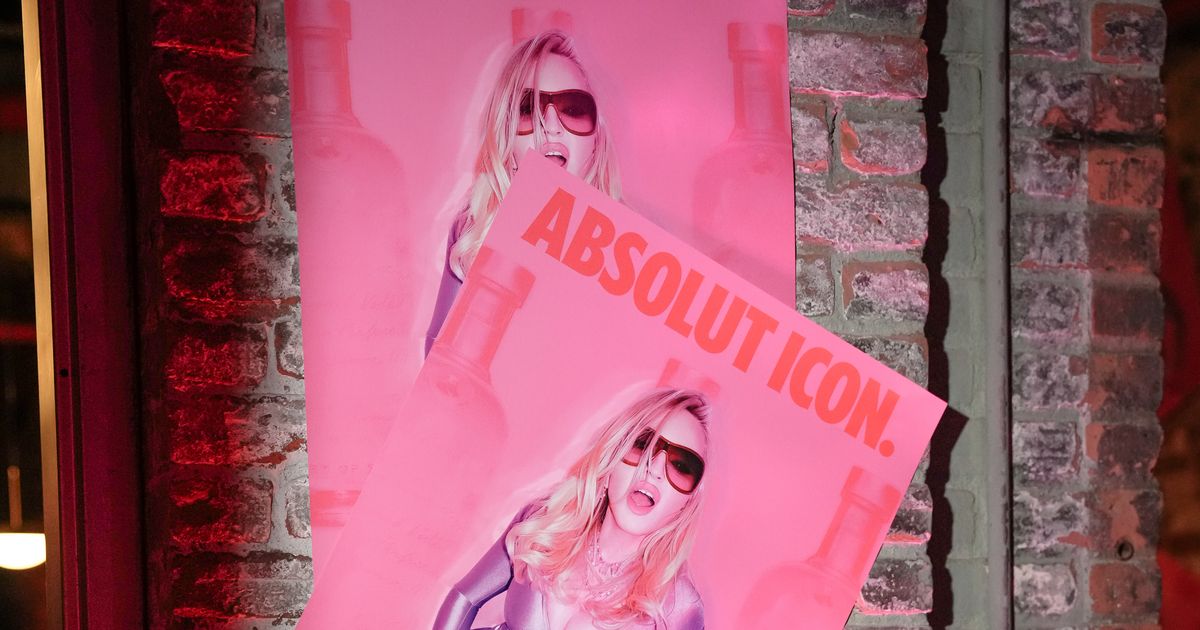
Go-go boys greeted attendees, who were dressed in everything from circuit-party garb to full drag as they grabbed their free-drink tickets with the “Absolut Icon” herself printed on them before converging into a sea of surprisingly familiar faces. Yes, the likes of Julio Torres and Andrew Scott were casually roaming about, but even more typical was the sight of friends throughout the venue unexpectedly running into one another. For an event where few seemed to get more than a single ticket, everybody seemed to know someone. It was like if “Danceteria” were written about Gay Twitter.
After a set from her producer Stuart Price, Madonna finally emerged at the reasonable-for-her hour of 1 a.m. — and since the five-foot-three singer was initially out of view to most, her entry was signaled by a wave of cheers moving through the crowd and a sea of phones jutting straight into the air being used like makeshift periscopes to see the 67-year-old pop star
In theory, the event was supposed to be about the dance floor, not the stage, which is why this promotional tour has been such an effective representation of the material. The creation of “Club Confessions,” which had previously opened its doors in Los Angeles and London, feels like a conscious effort not only to encourage a return to the dance floor but also to do it on Madonna’s terms
This was most evident during “School,” at which point she got up onto the DJ booth — knee cartilage be damned — becoming visible to the entire electrified room, and theatrically mimed looking out across the crowd and pointing to everyone there. “School is in session,” the track repeated, and we were there to learn. It felt as though the New York nightlife scene had a guest lecturer come in to teach the class how to club. The rapt audience members were students, and Professor Ciccone taught, hoping that her expertise on the dance floor would resonate. Would it?
She seemed most encouraged during “Danceteria,” when she visibly lit up as the entire audience shouted back every single word like it was already a decades-old greatest hit. The recorded song transports you to the past, but in this setting it becomes a conversation with the present. It doesn’t just tell you about the energy of that specific club scene in the ’80s but resurrects it, because, as she says on “Fragile,” energy never dies. The song is a portal for that energy — breathing it into these new dance floors, helping that feeling live on, and creating a new iconic moment in time altogether.
Fittingly for a night and album-promotion cycle that so artfully bridges the past and present, Madonna — flanked by Price and Honey Dijon (and Honey Dijon’s gorgeous large hat) — ended the night with “Hung Up,” off the new album’s 2005 predecessor, Confessions on a Dance Floor. By the end of the night, the room full of sweaty bodies was left basking in the gift of Madonna, feeling just one small sliver of a wider moment that has gone on to completely transcend conventional pop expectation. As attendees began filing back out into the world, rebirthed through Madge’s inflatable legs, someone in the crowd held their phone to their forehead with a flashing message as if to make a request of the DJ — except this one was meant to spread the word to the people. “LINDSEY GRAHAM IS DEAD,” it read. But Madonna is still standing.
Meet Madonna on the Dance Floor
