

‘Little House on the Prairie’ returns. Will the show’s reboot resonate with a new generation?
|Eric Zachanowich/Netflix © 2026
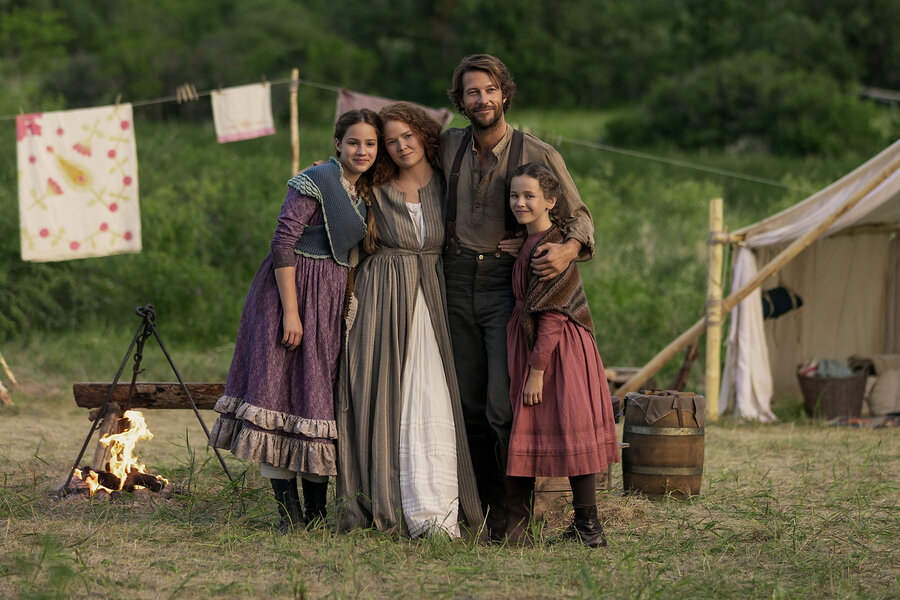
“Little House on the Prairie,” debuting on Netflix July 9, features (from left) Skywalker Hughes as Mary Ingalls, Crosby Fitzgerald as Caroline Ingalls, Luke Bracey as Charles Ingalls, and Alice Halsey as Laura Ingalls. The show includes a wider diversity of characters than the original book series by Laura Ingalls Wilder.
Loading
- By
It was the sight of Pa Ingalls’ fiddle in a museum that set Carole Nebhut’s heart aflutter
“Just somebody give me a chair, and I’ll sit here next to the fiddle for the rest of the afternoon. It was profound,” recalls Ms. Nebhut, a retired educator in Aston, Pennsylvania, of the moment when she saw the instrument, which she considers the “only character in the book still alive and functioning.”
Ms. Nebhut is what one might call a superfan of Laura Ingalls Wilder’s book series, “Little House on the Prairie.” For nearly a century, readers like Ms. Nebhut have followed the Ingalls family as it traveled deep into the Western territories and settled among the Osage people in the late 1800s
Why We Wrote This
A new “Little House on the Prairie” series launches on Netflix this week with a broader diversity of characters. The revamp of the enduring story illustrates the complexity of updating a classic story for modern viewers
Now, “Little House” fans have another opportunity to revisit the story. On Thursday, Netflix is launching an eight-episode series of “Little House on the Prairie,” a new adaptation of Wilder’s semiautobiographical books, produced by CBS Studios and Anonymous Content
This nostalgic story of a white American frontier family using ingenuity to survive hardship has resonated with readers, particularly schoolchildren, since the first book in the series, “Little House in the Big Woods,” was published in 1932. The nine-book “Little House” series has sold more than 73 million copies in more than 100 countries and has been translated into at least 27 languages, according to figures published by Netflix. The 1974 TV series, which ran for nine seasons and 204 episodes, continues to draw viewers, garnering 13.25 billion minutes of viewing on Peacock in 2024 alone, 50 years after it first aired, according to Nielsen.
Despite the series’ enduring and global popularity, Wilder has had her share of critics. Many scholars say Wilder’s original works and their depictions of homesteaders and Native Americans on the Western Plains are largely fictionalized, inspired by her own memories and stories told by her father, Charles Ingalls, and edited by her daughter, Rose Wilder. Wilder has been criticized so often for the pejorative descriptions of Indigenous people in the book series that in 2018, a division of the American Library Association removed her name from a prestigious achievement award for children’s literature.
Eric Zachanowich/Netflix © 2026
Tahlee Redcorn plays Governor Joe in an episode of “Little House on the Prairie.” In her adaptation, the show’s executive producer introduced an Osage family that befriends the Ingalls family.
The rebooted Netflix show addresses criticisms of Wilder’s work by giving diverse characters a larger role, a decision that prompted some to argue that the series would misrepresent the original books by portraying modern, progressive sensibilities. Rebecca Sonnenshine, the series’ writer and executive producer, says she feels the emphasis on community and family in her remake is the same spirit found in the book series and the original TV show. “We needed community, to help others and to ask for help. That’s how we are able to … not just survive, but find joy and love in our lives, to find purpose and meaning,” she says.
A close reading of Wilder’s works reveals that the author created a more complex picture of Native people than she is often given credit for, says Amy Fatzinger, an associate professor of American Indian studies at the University of Arizona. By the same token, any retelling of Wilder’s story should wrestle with those nuances, she adds. Some of these complexities include balancing the portrayal of more diversity while acknowledging the discrimination that occurred within frontier history
“An adaptation of an oldermake the story relevant in new ways for modern audiences. But that’s much more complicated when you’re talking about actual historical events,” says Dr. Fatzinger, who did not preview the Netflix series in advance. “So the interesting question is, How do you tell a story of modern acceptance, celebration, and understanding a diverse community [within the context of] this frontier history?”
Fans weigh in
While some fans are looking forward to watching the new show, others have reservations. Kris Haight, a systems engineer in Boston, believes remakes should closely follow the original story
“I think you should not appeal to a modern audience. The stories hold up on their own,” he says
Mr. Haight, who got in trouble for reading the books during class, first came to the series through watching the 1970s TV show. By the time he reached fourth grade, he had devoured the series
Mr. Haight is still fascinated by frontier life and has read widely about Wilder’s life and influences. The books “helped provide goalposts for life, just good values to follow,” he says
He isn’t sure if he’ll watch the Netflix series, adding that he’ll wait to see how it’s received by online fan groups. He felt the 1974 series left the original storylines behind by Season 3
A new adaptation of a beloved series
Ms. Sonnenshine says it was her own love of the “Little House” books that inspired her to become a filmmaker
“I read them so many times that … [my mom would] just take my ‘Little House’ set until I would do my chores,” says Ms. Sonnenshine in a Zoom interview with the Monitor
The episodes previewed by the Monitor run just under an hour and show a cinematic quality, with sweeping vistas and attractive costumes. The anticipated reception of the reboot of the American classic is so high that Netflix has already secured a rare renewal for Season 2
Ms. Sonnenshine says she dove into history books to learn more about Black doctors post-Civil War (such as Dr. George Tann, mentioned in Wilder’s works), the roles women and children played in settling the West, and the cultural practices of the Osage tribe
Eric Zachanowich/Netflix © 2026
Barrett Doss plays Emily Henderson and Jocko Sims portrays Dr. George Tann in an episode of “Little House on the Prairie.”
Based on her research, Ms. Sonnenshine created an Osage family that befriends the Ingalls family in her adaptation
“The Osages are certainly a part of the [Wilder] books; we just don’t get to know them,” says Ms. Sonnenshine. “I think that there’s no real reason to do this show without asking that question: Who were they and what were their lives like?”
While Ms. Sonnenshine does not steer away from the drama, danger, and hard work of frontier life (several episodes deal with injury and illness), it remains to be seen if her portrayal of characters through modern sensibilities and if the straying from original storylines will be acceptable to viewers and fans. The showrunner thinks the freedom and responsibility that children are given in the show will appeal to modern kids
Ms. Nebhut, who now serves as vice president of the Laura Ingalls Wilder Legacy and Research Association, a nonprofit organization dedicated to preserving the legacy of Wilder, hopes that the new series will inspire a new generation of “Little House” fans
“It will renew interest in the books,” she says. “I’m really looking forward to seeing this because there’s always room for a new interpretation.”
“Little House on the Prairie” premieres July 9 on Netflix. Rated TV-PG
You’ve read of free articles.
Subscribe to continue.
Thank you for contacting The Christian Science Monitor.
