

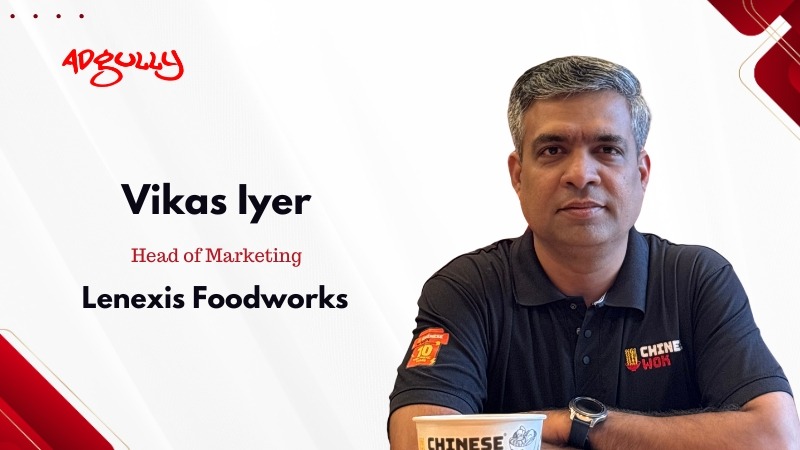
Lenexis Foodworks’ Vikas Iyer on future of QSR marketing & entertainment-led brand building



Eshika Chopra
| 28 minutes ago
Views: 493
Your browser does not support the audio element.
The way QSR brands market themselves is changing. It’s no longer just about launching a new product or running another campaign around a festive season or cricket tournament. As younger consumers spend more time with entertainment than advertising, brands are looking for ways to become part of those experiences instead of simply trying to capture attention.
Chinese Wok has been experimenting with that idea through initiatives such as WokFM, its music platform, and WokVerse, an interactive engagement platform, while also expanding into films, OTT, gaming and cricket. The objective is to build experiences that consumers engage with beyond ordering a meal and create brand properties that last longer than a campaign cycle.
In conversation with Adgully,Vikas Iyer, Head of Marketing at Lenexis Foodworks, speaks about the consumer thinking behind this approach, why the brand is investing in entertainment and owned platforms, how technology fits into the experience, and what he believes will define the next chapter of QSR marketing.
How would you describe the overall marketing philosophy that’s guiding Chinese Wok and Big Bowl today?
With both Chinese Wok and Big Bowl, we’re trying to build very strong, sharp brands in their own ecosystems. With Chinese Wok, we want to become India’s most loved brand in the Chinese cuisine space, where we deliver a great food experience while also creating engaging experiences beyond food. We see the brand at the intersection of food, culture and technology. We’re doing something similar with Big Bowl. It’s a cloud kitchen brand, but we’re building a personality around wholesome food while connecting with consumers across metros as well as Tier II and Tier III towns.
Chinese Wok has invested heavily in entertainment over the past few years through music, gaming, films, OTT and cricket. What made you believe entertainment could become a long-term brand-building strategy rather than just another marketing channel?
Consumers have shown us that entertainment is no longer just a media channel; it’s become consumer behaviour. Young consumers spend a disproportionate amount of time consuming entertainment compared to advertising. So we asked ourselves whether we should interrupt their entertainment or become a part of it. We chose the latter. A lot of what we’ve built over the last 18 to 24 months revolves around that idea. We launched WokFM, our QSR-owned music platform. While it started as an in-store music initiative, it has now expanded to YouTube and Spotify, where we’re receiving a lot of consumer love.
We also launched WokVerse, where consumers can play while waiting for their order. It’s an ecosystem that will continue evolving, with the simple objective of making wait time more engaging. We’ve partnered with films as well, carefully selecting the ones that fit the brand. Those collaborations have helped us connect strongly with audiences, and we’ve always complemented them with contests that encourage consumers to participate instead of simply consuming content. During the IPL, we launched the Wok Predictor League. While we advertised during IPL, we also created both offline and online engagement around it. We don’t see these as isolated campaigns. We see them as long-term brand assets that keep consumers engaged beyond the meal.
Chinese Wok is showing up across very different cultural spaces. What framework do you use to decide where the brand belongs and where it doesn’t?
Broadly, we ask ourselves three questions. First, is this something consumers genuinely care about? Are they emotionally invested in that space? Second, does Chinese Wok’s personality naturally fit there? Can consumers actively participate in whatever we create instead of just consuming content? Third, can that experience scale across our restaurants, delivery platforms and digital channels? That’s the framework we’ve followed for all the ecosystem assets we’ve built. Whether it’s IPL, movies, our music platform, WokVerse, OTT collaborations or gaming, we’re not jumping onto trends. We’re carefully selecting opportunities where this framework fits and where the brand has a meaningful role to play.
WokFM is a very unusual move for a restaurant brand because you’re creating original music instead of simply sponsoring it. What role do you see owned content playing in building stronger consumer relationships?
We thought deeply about that before building WokFM. We had two choices. We could sponsor existing music or create something that we could truly own. We chose the latter. Instead of rented attention, we wanted to build something that belonged to us and strengthened brand memorability. Today, WokFM has multiple albums, and we continue releasing new music every season. We have a monsoon album coming soon. We’ve already launched Wok’d Tonight, Cricket & Cravings and Crush Hour over the past few months. The idea is to engage consumers both in our stores and on streaming platforms, creating one consistent brand experience. When people hear a song, they should think of Chinese Wok. The objective is simple: build a cultural property that consumers return to even when they’re not ordering food.
With WokVerse, you’ve turned something as simple as waiting for an order into an interactive experience. As consumer expectations evolve, do you see QSRs competing as much on experience as they do on food?
Definitely. Food gets consumers to try you, but the experience gives them a reason to remember you and come back. At Chinese Wok, we’re looking at every customer touchpoint to see how we can improve memorability and increase brand recall the next time someone craves something similar. For example, when we launched our Schezwan Fries, we didn’t present it as just another product. We introduced it as a DIY shake-shake experience. Staying true to the Chinese Wok DNA, we also included chopsticks, making the experience more playful. The campaign was very Gen Z-led. We called it Walk the Fries, or WTF in code words. The DIY element made consumption more enjoyable, and we saw consumers having a lot of fun with it in our stores. Similarly, WokVerse transforms waiting time into an interactive experience. The objective is to improve memorability rather than simply delivering a functional experience.
Many of your recent initiatives focus on building owned brand properties rather than one-off campaigns. Is the objective to create a marketing ecosystem that consumers keep returning to instead of relying on periodic bursts of visibility?
That’s exactly the direction we’re moving towards. Instead of thinking campaign by campaign, we’re building an ecosystem. Consumers may discover us through WokFM or through WokVerse when they visit a store. They can then engage with other ecosystem assets like Wok Predictor League, seasonal packaging, OTT integrations or movie collaborations. Every initiative reinforces the others, creating much stronger brand memory than standalone campaigns ever could.
We’ve seen many brands chasing cultural movements today. How do you ensure Chinese Wok contributes meaningfully to culture instead of simply capitalising on what’s already trending?
A lot is changing in advertising today. The consumers we target don’t just want brands to advertise. They want brands to participate in their lives. That’s changing the way brands market themselves. Instead of only telling stories, marketing today is about creating experiences that consumers can be part of. Rather than chasing trends, brands should build ecosystems where consumers can participate, share stories and build communities around common interests.
Gen Z expects brands to entertain, interact and participate in conversations. How has that changed the way Chinese Wok approaches marketing compared to four years ago?
Four years ago, our marketing was largely product-led. We focused on our menu, our dishes, how they were made and what made us different from the large unorganised market. Over time, the brand has evolved into a distinct personality with a clear understanding of the audience we want to reach. As a result, our marketing has evolved too. It’s still a journey, and we’re learning from consumers every day. What we’ve realised is that beyond advertising, there’s an entire world where consumers can engage with and remember the brand much better. That’s what we’re trying to create through these ecosystem moments.
AI, AR and gamification are becoming more accessible today. How do you ensure these innovations solve a consumer need rather than becoming technology for technology’s sake?
For us, technology always begins with a consumer problem. If it solves a real problem, we use it. WokVerse wasn’t built because AR is exciting. It was built to make waiting for food more enjoyable. We identified waiting time as a friction point. Consumers are hungry and have already placed their order. We wanted those few minutes to become enjoyable rather than frustrating. Technology helped us solve that problem. Going forward, we may introduce AI-assisted self-ordering, but again, it will be to simplify ordering or improve recommendations. Technology should make the experience easier, more engaging and solve a genuine consumer problem. If it doesn’t improve the consumer journey, it’s not worth pursuing.
Entertainment platforms are long-term investments and don’t always show immediate business returns. How do you balance short-term metrics like footfalls and sales with longer-term indicators such as brand affinity, recall and repeat engagement?
That’s an interesting question, especially because we’re doing many of these things for the first time in the industry. We don’t evaluate these initiatives only through engagement. We look at three things. First, business outcomes such as orders, footfalls and repeat visits. Second, brand metrics like recall and consideration. Third, engagement metrics, including how consumers participate and whether they return.
Each initiative is designed to strengthen one or more of these pillars. For example, our Chinese Wok campaign drove footfalls while clearly establishing the category and our position within it. It delivered strong movement in both business and brand metrics. We’ve seen significant lifts in ad recall and brand association, surpassing several industry benchmarks. Over time, platforms like WokFM and WokVerse have helped us create longer-term engagement beyond individual campaigns. Together, these initiatives drive footfalls, strengthen memorability and build lasting engagement.
Looking ahead, do you see the future of QSR marketing shaped more by owned communities and entertainment ecosystems than by traditional marketing? Where do you see the industry headed next?
Traditional marketing will continue to play an important role because it helps create mental availability among consumers. However, the next generation of QSR brands will need to operate at the intersection of food, culture and technology. Brands will need to build strong identities that genuinely resonate with consumers. People will continue coming for great food, but they’ll stay connected because of the experiences brands create. That’s what we’ve been trying to achieve through the platforms, partnerships and collaborations we’ve built. We’re creating a brand that consumers engage with year-round, not just when they’re hungry. We’re not building campaigns. We’re building brand properties that consumers can relate to and keep coming back to.
Show More
exclusives20-Aug-2026Lenexis FoodworksVikas Iyer
similar newsFrom views to value: YouTube’s metric shift challenges creator economics
similar newsNewspaper majors’ non-print revenue share up 11-13 pps over seven fiscals: Report
similar newsAI is rewriting media planning. But what should marketers optimise for?
similar newsFrom V Spark to Fizz PR: Kanika Chhabra on building public relations for the AI era
similar newsTV’s 10+2 cap ends: How broadcasters can monetise more ad inventory without losing viewers
similar newsFrom legacy to lifestyle: Krutik Trevadia on Juliet Apparels’ strategy for next 50 years
similar newsWhy AI’s next marketing battle is for trust, brand distinctiveness and discovery
similar newsTrendspotting: Sprite gets on track; Samay Raina gets a verdict; Rani Mukerji gets a doctorate
similar newsSatarupa Majumdar – The woman behind brand Figaro’s next growth chapter in India

