

Sakshi Sharma15 Aug 2026
12:00IST
New Update
At the Jantar Mantar protest, a generation stereotyped to be unserious, raised on Reels, memes and internet slang discovered that humour can be a language of serious protest too!
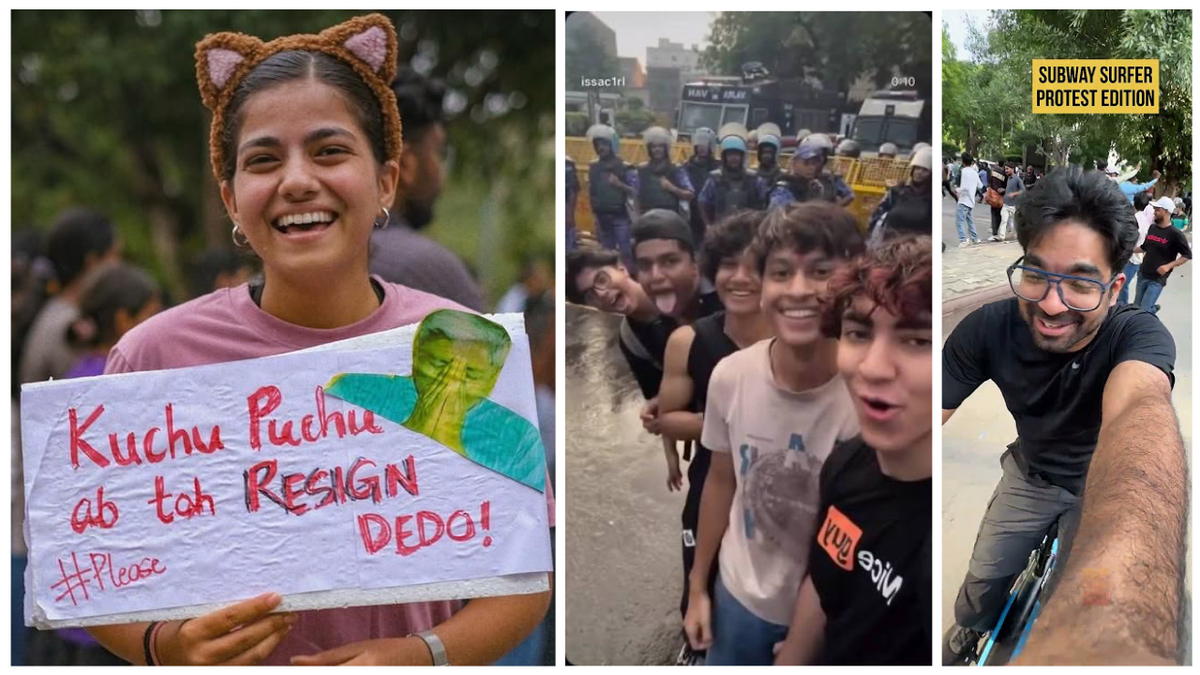
There was something almost contradictory about the student protests at Delhi’s Jantar Mantar. The anger was real, the demands were serious, and so was the police action. And yet, somewhere between the slogans, barricades and clashes, there were placards saying“Kuchu Puchu, ab toh resign kar do”, protesters turning up in bridal clothes, and Reels that turned being chased by the police into aSubway Surfersgame. It would be easy to dismiss this as Gen Z making a joke out of something serious. But perhaps that misses the point entirely!
For a generation that has grown up communicating through constantly changing internet slang, this is the language they know best. Hence the Delhi protest didn’t stop at Jantar Mantar; it travelled through Instagram, where a placard could become a post, a slogan could become a meme and a few seconds of footage could become a Reel <a href="https://comicvibe.com/d23-2026-watch-the-visionquest-trailer/” title=”D23 2026: Watch the 'VisionQuest' Trailer”>watched by thousands.
And that is what makes“Kuchu Puchu”or “vastagunnahuia” such interesting protest phrases. On paper, they sounds almost ridiculous as it is the language of internet pookieculture rather than political dissent. Yet that was precisely the point as it turned a demand for a minister’s resignation into something instantly recognisable to an internet generation. It was cheeky without being unclear, and its absurdity made it memorable. The placards worked in much the same way. Instead of every sign sounding like a political pamphlet, students brought their own vocabulary to the street. Some were sarcastic, some deliberately unserious, some borrowed from pop culture and others were simply funny.
One could be angry without necessarily sounding like a traditional protester. Becauseprotest has never had one fixed language.The slogans of one generation often become the references of another. Poetry, music, posters, street theatre and political cartoons have all found their way into movements. What changes is the cultural vocabulary available to the people doing the protesting as words from “Hum Dekhenge” to “Bol ke lab azaad hain tere” were heard through modern songs!
For Gen Z, that vocabulary is digital. They know how to make somethingshareable, understand irony instinctively or know that a sentence doesn’t necessarily have to sound profound to stick as an image. TheSubway SurfersReels from Jantar Mantar are a perfect example. Protesters were filmed running from police and edited the footage with the game’s familiar soundtrack. Another widely shared Reel was given by a creator who was seen creating Reels, in front of the police, on the song Mere Mehboob Qayamat Hogi. Other protesters borrowed the GRWMformat and turned getting ready for a protest into content.
It sounds flippant until you consider what the joke is doing – it takes an intimidating situation and changes the frame through which it is seen.If something wants to make you feel afraid, humour can sometimes be a way of refusing to give it that satisfaction.Some protesters did cross their boundaries while channelising this new language and became deliberately provocative. But the more interesting thing was everything happening alongside all this where the wordplay, costumes, memes, pop-culture references, handmade signs and absurd little jokes appeared in a space traditionally associated with formal slogans and speeches.
What this really tells us is that every generation finds its own way to communicate dissent. Previous generations had their ways but this generation has trends,POVvideos, reaction language and irony. It has the ability to turn one handwritten sentence into something thousands of people recognise within hours. The irony is almost too perfect because the generation accused of being chronically online brought its online language onto the street.The same people who communicate with an emoji, a meme or a five-second Reel in everyday life found ways to use those tools when talking about power.
The medium may look unserious but the message wasn’t! As they proved that a meme can still demand accountability, a joke can still expose hypocrisy, a silly placard can still carry a serious demand and more importantly, a Reel can document something that a traditional news cycle might otherwise move past. Maybe this is simply what dissent looks like when it grows up online. It moves faster in a more visual and self aware space but often sounds funnier! Because every generation eventually finds its own way of saying“we’ve had enough.”Gen Z just happens to know how to make sure everyone sees it on their feed!
What do you think about this? Tell us in the comments below!
For more stroies, follow us on @socialketchup.
MemesprotestDelhi protestreelsJantar Mantar
