

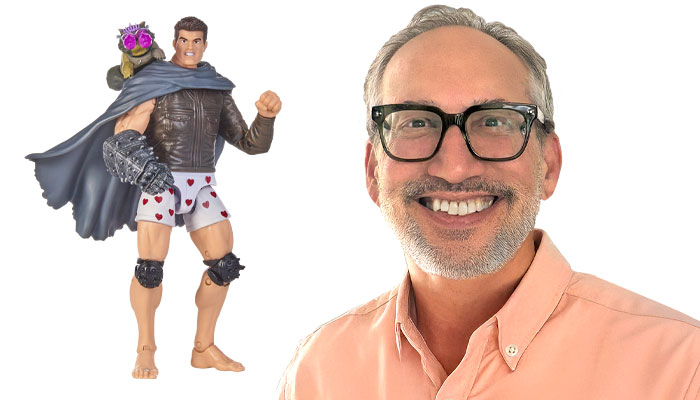
Karl, it’s great to catch up. I’d love to know: was toys always part of the plan for you? Was it always on the agenda.
No! I actually started off as an agricultural business major in Central California. I thought I’d either be walking in fields, selling ag chemicals or working for a farm bank or something like that…Because I was really into raising livestock and pruning trees; about as far away from toys as you could get. However, I grew up in what was known back then as a five-dime store. Essentially, that’s the bridge between the old general stores in the 19th century and what we have now with things like the dollar stores. And my dad had a five, ten, and 15-cent variety store in our hometown for 30-something years… And this is in a town of 3,000 people in the middle of farm country.
Did you work in that store?
I did! And one of the walls was all toys, so I think that probably sunk in because it was my job to restock it and make it neat and tidy – as well as to watch the kids and make sure they weren’t stealing anything. Later, I went to Fresno State, getting my start off as an ag business major and had my first advertising class. I thought that was really interesting stuff; that class really grabbed me. And like most kids, I thought it looked like a way out of my hometown, so I became a marketing major and ended up getting a master’s degree in marketing and finance…
Anyway, that was the beginning of it. Then, when I was graduating, there was one of the many recessions, so jobs were tough. But I’d torn out an ad from the original TOMY Toys about a year before and saved it in my resume folder… I decided I was going to cold call them and see what would happen. After a number of interviews, I got my first job out of school – and it was for a toy company.
Amazing. I imagine there’s very little crossover in skills between toys and agriculture…
No, you don’t castrate as many toys as pigs! That’s about as valuable as my MBA got – I’m not sure how much of it I used. After a couple of years in toys, though, I decided I needed real marketing experience, so I went and worked for a division of Ore-Ida Potatoes and moved to Boise, Idaho for half a year. That’s the only job I’ve ever had where I knew, on day one, that I’d fucked up.
There’s the headline! Why? How did you know straight away?
Because toys moves so fast; it’s so fashion oriented that there’s always something changing, ebbing, flowing… You have to stay on top of it at all times. Some people feel the opposite, but for me, if you’re working in packaged goods, say – especially if your brand is a cash cow – the number of decisions made is somewhat limited. And because the brand is so important as a juggernaut of cash creation, the whole company gets involved in every decision. Back then, I wasn’t used to any of that.
And you must’ve heard this so many times, Billy: the pace of toys may be draining over time, but it’s also so addictive and I really missed the adrenaline you get from working in toys and making 50 decisions a day – so I quickly pivoted back to toys. When I moved back to Los Angeles I got an interview and an offer from Playmates – right when they signed Teenage Mutant Ninja Turtles in 1986.
Great timing! Talk me through those early times with Turtles in terms of what you’ve seen when you joined…
All that was shown, and it was all during the interview process, was the comic books… I can’t remember if the graphic novel was part of it or not, but they threw the comics across the table and said, “What do you think?” And of course, I gave the kind of the answer that was expected, but at least it was pretty obvious that looking at the black and white turtles, it was damn hard figuring out which character was which… Between the design and the lack of colour, you really had to read the book and get to know the characters in terms of which weapons were theirs, belt design, and so on!
From day one, it became pretty clear that one of the main challenges was how we differentiated these four guys so clearly that they can stand on their own and be identified immediately. Part of that was personality too, but it was pretty obvious what you had to do… However, you had a whole group of people – not just Playmates Toys as the manufacturer and toy company. We did also fund the first five episodes of Turtles, so we were very involved in the creation of the series. But the producers of the show was Murakami Wolf. They hadn’t done action figures or an action-adventure-driven show before. They’d done more artsy stuff. Similarly, our ad agency hadn’t really done much in the action-figure space and they were very involved too.
And what about Playmates at that point? Had they done action figures?
No, we were completely inexperienced with action figures! So we were all making a lot of mistakes and kind of going around in circles until we finally found the direction – which was marrying the humour and action more seamlessly. But not having had years and years of action figure experience was probably a benefit in this case because we weren’t afraid to try something new or different, because we didn’t know better.
Yes! And how soon did you and the team realise it was something special and that the toys were resonating?
Only – and I mean only – when it hit the shelves and we walked into the store and saw it vaporising! Because quite frankly, in those days, you had a syndicated TV show, which meant our ad agency would go market by market, 100 different markets in the States, and clear it on the local independent station. We ran those original five episodes at the end of 1987; basically just after Christmas and into New Year 1988. Toys came out six, seven months later – and that line could’ve been dropped at any time because the retailers weren’t jumping up and down. We’d gone on road trips that were the road trips from hell…
In what way?
They were just so unsuccessful! I was literally updating my resume on some of those trips because – other than Toys R Us and maybe a couple of others – people just weren’t jumping up and down for the line because it was so bizarre. Of course, once you gain some experience, you realise that, often times, the weirder stuff is what works in a big way. But convincing people that it’s the next great thing is near impossible because they can’t relate it to anything; they can’t relate it to a previous success. Power Rangers, I would say, was probably the same thing. With Turtles, the name itself got attention, but it also was like, ‘Well, that’s just too weird to work…’
Broadly speaking then, what turned it around? What was the reason or worked?
Well, Turtles just happened to be weird enough TO work! And really, other than maybe spin-offs from the Ghostbuster movies, nobody had tapped into the humour as an element of action adventure. So that was one of the big points of difference, and one of big reasons why it worked.
We were also going through a period where the action-figure category was at its low point; maybe – and I may not have the numbers completely right – but maybe a third to a half of what it was at its peak. Mighty Morphin Power Rangers was chugging along and G.I. Joe was working as well as all the other fantasy-driven action figure brands. But then, all those started to fade and all of the new brands, well, they weren’t working.
Normally, you might ask why you’re going into a category that’s suffering like that, but oftentimes it’s a cry for freshness or newness. It happened to be the case that kids were looking for something new… Turtles happened to be so out there that it got their attention, and it took off from there. Once it hit the shelves, it was a success from day one for sure… But it surely wasn’t a success before then! We had to do a lot of convincing, and Playmates could’ve dropped it at any time – but I think we’d invested too much at that point so we went ahead with it. We tooled a pretty focused line. And it just built from there.
At what point did it peak, Karl?
The peak was a couple of years later. We had a highly rated TV show, not only in syndication, but also on CBS at a time when Saturday-morning TV still meant something. On top of that, we had the first live-action movie – which we were very sceptical of, actually! But we previewed it for a lot of people at New York Toy Fair in what must’ve been 1990.
I’m curious about that – why were you sceptical about the movie?
The movie was truer to the comic book series; it was darker and edgier. It still had humour – but it was so far away from what we’d gotten used to with the cartoons that we thought the movie was going to alienate kids… But, of course, the opposite happened! The movie not only cemented the Turtle phenomenon, but also elevated it for quite a while – all three of those movies, actually, but especially the first one. You may not notice, but it was the biggest indie movie of all time until The Blair Witch Project came out years later. So it was shockingly successful!
Amazing!
That success probably taught us another lesson: unless you really screw up, and totally miss the core elements of Turtles – the humour, the personalities, the ninja action, the sewers – fans do accept a lot of different versions of Turtles… Whether it’s live action, animation; 2D or 3D. Even if you change the design of the Turtles, people are very accepting. Over the years, there’ve sometimes been too many changes all at once – well, then it didn’t resonate with fans. But over half the time it has worked. And even though everything seems to have been knocked off over the years, nothing’s really been able to replicate Turtles. They’ve tried with different mutants and different anthropomorphic characters, but nothing has gotten close.
Absolutely. And how did the design team at Playmates get set up to be doing this sort of stuff?
We did struggle to find a direction for sure, but we had some folk in house. It helped that Mark Taylor came on board. He’d helped create Masters of the Universe so he could do this stuff in his sleep! He was the experienced hand who really defined things; he was integral… But from day one, we’ve always used a lot of outside resources to develop product. In some cases, it might be the artists that work for Mirage Studios – the creators of Turtles. We also worked with the creators, Kevin Eastman and Peter Laird… They were quite generous with how they treated their buddies at Mirage. They’d peel off a couple points of royalty and give it to them so they were motivated.
Also, we’d create a lot from scratch; a lot of new characters. We were never shy about introducing a tonne of different characters whether they ended up in the show or not because Fred Wolf – who was the lead TV guy – was very focused on keeping the core team… So they didn’t continuously introduce a lot of new characters. So lot of the time, we’d introduce characters that never saw the light of day in the show! Were they as popular as some of the core characters? Of course not! But they helped fill out the team and they were still successful.
I didn’t realise that! And I almost didn’t ask: how many characters are we talking about?
Oh, in some years where we’d introduce 100 new characters! It was pretty crazy. At the peak – which was in 1990 – we shipped around 100-million units of figures globally, which I’m pretty damn sure never has been even closely approached by other brands… There’ve been other iconic figure lines like G.I. Joe and Masters that’ve lasted longer. I’ve never done the math and, obviously, Star Wars overall has done bigger volumes over 50 years… But I’d say nothing gets hotter than Turtles when it’s firing on all cylinders, which is why we often managed it very carefully. We’d make sure we were introducing a lot of freshness, but then we’d take five, six, seven years to give it a break.
Before we talk about some more recent stuff, how did the success of Turtles shape Playmates? Did it get you more interested in brands?
So Playmates is celebrating its 60th anniversary this year – Chan Tai-ho started it in 1966. It was factories to begin with: Playmates was one of the world’s biggest producers of Barbie dolls. Then they started creating their own dolls – Precious and things like that – offered on a direct import, FOB basis. Closer to the 1970s, they also had the Disney license… This is before I was on board. Then, in the 80s, and they created Cricket, which essentially was the doll version of the animatronic interactive bear Teddy Ruxpin.
Cricket, did you say that was called?
Yes. Cricket was an animatronic doll that would read you stories, play games with you and so on. That came out in 1986; it was a massive hit… It had a custom cassette deck in its belly – that was how the programming was updated. It was followed by a number of different animatronic dolls over the years. I mean, we were always a doll company; we’d always had doll people working in-house overseas but Cricket was the first time Playmates Toys got into creating their own branded promotional toys. So we were doing TV advertising for the first time, putting our name on the map with dolls and it kind of cemented that direction for us…
So dolls have always been in our DNA, but we were also many different companies over the years. We were quite successful as a handheld-electronics company for a number of years; a smaller version of Tiger Electronics. Some of that spun off from what we’d done with the animatronic dolls – we became more well-versed with electronics. We also had a video game division for a while with the original game launch being the most successful, Earthworm Jim. There was a range of toys that tied in with that before it faded out.
When would that have been, Karl?
Earthworm Jim would have been 1995. But Turtles in 1988 definitely established a permanent direction and overall strategy for the company, which was often relying on entertainment-driven IP. We liked that… A little pre-sold awareness and love for characters that our advertising alone couldn’t accomplish. We also liked focusing more on the lower end of the pricing spectrum so that the buyer could afford to collect our action figures – the child with their allowance or the parents with some disposable income, but not infinite disposable income. We felt comfortable with that model and with that strategy.
In some years, we introduced five or ten new action figure lines while still doing our dolls and electronics. In today’s world, it’s a lot more competitive, so you can’t launch that many IP brands at once – especially a company of our size. And one thing about Playmates is we’ve always loved to stay lean and mean in terms of the overhead… That allows us to deliver a hell of a lot of value for the dollar. We don’t have to service some massive overhead and feed the machine. So if we find something good, we plug it into our portfolio… If we don’t see anything we like, then we just wait it out. In any given year, we probably have six to eight brands and that’s enough for us!
Amazing!
Another thing that happened before Turtles really hit was that the entire R&D staff was laid off… That changed the direction of how we worked because all the product development was suddenly done on the outside. I literally had to dig through POs to find out who the hell we were using on the outside because I was a marketing guy. So that did set the tone – accidentally, I guess – but it became a strategy of not formally separating R&D and marketing. We do have development people in-house but, for the most part, the marketing folk are really the true stewards of the brand; they’re responsible from concept to shelf. There’s no handover to development. There’s no handover to engineering. There is a handover to Asia, but they’re still involved in the decision-making and review process.
It’s unusual but it obviously works for you! What percentage of a marketing persons time is spent in product development, do you think?
Any of these marketing folk you meet from Playmates, probably 75% of their time is spent on the product development process… They’re working with outside or inside designers, sculptors, model makers, costing engineers and so on. And what’s nice about that is that their goal is to retain as much of the original vision as they can; ensuring the purity of the creative makes it to shelf at the right price. As you say, it seems to work for us – we’ve been doing it for – I don’t know, 40 years!
And with you having a more traditional marketing education, did it take some time to add the development string to your bow?
100%! It did take a long time and part of that is explained if you look at the Turtle line, say, and ask how it’s evolved over the years. If you take a look at the basic figures, they do – of course – look better and better over the years because we learned what made for a good action figure and what didn’t! We learned what screamed off the shelf and what didn’t, and which elements the fans liked or didn’t like. So that was a great learning experience and most of the people we hire don’t have that experience – they have to go through it as well.
It’s also one of the reasons why when you run across a very talented outside person – designer, sculptor, whatever – boy do you hold onto them! In some cases, we’re using the same sculptors we used – or their offspring, or their team – that we were using in the 1980s. Some folk, I think, are just a head and shoulders above the rest and we tend to use them a lot.
Amazing. Now, when we caught up at Toy Fair, I was immediately taken with Dungeon Crawler Carl… How did that come to you?
Dungeon Crawler Carl! Besides having the right name?! I mean, that was half the battle! Ha! No, the truth is, I discovered it the same way a lot of people did. I’ve got a long drive to work so I finally jumped on the audiobook bandwagon. I kept seeing people recommend Dungeon Crawler Carl alongside things like Project Hail Mary and Murderbot Diaries… I gave it a try and was completely hooked because – with its R-rated language and cartoon violence – it’s a hilarious and irreverent parody of certain conventions.
Another thing that struck me was how toyetic it was. Some stories are brilliant, but you can’t imagine them as merchandise. This one was the opposite. It has fantastic one-liners, incredible worlds and dozens of memorable characters – all played by this one guy Jeff Hayes – across every imaginable species. So it felt like a huge creative playground.
Beyond that, the timing was perfect as well. At the time, we thought Turtles might be slowing down, so we were actively looking for something different that was aimed at an older audience through the specialty market. Dungeon Crawler Carl fitted that perfectly, even before the TV adaptation was announced.
What really convinced me, though, was meeting the fans. I went to one of Matt Dinniman’s book signings expecting a room full of twenty-somethings. Instead, there was a wide range! There were a lot of grey hairs! I wondered if it was people who might be old gamers or fantasy lovers or old Turtle fans that embraced the craziness of it.
What genre would you pin on it?
Lit RPG; Literature Role Play Games… Basically, a structure based on video games. Ask anybody, including me, if that’s a genre they’re just going to dive into… I’d say it’s the last thing in the world I’d want read! I’m not a video game guy, but I’ve gone through all seven books in a month. Ha!
It’s just really well done and has characters that you really care about, which is usually what everything’s all about, as a result, there are plenty of men and women that are on this and people of every age. The common thread isn’t demographics; it’s how much they loved the characters. Ultimately, that’s what every successful toy line is built on.
And in a future without Turtles, are you looking for another mega brand? Or more at taking several swings at different things?
I think there can be various ways to attack this. First, it financially frees us up to do a lot of different things. Some may be proven juggernauts that we get the rights to and others may be, as you said, a few swings that may or may not work. But we’re not risking a whole lot other than if it does work, it could really lead to a new direction. So we’re trying a number of things because the world’s changing, the consumer is changing, retail is changing – besides our big retailers, whom we love. So there’re many ways you can take these things…
And look: we love Turtles – we’ll always love Turtles! But this does free us up to try some different things while still doing what I’ll call the more traditional mass approach – albeit a little more aggressively with things like Godzilla and Kong, Mighty Morphin Power Rangers and some of our doll brands. It’s great having stable brands like that, but now we can add in some flyers. And the response, by the way, to Dungeon Crawler Carl from the speciality community has been massive!
And what, since you’ve been at Playmates, would you say is the company’s most underrated item?
That’s easy in my mind! Again, I’m sticking with action figures, but Exosquad was a damn good show even before they had a full-blown group… But Universal Animation really loved Robotech and that whole genre, so they essentially wanted to create an Americanized version of it, and that’s what they did.
Sorry – did you say Exosquad? I dont remember it…
Yes – but you wouldn’t remember it because the ratings were abysmal.
Ha!
We sold a decent amount of product because it was the best toy line I think we ever created. The amount of detail of the Exo frames, the robotic bodies… And the figures that would go inside those robotic bodies were great. The figure and the exo frame would work together as you played with it and we built in all these really cool features… The amount of deco we had on it, the way you would launch your spring-loaded weapons – we tried to make everything a little different. It was just a beautiful product. And very detailed, copy-heavy packaging.
It sounds great!
We probably were full of ourselves looking back, but it lived for a surprising number of years given the fact the show was almost never watched. It was just a great toy. We eventually brought the person who did a lot of the work on that in-house – he’s now Head of Development here. This is before the digital age so he was doing all this on mechanicals and things, and it was all night projects.
Very, very cool.
And I’ll also say the biggest disappointment actually…
Oh! Should I not have got you started?!
Ha! Well, because it was so beautiful and so well received but didn’t do that much, was Skeleton Warriors. That came from Landmark, a studio that did a lot in the amusement-park-ride space. But they had come up with this concept which eventually became an animated series on CBS – not a good one. They created all these maquettes and they had these beautiful skeletons and warriors; all mediaeval looking, bleached bones, lots of of dipping and shading – they were the bad guys, but just beautifully detailed. And when they showed us that, we all said, “Oh, my God! We’re in love!” And everybody responded great at Toy Fair… But it just never took off.
Was that because the show was no good, do you think?
That was part of it. But part of it was that it didn’t have a clear play pattern. You know, I used to be married to this idea of a good-versus-evil dynamic. In today’s world, you can sell a lot of products without such a clear play pattern, but in those days, it was crucial. But finding heroes that could live up to the Skeleton Warriors themselves was impossible.
If those were introduced in today’s world, it probably would be a lot more successful because you wouldn’t worry about a lot of those things. And listen, we have a lot of older people who are collecting now, which you didn’t in those days …
I was going to say: I just typed them into Reddit. There’s a lot of fans think they were the coolest toys ever!
That’s the part that always shocks me! I understand there’s a lot of baby boomers and younger who still collect, but sometimes what they collect is stuff that didn’t even work the first time. I mean… How much love and nostalgia can there be for stuff you didn’t care about the first time?! And I’m not talking about just our brands; other people also bring back stuff that was a disaster the first time. We know it’s partly the fallacy of the internet because there might only be a thousand hardcore fans out there and that’s not enough to warrant a relaunch for some of these lines.
Absolutely. My last couple of questions, Karl! How long have you been at Playmates? A bit longer than 16 years?
Back and forth, yes. This is my third tour of duty. The first time, I started in late 1986 until roughly ’95. After that, I went to DreamWorks and did the studio thing for a while; came back for another stint of three or four years. Then I did a few other things, supposedly closer to home and near my kids. In 2010, I came back to Playmates when Nickelodeon acquired the Turtles IP and they asked me to come back. I thought it could be a great opportunity to put Turtles back on the radar – and I’ve been back ever since.
And what is it about Playmates that keeps you coming back?
Well, first of all, they keep inviting me! Ha! But honestly, it comes down to the people. Playmates really does feel like a family. Some colleagues have spent 30 or 40 years here, and the Chan family remains deeply involved in the business. That continuity creates a culture where everyone genuinely cares about making great toys.
Thomas Chan, who led the company for many years, taught me a lesson I’ve never forgotten: the consumer comes first. He’d look at a product and say, “I know the numbers say it should retail for $40, but it only looks like a $30 toy. Let’s make it $30 and figure the rest out.” That philosophy has always stayed with me.
He also gave us the freedom to experiment. Not every product is going to succeed, so you need the confidence to keep developing the next great idea. That mindset made Playmates an incredibly fun place to crete… Teenage Mutant Ninja Turtles was the perfect brand for that because it was so flexible. You could layer on new themes, mechanisms, humour or trends, and somehow it all still felt true to the property.
We also became very good at bringing characters to life, whether through better sculpting, extra paint detail or inventive action features. Working closely with inventors – particularly in Japan, but also the UK and US – has always been a huge part of that success, and we’re applying that same approach to our other brands today.
And just quickly on inventors: do you have specific ways you like to work with inventors?
They all want a wish list for sure, and we provide that. But we also tell inventors that if they have something they think is their payday, show it to us. Now, if they’re going to show me a game or a construction system, it’s probably not for us. If you’re going to show me arts and crafts, probably not for us – unless it’s applied to an action figure. Because I don’t want to waste their time… So we try to keep that relationship in place.
Over the years, I think my biggest challenge is that I like products, so we’d hang onto things… Over time, we’ve learned to really be selective because people have to make a living, so we now try to make very quick decisions and not hang on to things for too long. It’s been part of the lifeblood of what we do with our brands. That’s true of Turtles in particular, but now more and more with things like Power Rangers and Godzilla and Kong.
Amazing. And to wrap things up, Karl: what fuels your creativity?
That’s a good question! I still love what I do. I’ve always believed – whether it was a pure marketing role or a marketing-development role – you’ve got to love what you’re doing and what you’re working on. And I’ve never bought into the prevailing wisdom for marketing people that it doesn’t matter what you’re marketing: ‘It could be a widget: It’s your job to market it.’ No, no! Not for me… I’ve got to be passionate about the brand I’m working on.
The beauty is that this company, whether I was involved or not over the years, has always picked up really fun, meaty stuff that lets your imagination run! So that’s a biggy because I think that keeps the passion going.
Something else I’ll mention – is a weird thing! As I told you earlier, we have a lot of very experienced people here. But we also brought in a whole layer of young people. Now take one girl for example, Lydia Torres… Lydia came from straight out of college, first as our intern, and then as a full time employee. She really has her finger on the pulse of what’s going on in terms of pop culture and trending and stuff. So that surely helps invigorate everything we’re doing! That’s invaluable. And because we’re a small group, it’s not like anybody gets siloed. We’re always passing in the hallways, trading information, trading ideas. And it’s a great way to work.
Amazing. Karl, this has been great – I love chatting to you; thank you so much.
