

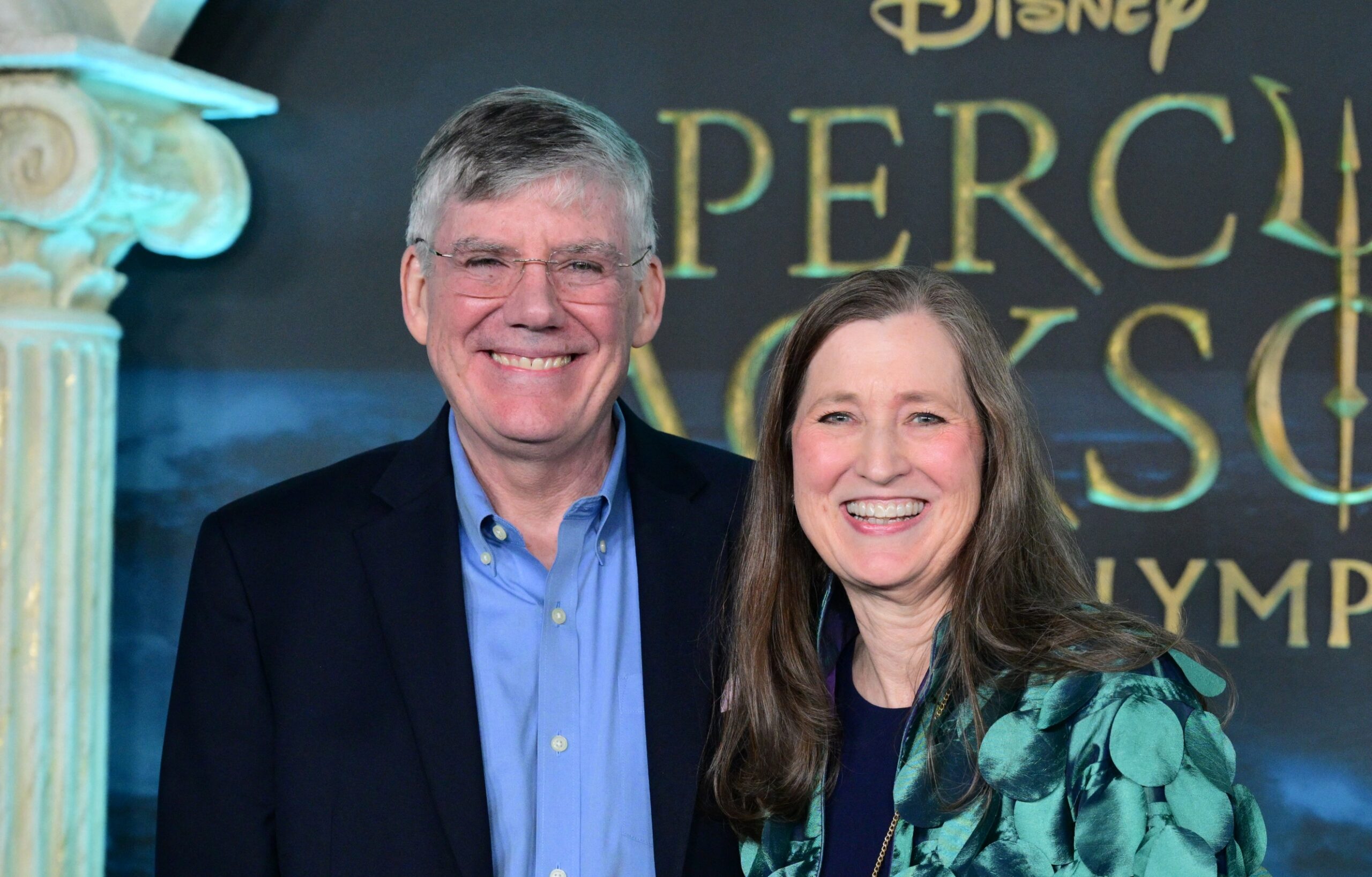
Disney+ is developing a live-action series adaptation of Rick Riordan’s The Kane Chronicles trilogy, with Riordan co-creating and executive-producing alongside writer-director Angela Robinson — and Robinson’s selection is the story inside the story. The development was confirmed by Deadline, Variety, and The Hollywood Reporter on September 3, 2026. A filmmaker whose most structurally demanding work, Professor Marston and the Wonder Women, dramatized scientific credentialing and identity, Robinson arrives at a series whose core mythology is built around exactly that kind of complexity: two Black siblings forced to inhabit divine identities from a culture they are discovering they have complicated, dual claims to.
20th Television, the same studio arm behind the ongoing Percy Jackson and the Olympians series, is producing. The Gotham Group, which brought Percy Jackson to Disney+, is also aboard. The series is based on Riordan’s three-book trilogy — The Red Pyramid (2010), The Throne of Fire (2011), and The Serpent’s Shadow (2012) — which follows siblings Carter and Sadie Kane, descendants of the Egyptian pharaohs Narmer and Ramses the Great, as they battle chaos gods threatening the modern world. No casting, episode count, or premiere date has been announced.
The creative team’s composition is best understood against the six-year development history that preceded this announcement. In September 2020, Riordan announced that Netflix had taken the Kane Chronicles rights for a theatrical film trilogy, with a script commissioned from writer-director Diandra Pendleton-Thompson. Per Variety’s 2024 reporting, Pendleton-Thompson was attached to adapt the first book, The Red Pyramid, as a Star Trek: Prodigy alumna. By February 2024, after four years of development and no film, Riordan announced on Goodreads that the project was in turnaround — Netflix’s option had lapsed after they failed to develop a script they liked.
“Right now, Kane Chronicles is in ‘turnaround,’ which means Netflix has decided not to move forward and their option has lapsed after trying for two years to develop a script they liked,” Riordan wrote. The rights reverted to Riordan, and 20th Television subsequently acquired the property for Disney+, shifting the format from feature films to a streaming series.
The shift from theatrical film trilogy to prestige streaming series is not a downgrade. Percy Jackson and the Olympians Season 1 drew 26.2 million premiere-episode views in its first three weeks on Disney+ and Hulu after its December 2023 premiere, becoming one of the top five season premieres of the year across all streaming. The television format’s capacity to adapt one book per season — rather than compressing an entire novel into a two-hour film — is directly why Riordan’s fictional worlds have succeeded on streaming when they failed in theaters.
Carter and Sadie Kane: Two Protagonists, Two Inheritance Lines, One Shared Crisis
The central characters of The Kane Chronicles are Carter Kane, a Black American teenager who has traveled the world with his Egyptologist father, and Sadie Kane, his younger sister raised by their maternal British grandparents in London after their parents’ separation. Their shared maternal lineage descends from Narmer, Egypt’s unifying pharaoh, the historical unifier of Upper and Lower Egypt around 3100 BCE; their paternal lineage descends from Ramses the Great. This dual heritage makes them vessels for two of the Egyptian pantheon’s most powerful forces: Carter hosts the war god Horus; Sadie hosts the goddess Isis.
The narrative premise of The Kane Chronicles — when their father accidentally unleashes the chaos god Set and vanishes, the estranged siblings must master their inherited magic, forge unlikely alliances, and rescue him before Apophis, the primordial serpent of entropy, breaks free and unmakes creation — is structured as an identity story as much as a fantasy adventure. Carter and Sadie are never quite sure whether the Egyptian magical tradition they are inheriting is fully theirs, whether the gods inhabiting their consciousness are using them or partnering with them, and whether the concept of “mixed heritage” applies not just to their human cultural identity but to their divine one.
Robinson’s selection as showrunner signals that Disney and 20th Television understand what the books are actually about at this level. Her 2017 biographical drama Professor Marston and the Wonder Women, which she wrote and directed, centered on psychologist William Moulton Marston — who invented both the lie detector and Wonder Woman — and his polyamorous partnership with two women whose unconventional relationship structure was simultaneously the source of his professional risk and the experiential foundation of Wonder Woman’s power iconography. The film examined identity, institutional credibility, and the question of who gets to claim a cultural legacy. That is, precisely, the Kane Chronicles at a mythological scale.
What Ancient Egyptian Magic Actually Is — and Why Riordan’s Version Holds Up Scientifically
Riordan based the Kane Chronicles magic system on the authentic ancient Egyptian concept of Heka, the magic deity — the deification of magic and medicine, one of the oldest and most foundational forces in Egyptian cosmology. According to the Egyptian Coffin Texts (Spell 261), Heka existed “before duality had yet come into being.” The practical system: magicians wielded Heka through spoken words, written hieroglyphs, ritual gestures, and amulets — all understood as modes of accessing the same underlying universal force. Egyptian doctors were, literally, “priests of Heka.”
What makes this conceptually durable is what Egyptologist Ogden Goelet observed in 1994: “In the realm of Egyptian magic, actions did not necessarily speak louder than words — they were often one and the same thing. Thought, deed, image, and power are theoretically united in the concept of Heka.” This is the ancient Egyptian formulation of what the British philosopher J.L. Austin described in the 1960s as performative speech act theory — utterances that do not merely describe reality but constitute it. The priest who destroyed a clay effigy inscribed with Apophis’s name was not performing a symbol. He was, within the framework of Heka, performing causally.
Whether Heka could exist in the physical universe depends on whether information has genuine causal force beyond its social meaning. The physicist John Archibald Wheeler’s “It from Bit” hypothesis — the proposition that physical reality is at bottom an information-theoretic phenomenon — suggests the question is not as easily dismissed as it sounds. In quantum mechanics, the act of measurement (an information-gathering process) physically collapses probability distributions. A universe in which Heka operates would be one where structured semantic information has causal reach into the physical fabric of reality — something like a “semantic force” analogous to electromagnetism. We have no evidence such a force exists. The Egyptians had no evidence it did not.
The Real Science Behind Ma’at, Isfet, and the Arrow of Time
The trilogy’s deepest cosmological frame is not magic — it is the relationship between order and chaos. Ma’at, Egyptian cosmic order, the goddess and philosophical principle of truth, cosmic balance, and justice, is not merely a metaphor for moral goodness. In authentic Egyptian theology, the Pharaoh’s primary duty was to “establish Ma’at and smite Isfet” — the daily, active maintenance of cosmic order against Isfet, the universe’s tendency toward dissolution, injustice, and the undifferentiated void. Ma’at was not a state to be achieved once. It was a dynamic effort requiring perpetual renewal.
Isfet’s personification as Apophis — the blind, mindless, screaming serpent who waged nightly war against Ra’s solar barque as it traversed the underworld — maps, with striking precision, onto the Second Law of Thermodynamics. The Second Law states that in any isolated system, entropy — the measure of disorder and the unavailability of energy for useful work — never decreases. Order is thermodynamically improbable. Structures, civilizations, and narratives require continuous energy expenditure to exist. The universe’s baseline tendency is toward equilibrium-as-dissolution: maximum entropy, minimum structure. Thermodynamicist Rudolf Clausius formalized entropy theory in the 19th century, describing it as the universe’s arrow of time.
The Egyptians did not have Boltzmann’s statistical mechanics. What they had was a mythological framework in which the default condition of the cosmos was entropic dissolution (Isfet/Apophis), and the preservation of ordered existence required constant, active, communal effort — ritual, governance, and magic — in service of Ma’at. The parallel is not coincidental. It reflects an ancient intuition, arrived at through religious and political observation rather than physics, that creation is not a finished event but an ongoing process, perpetually threatened by a universe that does not favor it.
In The Kane Chronicles, Apophis is not merely a powerful villain. It is explicitly framed as an existential cosmic threat — an entity whose victory would dissolve all structure, divine and mortal alike, back into the primordial chaos from which Ra created the ordered world. That framing is thermodynamically accurate. Entropy wins eventually unless energy keeps being spent. The question the trilogy never asks but always implies is: what is the Egyptian equivalent of a heat pump?
Set and the Necessary Edge of Chaos
One of Riordan’s most intellectually sophisticated choices is the treatment of Set, the Egyptian god of storms, desert, and chaos. Set is not simply a villain in the trilogy’s cosmological structure. In authentic Egyptian mythology, Set battled Apophis each night at the prow of Ra’s solar barque — the only god powerful enough to do so. Set’s chaos, violent and disruptive, was the necessary mechanism through which cosmic order renewed itself.
This maps onto what complexity theorists call edge of chaos dynamics — the zone between rigid order and complete disorder where complex, adaptive, self-organizing systems actually thrive and evolve. A universe of pure Ma’at, without Set’s destabilizing force, would be a universe of crystalline rigidity incapable of change. Set’s chaos — like the dissipative structures that Nobel Prize thermodynamicist Ilya Prigogine described in equilibrium — is not the opposite of Ma’at. It is the precondition for Ma’at’s renewal.
Divine Hosting and the Neuroscience of Shared Consciousness
The Kane Chronicles’ most philosophically novel mechanism is “Hosting” — the system by which the god Horus occupies Carter’s body and Isis occupies Sadie’s, both the human host and the divine passenger retaining distinct awareness, personality, and agency, sometimes arguing over decisions in real time. Riordan draws here on authentic Egyptian anthropology: the concepts of the Ka, Ba, and Ib (vital force, personality/soul, and heart/consciousness) as distinct but co-inhabiting components of a single person already encoded a sophisticated model in which the self was not a singular, unified entity but a multiplicity of co-present forces.
The contemporary neuroscience of consciousness arrives at a structurally similar problem. The global workspace theory of consciousness, developed by cognitive scientists including Bernard Baars, proposes that the brain integrates many semi-autonomous processing modules into a single coherent phenomenal experience — a physical form of many occupants presenting as one. More directly, split-brain research by neurologist Roger Sperry, Nobel laureate 1981, demonstrated that patients whose corpus callosum had been surgically severed housed what appeared to be two distinct centers of intention and attention in one skull: two apparent selves, sharing a body, each unaware of the other’s perceptual experiences.
The Kane Chronicles’ Hosting mechanism is a mythological externalization of questions modern neuroscience takes seriously: what is the minimum unit of selfhood, and can more than one occupy the same physical substrate? Riordan’s answer — yes, imperfectly, with negotiation — is more nuanced than most neuroscientific models currently accommodate. For a series aimed at young readers navigating questions of dual heritage, bicultural identity, and inherited obligation, it is also the right metaphor at precisely the right scale.
Why This Adaptation Arrives With Better Quality Signals Than Percy Jackson Did
When Percy Jackson’s first live-action adaptation was announced (as films at 20th Century Fox, not as the Disney+ series), Riordan had no creative control. He was explicit about the result: “To you guys, it’s a couple hours entertainment. To me, it’s my life’s work going through a meat grinder when I pleaded with them not to do it.” The Kane Chronicles Disney+ series arrives with Riordan as co-creator and executive producer, the same infrastructure that produced a critically successful Percy Jackson series, and a showrunner whose career suggests she understands that the stories’ deepest value is not the mythology but what the mythology is standing in for.
Percy Jackson and the Olympians Season 3, adapting Riordan’s third novel The Titan’s Curse, will debut on Disney+ in November on November 20, 2026. That timing matters for Kane Chronicles strategically: a third successful Percy Jackson season creates the audience appetite and platform infrastructure for a second Riordanverse live-action franchise. The Egyptian mythology expansion has been building toward this moment since 2020. What is different now is not the demand — Riordan’s global book sales exceed 180 million copies — but the production context, the creative team, and the hard-won knowledge from six years of learning what the right format for these stories actually is.
Frequently Asked Questions
Is The Kane Chronicles coming to Disney+?
Yes. Disney+ and 20th Television officially announced in September 2026 that a live-action series adaptation of Rick Riordan’s three-book Kane Chronicles trilogy is in development. Rick Riordan is co-creating and executive-producing the series with writer-director Angela Robinson. The series is produced by 20th Television, the same studio behind the ongoing Percy Jackson and the Olympians series. No premiere date, casting, or episode count has been announced.
What happened to the Netflix Kane Chronicles movies?
In September 2020, Riordan announced that Netflix had acquired rights to develop The Kane Chronicles as a trilogy of theatrical films. Netflix commissioned a script from writer Diandra Pendleton-Thompson but spent four years in development without producing a film they were satisfied with. In February 2024, Riordan announced that Netflix had placed the project in turnaround — meaning the studio’s option had lapsed without production beginning — and the rights reverted to him. 20th Television subsequently acquired the property for Disney+, shifting the format from feature films to a streaming series.
How does The Kane Chronicles connect to Percy Jackson?
The Kane Chronicles is set in the same fictional universe as Percy Jackson and the Olympians — Riordan’s broader “Riordanverse.” The Kane books take place in the modern world alongside Greek mythology (Percy Jackson), where Egyptian gods are equally real. Riordan even published a set of crossover short stories — collected as Demigods and Magicians — in which Percy Jackson and Kane Chronicles characters directly interact. Disney+ is developing both series under the same production umbrella (20th Television, The Gotham Group).
What is the Egyptian concept of Heka, and how does The Kane Chronicles use it?
Heka is the ancient Egyptian deification of magic and medicine — a force that, according to Egyptian cosmological texts, existed “before duality had yet come into being.” In the Egyptian framework, Heka was wielded through spoken words, written hieroglyphs, ritual gestures, and amulets, all understood as channels for the same underlying universal force. Doctors were called “priests of Heka.” Riordan’s adaptation of Heka into The Kane Chronicles closely follows authentic Egyptian theology, presenting magic as a learned discipline rather than an innate power — which has genuine parallels to modern theories in philosophy of language (speech act theory) and quantum information physics (the hypothesis that information has genuine causal force in the physical world).
ⓒ 2026 TECHTIMES.com All rights reserved. Do not reproduce without permission.

3 Comments
Pingback: Spider-Noir: Prime Video Cancels Nicolas Cage - Comic Vibe
Pingback: Andrew Tate Formally Indicted on Trafficking a Minor and Money Laundering Charges in Romania - Comic Vibe
Pingback: Alix Earle finally speaks out on Alex Cooper drama in Netflix series 'Earle Meets World,' calls the podcaster 'toxic' - Comic Vibe