

The project seeks to connect a largely unorganised community of Kamrupi speakers whose language has historically remained culturally marginalised
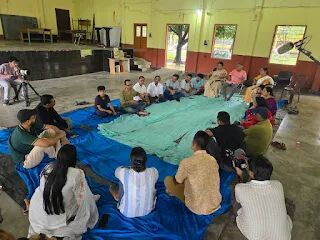
Artists, writers, cultural practitioners and digital content creators participate in a programme on creative expression in the Kamrupi dialect at Barnagar College, Sorbhog (Photo- Meta)
Guwahati, July 21:Artists, writers, cultural practitioners, and digital content creators working in the Kamrupi dialect came together at Barnagar College, Sorbhog, for a programme that explored the creative and intellectual work being undertaken in the dialect.
The event brought together practitioners from literature, art, culture and digital media to share their experiences of using Kamrupi for serious creative expression. Discussions focused on both the possibilities of working in a non-standardised linguistic variety and the challenges faced when it lacks the cultural legitimacy enjoyed by standard Assamese.
Among the speakers, Dr Amiya Mahanata spoke about her work on compiling a dictionary of words used in the region. YouTube content creator Riki Bharali discussed his efforts to document and promote the traditional food practices of western Assam, particularly those of his own region. He also expressed concern that knowledge of many local dishes and culinary traditions is gradually fading among younger generations.
Cartoonist Nituparna Rajbangshi spoke about representing Kamrupi culture through art, while filmmaker Kangkan Deka discussed his Kamrupi-dialect film Upasarga, saying it demonstrates the potential of the language of lower Assam as a medium for serious cinema. Poets Jugajyoti Das, Ajay Kumar Ray and Ziaul Islam shared their experiences of writing in Kamrupi and publishing their work in magazines.
The programme was organised as part of a project led by Jyotirmoy Talukdar of Ashoka University. The Foundation Project is being implemented by India Foundation for the Arts under its Arts Practice programme with support from HudumDeo.
HudumDeo is a socio-cultural organisation engaged in the research, restoration and dissemination of Assam’s folk art, literature and cultural traditions. It also provides a platform for discussions on local art, language, literature and indigenous heritage.
The project seeks to connect a largely unorganised community of Kamrupi speakers whose language has historically remained culturally marginalised. By creating a common platform for artists, writers and researchers, the initiative aims to build confidence among speakers and encourage the use of Kamrupi in both creative work and everyday communication.
Talukdar said the project also seeks to contribute to the ‘declownisation’ of Kamrupi by challenging its frequent portrayal as a language used mainly for comic effect through exaggerated accents, stereotypical characters and caricatures. Such portrayals, he argued, have hindered its recognition as a legitimate medium for literary, artistic and intellectual expression.
The initiative encourages practitioners to represent local experiences in their own language rather than feeling compelled to adopt standard Assamese because of its greater institutional acceptance. Organisers said the growing reach of digital media also offers new opportunities to document, preserve and promote linguistic traditions such as Kamrupi.
