

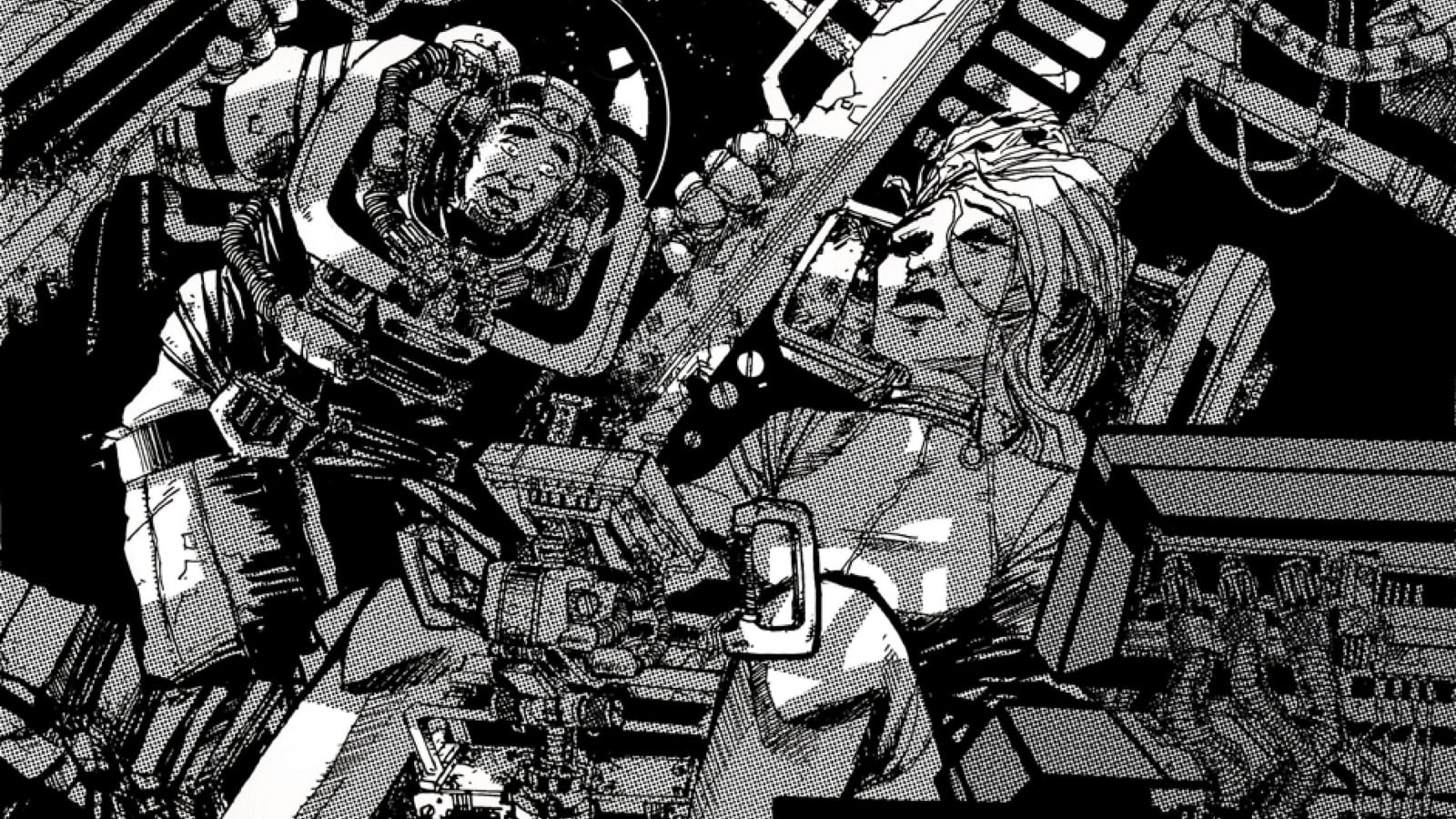

Karl Slominski is a lifelong draftsman and picture maker who believes the comics medium is infinite, a construct of impossible things in impossible worlds. A graduate of the industry-renowned Joe Kubert School of Cartooning and Graphic Art, Slominski pursued a career as a cartoonist rooted in the DIY/indie press background. He self-published and self-financed his earliest works while also moonlighting as a storyboard artist and concept illustrator for studios including 20th Century Fox, Netflix, and Shudder.
With over 20 years slugging it out as an independent creator, Slominski is dedicated to one single understanding: “YOU ARE NOT LIMITED, NOR CONSTRAINED BY A BLANK PAGE.” This philosophy is front and center in his new work, The Last Watchtower
On creating The Last Watchtower
The Last Watchtower is the story of a man, Cal, who is isolated on a remote space station and tasked with keeping a record of disasters that occur on Earth. However, the book is less about the plot and more about the challenge of creation itself
The project began during the first few months of the COVID lockdown, when Slominski was trying to keep his wits about him and was limited to only the art supplies he had left: a few pens, a jar of ink, and some beat-to-shit brushes. He decided to draw a page a day, with each previous page influencing the next, operating with only three general beats on the back of a takeout menu. The story evolved as he drew it
Slominski describes The Last Watchtower as an “exercise in free expression: no script, no plotting, no pencils, no layouts, just pure, organic, ‘off-the-cuff’ comics.” He notes that this method, which he sees as a “flex” and a challenge in vulnerability and confidence, is what makes the book unique. There isn’t a single panel he went back and redrew; every page is the first time it was drawn
The book itself is “unabashedly nihilistic in its cold reflection of humanity,” but it lands on a grey area that is open for discussion, what could be interpreted as hope. The current relevance of the story lies in Cal’s routine of cataloging terrible things he’s not a part of, which reflects the “rampant cavalcade of bad news we’re fed daily,” or “Doomscrolling by proxy.”
Upstate roots and punk rock travels
Slominski’s upbringing in a small upstate New York town, which he felt “lacking in any extraordinary or outstanding characteristic,” fueled his hyper-imaginative nature and sense of rebellion. He explains that it was the suburbs where “dreams go to die if you don’t rebel against that nagging feeling.” His rebellion involved starting punk bands, organizing basement shows, and plotting an escape
The one major influence that broke through the Rockwellian surroundings was a used bookstore that sold vintage comics for quarters. He considers those “comic book quarter bins” his “art school before art school,” where he discovered masters like Jack Kirby, Joe Kubert, John Romita Jr, Bill Sienkiewicz, and Mike Kaluta. Artists who made comics that “could ONLY exist in the comics medium.”
After school, Slominski lived in New Jersey and Brooklyn, spending weekends soaking up the museums, concerts, and art in the city. His earliest comics were often drawn in the back of a touring van while on the road with a hardcore band. He attributes his initial view of the country to “punk rock and comics,” attending indie zine fests and comic swap meets
The craft of the medium
When introducing people to his work, Slominski notes that he is a “niche within a niche: people that understand and appreciate the MEDIUM of comic book storytelling, while also valuing when the art is created traditionally by hand (ink and paper).” He describes his visual style as “Informed by its predecessors, executed organically, born of frustration” and his writing style in three words: “Raw. Imaginative. Earnest.”
For nearly a decade, Slominski has lived with his fiancé, who is also a working author and screenwriter. He finds their shared environment to be a “clubhouse and a sanctuary” where they can dream and create, providing a “very supportive and inspiring place.”
Outside of his creative work, Slominski is an avid reader, citing literary influences like Kurt Vonnegut, Ray Bradbury, and Hunter Thompson. He is also a gym rat, enjoys crate digging at record stores and comic shops, and loves getting away from everything in the quiet of nature
A frank take on the comics industry
When asked what question he wishes interviewers would ask, Slominski states: “What can comics, both as a medium and an industry, do DIFFERENTLY for the better?”
He is candid about the current state of comics, expressing a desire for more risks and “big swing books from unproven creators.” He argues for less focus on social media follower counts, more work from artists who write their own material, and fewer books that feel like an elevator pitch for other media. He also wishes people would stop using “graphic novels” for single issues because they are embarrassed to read a “comic book.”
Ultimately, Slominski hopes readers will take away two things from his work: “Fearlessness. And an appreciation of craft.”
What’s next?
If he weren’t a writer/illustrator, Slominski says he’d be directing or making music, though he is currently doing both
He is collaborating with his fiancé once again on a gothic werewolf book titled Lunatic that is expected next year. Additionally, he has two more books likely to be released by the tail end of 2026: (In The Company Of) Dead Men and The Gun Moll. Beyond his comic work, he wrote a film that is scheduled to begin shooting early next year, and he is developing a project to direct later in the summer
The Last Watchtower will be available wherever books are sold on July 21. You can follow Karl Slominski on Instagram at @slosaysso and see his work at slomotionart.com
