


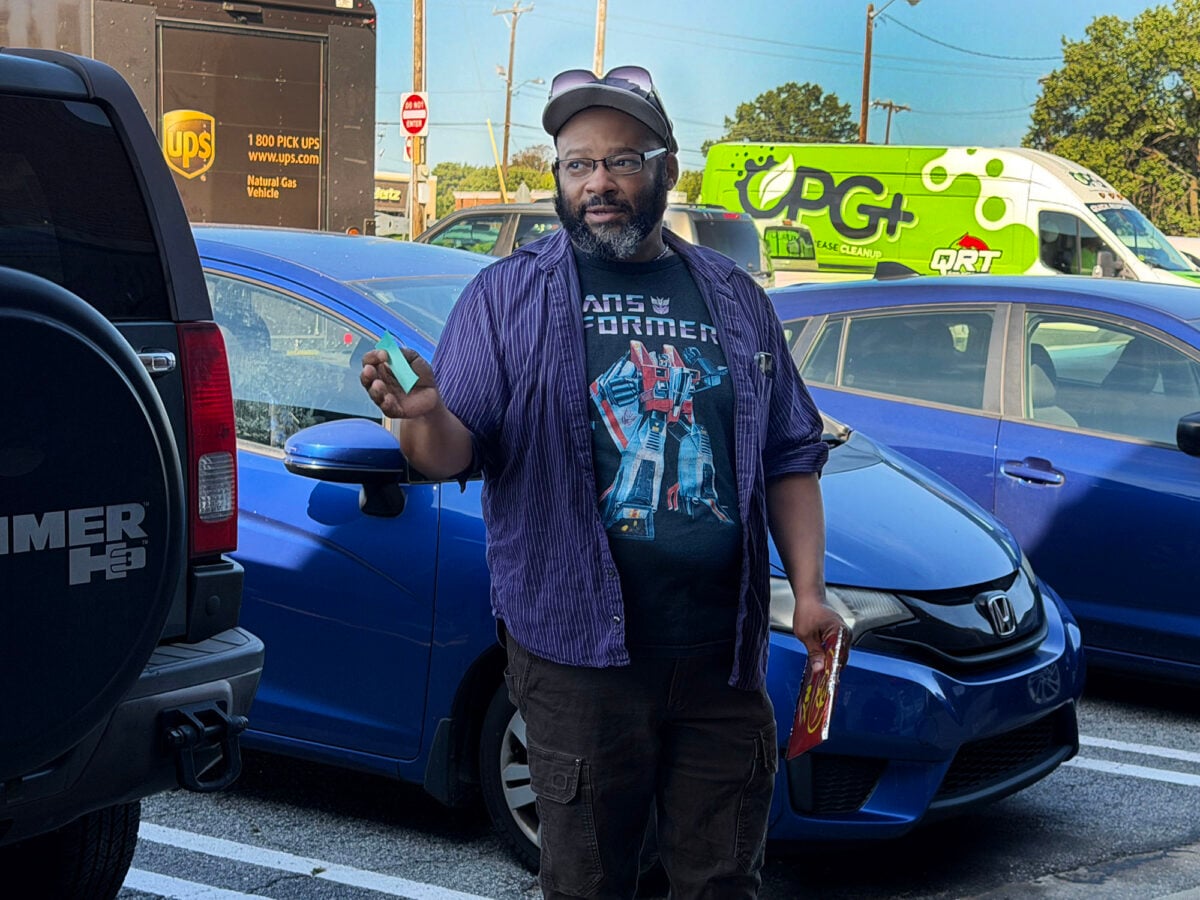
Jermaine Exum, owner ofAcme Comicsin Greensboro, NC, might be something of a legend in comic industry circles, but he goes out of his way to avoid the spotlight. Known to many by his Jinxworld handle “Lord Retail,” he’s cultivated a reputation as one of the country’s most influential comics retailers.
When you visit his10-time Eisner-nominated store, you’ll see him eagerly engaging customers, making curated recommendations for every type of reader, or (in his rare moments of sitting down) doing battle with distributor websites to track down an out-of-stock issue. Every Wednesday morning (New Comic Book Day), he personally greets the line outside with his notes and personal recommendations for the week’s new offerings, written by hand aftera marathon 25-issue reading sessionthe night before.
Creators and publishers know him by name, and his store is regularly filled with lively conversation and a mix of families and lifetime collectors. Author Brian Michael Bendis, who featured Exum inUltimate Spider-Manas an actual in-universe character, calls him “the perfect retailer. Passionate, informed, savvy, a perfect balance of loving the art and the business. To me, he is the gold standard.”
2026 marks Exum’s 30th year at Acme Comics, where he’s worked his way up from volunteer to employee to manager to owner, leading the store to win the2025 Image Comics Select Retailer Award. We sat down to talk about his lifelong journey in the comics world, the challenges of being a minority comic shop owner, and an in-depth, honest discussion of the current state of comics retail and what publishers can do better to help stores succeed.
David Cirone: 30 years of working in comics retail. Do you have 30 more in you?
Jermaine Exum:I ask myself that question all the time: “How much longer can I do this?” It really does feel like I’vealwaysdone this, because I’ve been here since not long out of high school. 30 years of New Book Day, 30 years of Final Order Cutoff, there’s no time off. It’s a weekly thing that you can’t ever take your eyes off of. That’s where having good and capable people around me comes in.
David Cirone: In most professions, three decades would put you in a position to feel some confidence. You’ve seen it all.
Exum:Sometimes, but there are days when I have no idea what to do on these new initiatives. No clue. Like right now, to put a date on this thing, Marvel’s Final Order Cutoff on theMidnight Universeprojectsis Monday. Today is Thursday, and we’ve got to doSpider-Man#1.Fantastic Four#1,X-Men#1. We’ve got to make our orders for all these first issues and all the variants. And I feel like, for the energy behind this project, the pre-orders aren’t where they’re supposed to be.
Cirone: For a premium launch like the Midnight Universe, how much risk does that involve?
Exum:Well, it’s going to get a second printing, because in today’s world, especially with Marvel, your victory is to announce a second printing, third printing. That’s your win, but that doesn’t really help anybody when issue #2 is on the shelf and you have to tell a customer that third printings of issue #1 are going to be here in three weeks.
Cirone: To what extent are you able to predict what your customers will show up for?
Exum:We have to be reliable. And does that mean that we’re going to carry hundreds of copies? Sometimes I get nervous. You look at that stack on Tuesday, and you’re like, “Wow, that’s a lot of our cash flow sitting on that table right there.” Sometimes you get burned, but other times it’s the right call. You can take care of people when they’re right there in front of you.
Cirone: The FOC system has been bemoaned by retailers for a long time. Knowing that the situation isn’t going to change anytime soon, what would be your recommendation to a publisher like Marvel? What can they do better?
Exum:I’ll say right now the marketing doesn’t line up with when it’s time for us to turn in our orders. I think we needed the ashcan a long time ago, and we needed it in large quantities. Let us put it out there.
Cirone: What about digital previews?
Exum:Here’s what I’ve noticed from my point of view behind the counter: people are completely overwhelmed with emails and links and QR codes, so they tune out. But what theydon’ttune out of is when they’re sitting down to read something in their hands. There’s no link to send you down a rabbit hole. There’s no “play next.” It’s something they can read and say, “Oh, this book’s coming out in two weeks. Let me send an email real quick.” It’s controllable and not a distraction. So I think digital is not the answer for promoting.
Cirone: How many of your customers are reading comic websites or watching enough interviews or podcasts to keep up with new releases?
Exum:There is a percentage of our clientele in 2026 who are listening toOff-Panel, they’re checking outComics Beat. But a lot of our clientele, they’re hearing about a book from us. They’re seeing a book for the first time when it’s on the shelf on Wednesday. Even when we do our weekly newsletter, telling people, “Here’s a book we think is going to be good,” I still don’t hear anything until maybe Tuesday night.
Cirone: And you can only make these recommendations if you, as a retailer, are getting the previews in advance.
Exum:That’s critical. If DC hadn’t madeAbsolute Batman#1 available for me to read cover to cover, I would have bombed that order completely. I would have carried 100 copies, as opposed to 300 copies. With reorders and the subsequent printings, I don’t even know where those numbers are now, but had I not seen that issue before FOC, I would have gotten it wrong.
“If DC hadn’t madeAbsolute Batman#1 available for me to read cover to cover, I would have bombed that order completely.”
Cirone: I’d like to get your take on industry trends, things that keep cycling back. For example, crossover events. Do events still work?
Exum:Yes, certainly. I’ve been behind the counter sinceOnslaught, for example, and everything since. Despite what everyone says about event fatigue, every event is somebody’s first, and that book is one comic you can buy and see as many marquee characters as possible. You’re getting Spider-Man, you’re getting Wolverine, and then you’re getting characters you’ve never seen before. You’re saying, “Who is that?” An event is a gateway.
Cirone: You’re seeing new customers coming in now, young customers. What’s bringing them into your store?
Exum: TV, movies, video games, those are always major factors. And DC’s Absolute line has brought in a whole new set of readers. But it’s not just limited to what’s out now. People come in because they just watchedMoon Knight, or they want Wanda Maximoff comics, which would make you say, “I don’t understand. Those TV shows came out years ago.” I’m pretty sure I first saw Batman and Robin onScooby Doo. I didn’t see them in comics. I didn’t know what comic books were yet. People meet these characters in other media. Suddenly, because of theMarvel Rivalsvideo game, Magik is a household name.
Cirone: How are new customers reacting to the recent wave of pocket-sized collections?
Exum:For a generation of readers, the manga format is what they know sequential art and story to be. It looks likethis. It doesn’t look like, you know, twenty pages held with a staple. It looks like a little book. And I think that’s great. Do I love thatKingdom Comeis shrunk down? Not personally. But I love that people are reading it for the first time.
Cirone: Who are the characters that bring people through the door day after day?
Exum:It’s going to be mostly the ones you would predict. Regardless of whether there’s a new movie, someone’s going to come in and say, “What’s Spider-Man doing right now?” Batman’s gonna do it, even without a new event reminding people. AndInvincibledoes it right now, because it’s something that’s coming into people’s homes on a regular basis. It’s winning people over.
“Regardless of whether there’s a new movie, someone’s going to come in and say, ‘What’s Spider-Man doing right now?’”
Cirone: Once these fans come in to try out the comics, how do you guide them to new stories or new characters?
Exum:We’re lucky that we have voracious readers. We have people that sometimes come back a day or two later to say, “What’s next?” Because we’re not just pointing at some shelf, saying, “They’re over there.” We become the person that you can go to and say, “What do you think I’d like next, based on what you know about me?” There aren’t many businesses you can walk into where someone can do that for you.
Cirone: Sometimes you hear from new comic book store owners, “I’ve loved comics all my life, and I couldn’t wait to own my own shop and share my love of comics with others. But I didn’t realize how difficult the business part was.”
Exum:Are comic books fun? Yes, they are, but it’s also retail – products, marketing, customer service. It’s still all of those things. I love reading comics, but I have to pay attention to the business. We need to still be open next month. So you hope that you get the magic and the math right so that that love of comics can translate into a business that keeps you alive.
Cirone: What’s the most common misconception about your job as a comic store owner?
Exum:The most common misconception from consumers is that they don’t know that we have to pay for the books. They think that the Marvel truck pulls up and drops off your allotment of stuff, and they’re gonna pull up next week and take back whatever you didn’t sell. In today’s world, people feel like they know a lot about “the industry,” but they don’t seem to know that’s a basic part of our business.
Cirone: What’s the skill of being able to handle that risk? On a weekly basis, you’ve got to guess what your customers are going to respond to, and you’ve got to commit financially to that.
Exum:I’m not a believer of, “If you build it, they’ll come.” You have to have a plan for it. And that’s something that I kind of learned 30 years ago. If you’re gonna raiseShadow of the Batup toDetectivenumbers, you’ve got to have a plan. How are you going to convince people that this is something worth checking out? So I think that stores have to have confidence in selected situations, not everywhere. If there’s something you believe in and you believe that you know how to represent it, show up for it. You’ll know pretty quickly if it’s not connecting.
Cirone: How does customer interaction factor into this? How much time do you need to spend getting to know your customers in order to make those judgment calls?
Exum:You have to know your clientele. A person comes in and says, “Hey, my kid likes Spider-Man.” You could say, “Here’s a Spider-Man comic. Okay, see you later.” You’ll never see him again. If you don’t get to know that person, then what are you doing? Your clientele is that person who selectedyour storeas the place where comics come from. You see them once a month, maybe every two weeks. If you don’t notice that person really loves Gambit, that he’s their favorite character, then that’s on you. But when you remember that type of thing, then that person begins to appreciate it and they’re going to trust you. And also, maybe you’re the only person in their universe who even notices that type of thing about them.
Cirone: Acme Comics is a Black-owned comic book store. Why is it important for people to know that?
Exum:I think that something that I notice among clientele, and something I know about myself, is that people like to know who they’re buying from. I like to know where I’m spending my money. There are people coming into our shop who are within walking distance of other stores, but they’re driving across town or maybe from a different county to come to us, and I appreciate that. That doesn’t happen for no reason. There’s got to be something that we’re doing that makes someone want to do that and feel good about doing that. It truly means a lot to me when people make that kind of decision. There’s an element of community and feeling like you’re part of something at this local comic book store, and yes, this is a Black-owned store, which is a rarity. There’s only “X” number of comic book stores in the country, period. And then, looking at the number of minority-owned, Black-owned, women-owned stores, that gets smaller and smaller.
“Something that I notice among clientele, and something I know about myself, is that people like to know who they’re buying from. I like to know where I’m spending my money.”
Cirone: We’re talking now just one week after the successful launch of the Ink Alliance’s first exclusive variant cover, created by Sanford Greene, and Acme Comics is one of the founding members of this collective of Black-owned comic book stores. What are your thoughts about how that went?
Exum:That’s something that came together so quickly. That conversation just started earlier this year as, “Hey, wouldn’t it be cool if we talked to each other about stuff sometimes, or maybe did cool stuff together?” I’ve always been a proponent of being open source to other like-minded, well-intentioned retailers. If a store is trying their best and they’re good to their customers, then I’ll tell them how much I order, or how we were able to sell this many copies of this graphic novel. The cool thing about Ink Alliance is that I’m able to do that with a great group of owners. Some are stores that I think maybe never had anybody to talk to, anybody to share successes and failures with or to say, “How do you handle it when this distributor does that?” versus just being on your own. Because comic book retail can be so isolating. That’s how I felt for a very long time.
Cirone: What opportunities did this create for you, not just in terms of producing an exclusive cover, but working together to promote this as an event?
Exum:Here’s what I know: through Ink Alliance promotion, people who live in Greensboro and had never heard of us before came in because they saw we were part of “that Ink Alliance thing”. That’s the power of marketing as a group. There’s an element of motivating people to drive several states to come to our store to get a certain book. That’s just incredible. And ideally, what’s happening here with Ink Alliance is you’re not just a client, you’re transforming into an advocate where you’re supporting the business, and then you’re telling other people, “Next time you’re in North Carolina, you’ve got to go to this place in Greensboro. It’s awesome.” You can’t put a price tag on that type of thing.
Cirone: What are you hearing from your customers about the presence of Black characters and Black creators in mainstream titles?
Exum:So that’s been a topic for decades, but what we’re seeing now is when someone might say, “Do you have anything by a Black author, Black artist?” There are so many on the shelves and so much back library material, I can say, “Do you want superheroes? Do you want something historical or supernatural?” I gotta start narrowing it down. I can’t simply say, “Oh, that book over there, that’s the only one.” But right now I’m seeing something different, though. I’m seeing action, like “Oh, I heardVixen’s about to get a comic bookand Stephanie Williams is writing it. Let me go and put in a pre-order.” That’s the change, and that’s what makes a difference in the comic industry.
Cirone: There was a recent interview with Yahya Abdul-Mateen, where he said Black superhero projects need “a little bit more time to cook, because I think Black audiences usually find out and gravitate to the niche projects a little slower.” You’ve mentioned marketing a few times, so how do you feel about major publishers getting the word out about their projects so customers can take action and help you beat FOC?
Exum:I don’t know the answer, but they definitely can do something more to reach an audience that’s not already there just waiting to hear from you.
Cirone: Are they setting you up to be successful? For example, when a new Vixen series is announced, are you able to start putting in orders?
Exum:I can’t start putting in orders because it’s not “in the system”, but I can start taking pre-orders on our internal list, and we did that immediately. Here’s the way the systemcouldwork: A publisher announces a comic, and you can then go on the distribution website, see the page count, cover price, all the variants. But we can’t do that, and it’s very frustrating. Ideally, they’ll tell us first, but sometimes I’ll hear about a new series from a customer. I’ll hear about the Steel series and I’ll say, “Where did you hear about that?” Because I’ve been at work all day.
Cirone: How is it for you as a retailer dealing with multiple distributors?
Exum:We’re lucky that we’re only dealing with two now, Lunar and Penguin. It could be five or six. But that’s still two separate invoices, two separate billing systems, two separate delivery days. You’re trying your best to speak and manage these different languages, but it is what it is. And you’ve got to do it every week.
Cirone: And that’s just part of what you have to do to keep your customers happy.
Exum:We manage pre-orders for 526 people. That’s a lot of people for a small business, for a micro-business. That’s a lot of people that you’re managing on an individual basis.
Cirone: In your experience, what does it take to move a casual customer into committing to a pull list?
Exum:It takes that person missing something about three times. It takes, “I’ve never had trouble buyingDaredevilbefore.” I think some people really do have a fear of a pull list. But I’ll say, “Look, I’ve watched you buyGreen Lanternevery month for six months. You getGreen Lantern, so this is a safety net in case you can’t get off work, if you’re traveling, or in case something happens in the next issue and it’s sold out fifteen minutes after we open.”
Cirone: You’re doing a lot of outreach. You do a weekly newsletter, and you also do these marathon Tuesday night Blue Sky sessions. How do you manage that?
Exum:So thatstarted off on Twitter. I was already on Jinxworld by that time, and I thought maybe I could talk to not just our clientele. Maybe I could say to everybody, “Hey, thisX-Menbook next week, you might want to look at that. Even if you haven’t readX-Menin years, you might want to see what’s going on.X-Mennext week, tell your store.”
Cirone: On an average Tuesday night, how many books are you reading?
Exum:Sometimes I’ll read between 15 and 25 comics on Tuesday. If something was just OK, or if the lead-up chapters aren’t available, I’m not gonna really talk about it. It’s got to be something outstanding or something that I think someone would leave behind on the shelf if they didn’t hear about it.
Cirone: One of the things I’ve noticed in your posts is you’ll often not only talk about if issue #1s. You’ll sometimes talk about., “This is a good place for you to jump into” a series. What can publishers do to encourage people to start reading a title after a run is already established?
Exum:In most Marvel comics, if you open it up to the first page, it’s going to tell you everything you need to know to read the issue that’s in your hand. It’s going to tell you who these characters are and what you missed last issue. So you’re ready to go with what you got, and now you can be part of the immediate conversation in the store or on social media. The younger audience doesn’t seem to be as averse to jumping in, though. They’ll find what they need on TikTok and get right up to speed.
Cirone: What does the industry need to do to keep this younger audience and make them lifelong readers?
Exum:I think the industry could really stand to make New Comic Book Day more of a thing, especially for new people. I don’t think they know that every Wednesday all these cool new things come out.
Cirone: If comics and comic book characters are so widespread in our culture, why isn’t that message getting out?
Exum:What do you see from the industry? You see the technical term “FOC,” but that goes over most people’s heads, and “Free Comic Book Day”, which is something that some people show up for one time a year. I think maybe they’ve gone so big to promote Free Comic Book Day, they forgot New Book Day.
“I think the industry could really stand to make New Comic Book Day more of a thing, especially for new people. I don’t think they know that every Wednesday all these cool new things come out.”
Cirone: What does this say about the ways that publishers are showing support for retailers?
Exum:There are some publishers that are super supportive. Skybound is fantastic. They’re so good to us because they want us to succeed. If we succeed, they succeed, right? But I think there could be a collective push from every publisher to remind people that Wednesday is New Book Day and it’s an exciting day of the week. If you could get the power of Marvel or DC behind that, it could be transformative for everyone.
Cirone: Wednesday, of course, is your busiest time. I’ve seen you go non-stop all day long.
Exum:On Wednesday mornings, when people pass by andthey see the line of people outside the store, sometimes they’ll say, “Hey, what came out today? What caused this line here? This doesn’t happen every week, does it?” But it does. I’ll say, “A lot of stuff came out. It’s not just one thing making this line happen.” Something new is always coming out, every week, all year round. There’s always something else we can introduce people to.
Cirone: Why is having a physical comic book in hand still worthwhile or cool? What are you hearing from your customers?
Exum:I’ve overheard conversations among people who gather around the DC Absolute display, people who came in together. Time and again, people say, “Yeah, I read this online, but I really want to have this book.” Either they want to have it in their hands to experience it differently, or they want a memory of “I came in when that book was on the shelf and I got one.” And they want to have that memory with all their friends.
Cirone: Thirty years ago, you started as a volunteer.
Exum:Because I wanted to be around my new friends, and they were here.
Cirone: If Jermaine the volunteer walked into Acme Comics as it is today, would he have the same reaction?
Exum:Would I like the place? Would I start conversing with the people that work there? Would I find myself there multiple times a week? I think so. I discovered Acme Comics as a place you could come to, and they had nothing but comic books. It wasn’t a convenience store, it wasn’t a drugstore. They had old stuff, and sometimes different stuff I’d never seen before. But that was in ’88 or ’89. And I didn’t start helping out around there until ’96. There were different options for going to a comic book store, but Acme was it for me.
Cirone: What’s the common element in your view?
Exum:I think it’s community. It’s the daily conversations of, “Hey, I’m reading this. Do you know about this book?” “Hey, have you seen this before?” Reading comic books can be a very solitary experience. But if there can be a place you can go to where somebody else knows what you’re talking about, where people don’t just understand your experience but they want to help you geteven moreof that feeling, it’s going to make your whole day so much better. You’re going to keep coming back every chance you get.
Visit Acme Comics athttps://acmecomics.comand catch Jermaine’s weekly recommendations every Tuesday onBluesky.

