

Simulation and Training
2 Nov 2026|Terry Palmer
Featured in
Issue 176 | November 2026
Share
Terry Palmer explains how a shift in training frameworks is being instigated by the rise in advanced simulation equipment and technology, where the boundaries of possibility are being pushed back
It rarely starts the way it was briefed.
A routine call shifts. Weather moves in. The landing zone changes. Communication becomes compressed, and the margin for error narrows quickly. In air medical and search and rescue (SAR) operations, the difference between a successful outcome and a near miss often comes down to how well the crew adapts in the moment.
Training has always been the foundation for that performance. What is changing is how that training is delivered.
Helicopter emergency medical services (HEMS) and SAR crews operate in environments where there is little margin for error. Night operations, degraded visual conditions, confined landing zones, hoist missions, and time-critical patient transport all require a level of proficiency that goes well beyond basic aircraft handling.
For decades, full flight simulators have provided a high-fidelity environment to prepare crews for these challenges. However, cost, limited availability, and fixed training locations have restricted how often and how broadly this type of training can be delivered, particularly for smaller operators or highly specialized missions.
Today, a new generation of immersive technologies, including virtual reality (VR) and mixed reality (MR), is expanding access to simulation-based training. More importantly, these tools are supporting a shift toward more frequent, mission-focused, and team-oriented training, which is essential for real-world operations.
A broader training landscape
Recent regulatory updates have helped accelerate this shift. Both the European Union A and the Federal A have expanded how flight simulation training devices can be used, allowing more flexibility in meeting training and checking requirements. This has created space for newer technologies to complement traditional simulators
Today’s training environment is best viewed as a spectrum.
Today’s training environment is best viewed as a spectrum
VR systems provide fully immersive environments that allow for high-frequency repetition of procedures and scenarios in a relatively compact and cost-effective format. MR systems combine real cockpit hardware with virtual environments, allowing crews to interact with physical controls while operating in a dynamic visual setting. Traditional full flight simulators and flight training devices continue to provide the highest level of fidelity for certification and complex system training.
Rather than competing, these tools are increasingly used together. Operators are selecting the right tool for the right task, whether that is procedural training, emergency scenario practice, or full mission rehearsal.
Technology providers driving innovation
Several companies are actively shaping this evolving landscape.
Loft Dynamics has been an early leader in qualified VR simulation, with systems approved by both the FAA and EASA. Its platforms have been adopted by operators such as PHI Air Medical to support mission-specific training, including external load operations and emergency procedures.
TRU Simulation + Training is advancing immersive VR solutions that combine real avionics, motion systems, and visual environments to support helicopter missions including emergency medical services (EMS), SAR, and night operations.
Reiser Simulation and Training is focused on MR applications that allow pilots and crewmembers to interact in a shared physical space while operating in a virtual environment. This capability is particularly valuable for multi-crew coordination and crew re
Entrol is contributing to this space with MR systems designed for hoist operator training. By integrating pilot and hoist stations into a shared scenario, these systems support realistic communication and coordination during complex rescue operations.
Thales continues to incorporate mixed reality into its full flight simulator platforms, including integrated hoist training capabilities. These systems are designed to support complete mission profiles, combining high-fidelity aircraft simulation with realistic external task training.
At the same time, established simulation providers such as FlightSafety International, CAE, and Frasca remain central to the industry. Their full flight simulators and advanced training devices continue to play a critical role in certification and recurrent training, and many are exploring how immersive technologies can complement their existing platforms.
From individual proficiency to team performance
One of the most important developments in simulation is the shift from individual skill training to team-based performance.
One of the most important developments in simulation is the shift from individual skill training to team-based performance
Traditional training has done an excellent job of building pilot proficiency. However, real-world missions depend on how effectively the entire team operates together. Pilots, medical crews, hoist operators, and ground personnel must coordinate in real time, often under pressure and in rapidly changing conditions.
MR environments are particularly well suited to this type of training. Because they allow for natural interaction with physical controls and real crewmembers, they create opportunities to practice communication, workload management, and decision-making in a more realistic context.
This includes integrated communication, shared situational awareness, and the ability to adapt when plans change. These are the factors that often determine the outcome of a mission.
This is especially relevant for operations involving hoists, external loads, night vision systems, and complex rescue scenarios. In these situations, success depends not only on technical skill, but on how well the team responds together.
Operational impact in HEMS and SAR
Operators are already seeing practical benefits from immersive simulation.
In the HEMS sector, VR systems are being used to supplement aircraft training, allowing pilots to practice emergency procedures and mission scenarios more frequently. This reduces reliance on live aircraft while increasing exposure to high-risk situations in a controlled environment.
In SAR operations, mixed reality is improving training for hoist missions, one of the most demanding and risk-sensitive tasks in helicopter operations. By allowing pilots and hoist operators to train together in realistic scenarios, these systems help improve coordination and precision.
By allowing pilots and hoist operators to train together in realistic scenarios, these systems help improve coordination and precision
International operators working in mountainous or remote regions are also adopting immersive technologies to prepare crews for terrain-specific challenges. The ability to rehearse missions repeatedly under varying conditions provides a level of preparation that is difficult to achieve through traditional methods alone.
Benefits and considerations
Immersive simulation offers several clear advantages. It allows for more frequent training, supports safer practice of high-risk maneuvers, and reduces operational costs associated with aircraft use. It also contributes to environmental goals by lowering fuel consumption and emissions.
While immersive simulation continues to expand what is possible in training, it is important to recognize that these tools are most effective when used to complement, not replace, hands-on operational training. Real-world missions require physical coordination, environmental awareness, and team interaction that can only be fully developed in the aircraft and in the field. The greatest value comes from combining simulation with live, scenario-based training that brings the entire crew together, allowing teams to translate what they have practiced into real operational performance.
At the same time, successful implementation requires careful planning. Instructors must be trained to use these tools effectively, and training programs must be designed to ensure that skills transfer to real-world operations.
The most effective approach is a blended one
The most effective approach is a blended one. Virtual reality provides accessibility and repetition. Mixed reality adds realism and team interaction. Traditional simulators continue to provide the highest level of fidelity for certification and complex systems training.
Looking ahead
The evolution of simulation is not about replacing one technology with another. It is about expanding the training toolkit to better reflect how missions are actually conducted.
For HEMS and SAR operators, this means moving beyond minimum training requirements and focusing on mission readiness. It means training not just individual skills, but how teams perform under pressure.
Immersive technologies are helping make that possible by enabling more frequent, more flexible, and more realistic training.
The ability to translate that training into real-world performance, as a team, is what ultimately makes the difference
As operational demands continue to grow, this blended approach is likely to become the standard. The ability to train more effectively, and more often, is important. The ability to translate that training into real-world performance, as a team, is what ultimately makes the difference.
November 2026
Issue
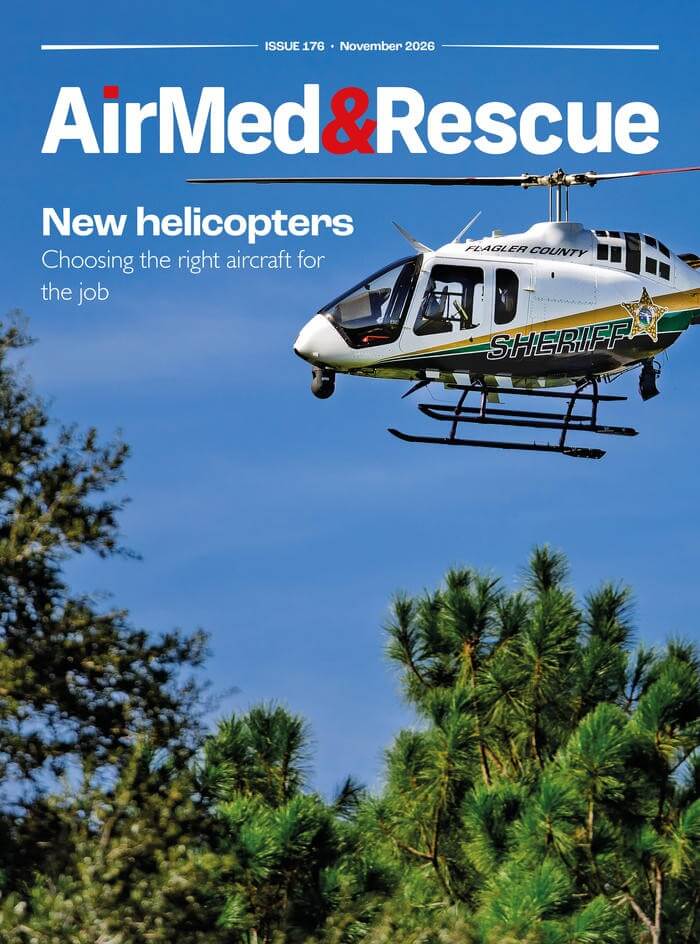
The November edition of AirMed&Rescue has a wealth of articles to keep you informed and engaged. We have features that explore the challenges associated with cable snag and entanglement; determine how and why special missions operators choose a new helicopter; look at the risks, regulation, and requirements of temporary helicopter landing sites; and examine the inroads that are being made by the drone industry into the medical sector.
Read full issue
Simulation and Training
2 Nov 2026
Share
Terry Palmer
Terry Palmer is a commercial pilot with over 30 years of experience in aviation safety and training and is the recipient of numerous international awards including HAI’s Agusta Westland Safety Award and the Airbus Jim Charlson Safety Award. Palmer is Board member and aviation advisor for the Commission on Accreditation of Medical Transport Services (CAMTS). In the last twenty years, Palmer worked closely with the associations and government agencies in the effort to raise the standard of training for helicopter operations. She has been instrumental in bringing flight simulation and training programs to the air medical industry.
