

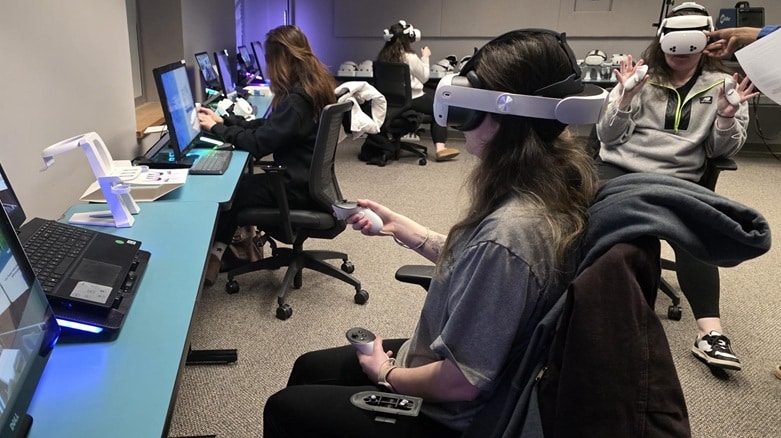
A Carroll Community College student explores immersive, handson experiences in the VR lab. (Photo: Carroll)
Carroll Community College’s Virtual Reality (VR) Lab began with a straightforward goal to use immersive technology to make learning more engaging, experiential and accessible. Through a thoughtful, multi-year approach, that goal has evolved into a robust VR lab that supports instruction across disciplines while demonstrating that community colleges can successfully launch and scale VR without significant upfront investment.
This article was originally published in Community College Journal. Read the magazine online here.
Enhancing education in a virtual world
VR enables students to practice, explore and learn in ways that are difficult or impossible in traditional classrooms, all within a safe, controlled environment. At Carroll, medical and industry simulations allow students to rehearse procedures and technical skills without real-world risk. Soft-skill scenarios, such as public speaking and conflict resolution, help students build confidence through realistic practice. In STEM fields, VR supports learning with interactive 3D models and virtual labs that deepen understanding in engineering and science.
The humanities also benefit from immersive learning. Students can experience history and art in new ways, such as virtually witnessing the 1943 Berlin Blitz or stepping inside Vincent van Gogh’s “Starry Night.” Some VR platforms also align with industry certifications and workforce training, giving students a competitive advantage. Across disciplines, VR provides space to experiment, make mistakes and learn without real-life consequences.
Partnering with faculty for success
Faculty collaboration has been central to Carroll’s VR strategy. Jordan Pearson, media and VR technician, works closely with instructors to understand course objectives before introducing technology. He often begins by asking faculty to consider what they want students to take away from a lesson, then curates VR experiences aligned with those goals. Faculty are invited to participate in hands-on demonstrations, allowing them to evaluate tools firsthand before integrating VR into coursework.
As interest grew, the VR team also addressed common concerns. A frequent misconception is that VR inevitably causes motion sickness. Carroll emphasizes that VR can be experienced in multiple ways, not only through headsets but also via projectors and monitors, allowing for accommodations and flexibility. Options such as stationary simulations, shorter sessions or augmented reality alternatives ensure that individual needs are met. This supportive, myth – busting approach has helped build faculty confidence and sustained adoption.
Phased growth and strategic funding
Rather than making a large initial investment, Carroll started small. In late 2020, the college piloted VR with just two headsets to assess interest and effectiveness. Positive feedback from students and faculty guided gradual expansion. A key catalyst was the use of federal Higher Education Emergency Relief Fund (HEERF) dollars during Covid, which enabled the purchase of additional hardware and VR ready computers.
Even with growth, the lab has remained cost effective. VR hardware continues to become more affordable, and many educational applications require modest, one-time purchases. Carroll also invested in select shared software subscriptions, such as Bodyswaps, used across multiple departments, including physical therapist assistant, social sciences and business. Shared licenses maximize impact while controlling costs.
Championing innovation
People, not just technology, have driven Carroll’s success. The late Andrea Gravelle, former director of digital learning and media, championed the VR initiative, identifying equipment needs, securing space and building institutional support. As the program expanded, Jordan Pearson became a key faculty-facing retional mindset
Carroll also leveraged existing digital learning and media staff and employed student workers to support lab operations. These students gain hands-on experience with emerging technology while helping keep the lab accessible and well-managed. Over time, the lab moved from a small library space to a larger, dedicated room, allowing more students to participate simultaneously.
Beyond the classroom
While instruction remains the priority, Carroll has also used VR to support student engagement and community building. VR games have been featured at student events and even at a foundation fundraiser, where a virtual mini-golf experience attracted interest and excitement. These activities broaden awareness of VR while reinforcing its primary role as a learning tool.
With a measured, collaborative approach, VR can become a practical, impactful tool, empowering students to engage deeply with content today and prepare confidently for tomorrow.

1 Comment
Pingback: Forefront Adds Fighter Jets & New Map In Latest Content Update - Comic Vibe