

Add The Wire As Your Trusted Source

For the best experience, open
https://m.thewire.in
on your mobile browser.
AdvertisementAdvertisement
In today’s climes of rampant Islamophobia in India and across the world, the books by Sufi Studio can be read as transgressive. For Vakil, this is something that has always operated at the back of his mind.
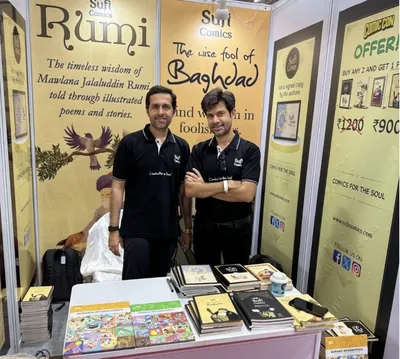
A book stall by Sufi Studio. Photo: By arrangement
Advertisement
New Delhi: Muhammad Ali Vakil grew up in Dubai in the early 1990s, suspended between worlds: learning and internalising Islam at the madrasa, and feverishly reading Tintin, Asterisk and Obelix, and Tinkle at home. When he and his brother moved back to India, in 2009, this duality took form as Sufi Studio – a graphic narrative studio that focuses on narrating stories of Muslim culture. They have since published multiple volumes of Sufi Comics, which chronicle a range of myths and folklore.
Their latest offering,Journey in Grace, is a slight shift from their previous work. The memoir of David L. Sterling, whose parents were holocaust survivors, tells the story of his transition and conversion to Islam: “how can ‘my people’ be the ‘chosen people’ and others somehow lower? After meeting ‘others,’ it seemed arrogant,” wonders the teenage David.
In today’s climes of rampant Islamophobia in India and across the world, the books by Sufi Studio can be read as transgressive, an alternative to much of the literature that is churned out by the mainstream. For Vakil, this is something that has always operated at the back of his mind.
“When you come to India, there is a sense of Islamophobia. When you meet people face to face, they generally seem like good people. But they have these images in their mind about what Islam is and what Muslims are,” he said. “I wanted to tell people about what the faith actually teaches.”
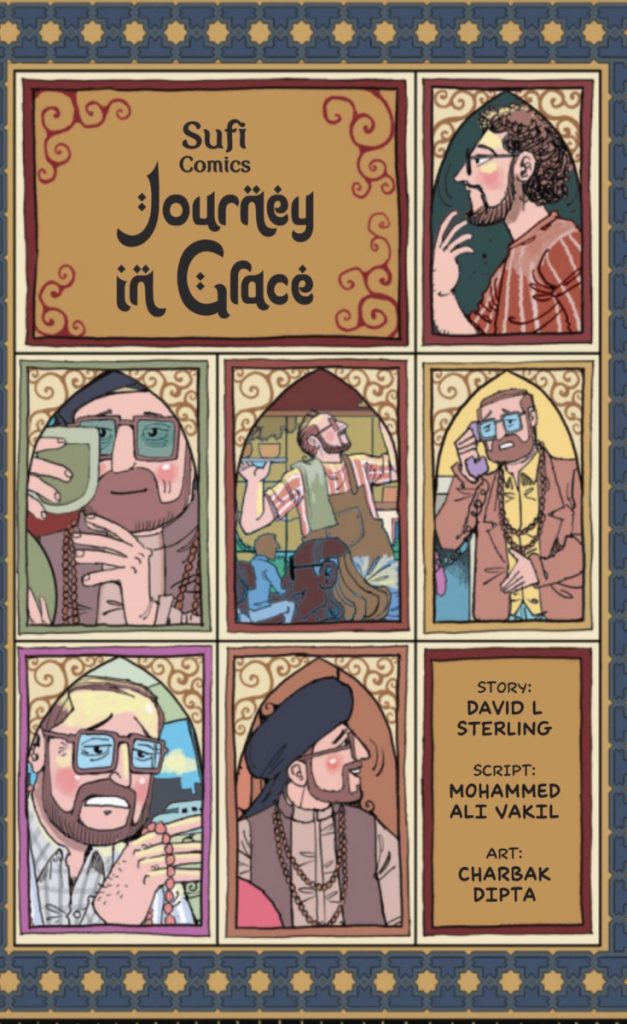
Cover of ‘Sufi Comics: Journey in Grace’
Sufi Studio has amassed popularity and has cemented itself in the comic book universe, both in India and internationally. It is present at various comic book conventions. In 2012, it beat out several legacy comic book studios and became the first Indian publisher to showcase at the San Diego Comic-Con.
While the majority of their distribution is online, Sufi Studio also relies on events. Vakil recalled a father and son duo purchasing a comic. The son, a school-going child, had Muslim friends. But the father was unable to answer any of the child’s questions.
“This is a medium that makes things much more accessible because it’s also seen as entertainment. Your guard is low when you pick up a comic book,” said Vakil.
‘It is its own medium’
Vakil’s first exposure to “Indian culture” was through comics like Tinkle and Amar Chitra Katha. It made him realise graphic narratives, as a medium, are not only entertaining, but can be transformative.
“It tells stories differently. It is its own medium. It does something that books can’t do, and nor can films,” he said.
There is something alluring about the form itself – it allows ideas to flow seamlessly, permitting easy absorption of what is complex. Joe Sacco’s Palestine and Art Spiegelman’s Maus, for instance, give the lives of the Palestinian people and the horrors of the holocaust a rare immediacy.
According to Vakil, the nature of storytelling is such that it allows readers to extract whatever they need. While the books of Sufi Studio were initially touted as being for children, they have found a far wider audience, driven more by theme than form. More adults tend to gravitate towards their comic books on Rumi, he said.
Ultimately, the origins of Sufi Studio lie in Vakil’s childhood, in the stories that flowed from generation to generation.
“They were passed down orally, and of course, through books. But I always imagined them visually,” he said.
This article went live on September nineteenth, two thousand twenty six, at thirteen minutes past eleven in the morning.
The Wire is now on WhatsApp. Follow our channelfor sharp analysis and opinions on the latest developments.

1 Comment
Pingback: 'NASCAR 26' Brings Historic Flare To NASCAR Video Games - Comic Vibe