

Auf dieser Seite
- 1
“MaxFX” in action - 2
Payne to the Max for GPUs - 3
Max Payne RTX & Remake
A dark, melancholic atmosphere, paired with stylized slow-motion gun-fu fights and a classic noir-style revenge story: Max Payne revolutionized the gaming world and remains one of the best story-driven shooters of all time. Twenty-five years ago, Finnish developer Remedy set new standards—not just in terms of graphics, but since we at PCGH are hardware nerds, we’re taking this opportunity to shine a light on the groundbreaking technology of that era.
“MaxFX” in action
When Max Payne was released in July 2001, the world was a different place. Intel was working on its 10-GHz architecture, 64 MiByte of VRAM was considered generous, the iPhone hadn’t been invented yet, and PC gamers were mourning the recent passing of graphics card pioneer 3dfx. It was a time when 1.5-GHz processors with a single “P-core” were the gold standard. Thanks to rapid advances in manufacturing, graphics cards were reaching new performance heights every six months. Instead of just three GPU manufacturers, there were countless companies, all trying to conquer the still-young graphics card market. This arms race went hand in hand with increasingly visually stunning games. There was often talk of “photorealism”—including, of course, in Max Payne, who took the stage in July 2001.
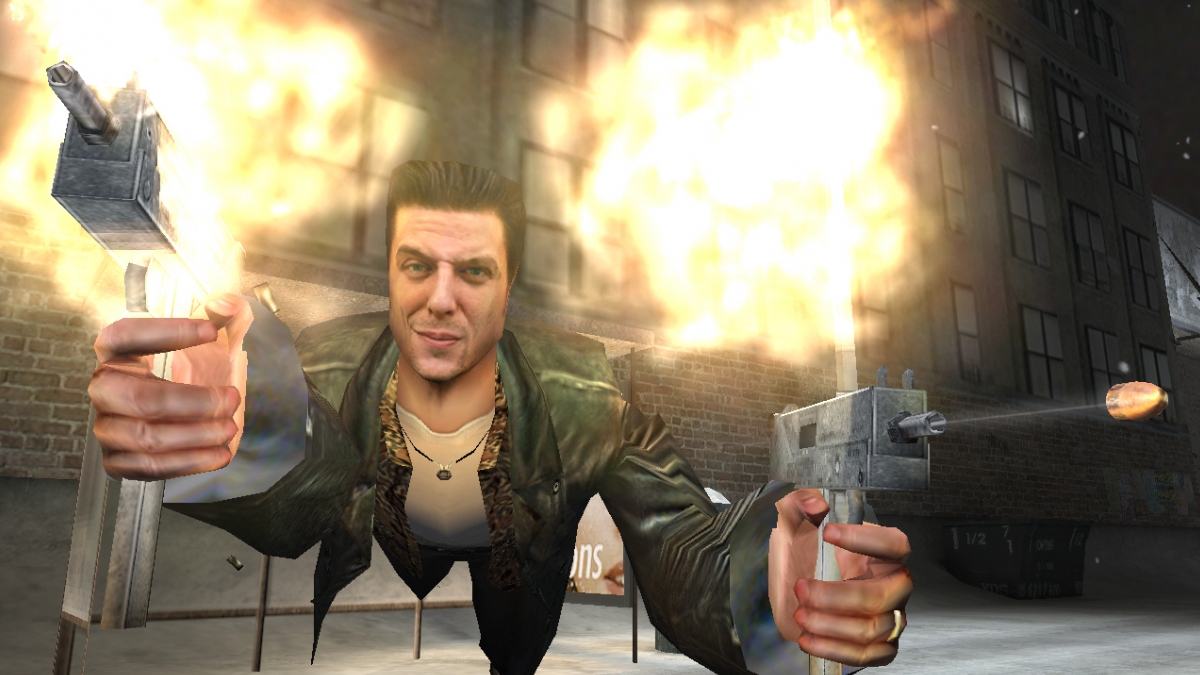
The visual splendor that developer Remedy delivered back then was breathtaking. Polygon count, effects, animations, style: No other game even came close to Max Payne—and there was a fantastic soundtrack that enhanced the ‘noir’ atmosphere even further. The foundation for this was the MaxFX engine, which Remedy had been working on since 1997 and which also powered the first 3DMark benchmarks (including its predecessor, Final Reality). From today’s perspective, the photo-realistic textures—especially the stiff facial expressions—seem dated, but 25 years ago, people thought that graphics couldn’t get much better than that. Contemporary PCs had a tough time because, in addition to staggering polygon counts, they also had to handle high-resolution textures with multiple layers, including detail (‘noise’) textures.
Empfohlener redaktioneller Inhalt[EMBED_URL]An dieser Stelle finden Sie externe Inhalte von
[PLATTFORM].
Zum Schutz Ihrer persönlichen Daten werden externe Einbindungen erst angezeigt, wenn Sie dies durch Klick auf “Alle externen Inhalte laden” bestätigen:Ich bin damit einverstanden, dass mir externe Inhalte angezeigt werden. Damit werden personenbezogene Daten an Drittplattformen übermittelt. Mehr dazu in unserer Datenschutzerklärung.
Externe InhalteMehr dazu in unserer
Datenschutzerklärung.
Payne to the Max for GPUs
Unless you’d invested in a ridiculously expensive Geforce 3 graphics card paired with an Athlon Thunderbird processor, you had no choice but to lower the detail and resolution. While enthusiasts who weren’t bothered by stuttering enjoyed 1,600×1,200 pixels at 32-bit color depth, most players struggled through New York at 1,024×768 in 16 bits (with max-imum detail, of course). Max Payne was one of the first games where a graphics card with hardware T&L—a new type of processing unit that handled polygon calculations and lighting—could make the difference between a smooth experience and a stuttering nightmare. Without this unit, the already overburdened processor had to handle these tasks. 3dfx Voodoo, ATI Rage, PowerVR Kyro, and many other graphics cards thus had significant disadvantages, while ATI Radeon and Nvidia Geforce showed their T&L muscle. Since upsampling hadn’t been invented yet, struggling graphics cards were relieved by lowering the resolution and color depth. The CRT monitors, which were ubiquitous at the time, didn’t just go along with this—they rewarded the effort with higher refresh rates. As we said, those were different times—the golden age of gaming and graphics, some would argue.
We’re celebrating Max Payne’s 25th birthday—to be precise, the guy is already 60—with freshly revamped retro benchmarks. Some of them come from our 3dfx History and Voodoo 5 special, while others are taken from our Voodoo 5 6000 review. The test includes graphics cards from 1999 through 2002, without any CPU limitations getting in the way. We’re showcasing not only Max Payne but also its 2003 sequel, Max Payne 2: The Fall of Max Payne. The latter does not use detail textures anymore and, despite the further refined graphics and physics, delivers fundamentally better performance. If you own Max Payne (1) and would like to replicate these results, we’re testing the venerable Final Scene No. 1 (VGA demo).
As you can see, there’s a significant difference in performance between Max Payne (July 2001) and Max Payne 2 (October 2003). The latter was optimized from the ground up for 32-bit color depth, whereas the first game can still run on 16-bit veterans like the Voodoo 3 (here clocked at an impressive 208 MHz). Apparently, a lot of time was spent optimizing the technology, whereas the first game was primarily designed to look spectacular.
Side note: When Max Payne was released, Nvidia’s Geforce 3 was the fastest graphics card available. ATI’s Radeon 8500 took its place on the throne just a few weeks later (August 2001), while the Geforce 4 Ti-4200 wasn’t available until May 2002. Most graphics cards of that era struggled significantly with Max Payne (1)—especially Voodoo models, for which driver support had already come to a halt by the end of 2000.
Max Payne RTX & Remake
After the controversial third installment, Max Payne took a break. Ten years later, he made a comeback: As Remedy announced on April 6, 2022, the studio is working on a “single-game” remake of Max Payne and Max Payne 2. Although the announcement delighted fans, it also raised concerns, as Rockstar Games—known for the GTA series—is once again involved. A closer read of the press release offers some relief in its wording: Rockstar is only handling publishing (and thus financing)—just as it did with the first two games. The concern stems from Max Payne 3, where Rockstar also handled the game’s development and took a significantly different approach. In that regard, all is well: the remakes of Max Payne and Max Payne 2 are being developed by Remedy and will use their Northlight engine (the successor to “MaxFX”). It’s not yet known when the game will be released, but the latest rumors suggest it might not be too long from now. If you can’t wait, try out one of the new path-tracing mods for the original, which are based on Nvidia’s RTX Remix.
Original PCGH screenshots (July 2001)
- Max Payne serves as a prime example of how powerful GPUs with hardware T&L in the early 2000s accelerated technical progress in PC gaming and quickly pushed older graphics cards to their limits.
- These retro benchmarks provide hardware enthusiasts with a rare performance comparison of historic graphics cards and demonstrate just how significantly optimizations between Max Payne and Max Payne 2 impacted performance.
- Fans of the series are looking forward to the announced remake, which is being developed by Remedy and uses the modern Northlight engine—though a release date has not yet been set.
Max Payne, dearest of all my friends – what do you think? Use the Reddit post to share your thoughts with us! You’re also welcome to follow us on Whatsapp and X for the latest news from the world of hardware and our exclusive content. You can find our video content (often spiced up with a dash of humor) on Youtube , Instagram , and Tiktok .
‘)
.css(‘opacity’, 0)
.html(tip)
.appendTo(‘body’);
self.init();
self.target.on(‘mouseleave’, () => {
console.log(‘mouseleave’);
console.log($(‘#shareDialog’).hasClass(‘is-open’));
if ($(‘#shareDialog’).hasClass(‘is-open’)) {
self.remove();
}
});
self.tooltip.on(‘click’, () => {
self.remove();
});
});
$(window).on(‘resize’, () => {
self.init();
});
}
/**
* @param target
* @param info
* @param timeout
*/
showTemporary(target, info, timeout) {
let self = this;
timeout = timeout || 10;
this.target = target;
let tip = self.textList[info];
if (!tip || tip == ”) {
return false;
}
if (this.tooltip) {
this.tooltip.remove();
}
this.tooltip = $(”)
.css(‘opacity’, 0)
.html(tip)
.appendTo(‘body’);
this.init();
setTimeout(() => {
self.remove();
$(this.target).removeClass(‘active’);
}, timeout * 1000);
}
/**
*
*/
remove() {
if (!this.tooltip) {
return;
}
this.tooltip.animate({
top: ‘-=10’,
opacity: 0
}, 50, function() {
$(this).remove();
});
}
/**
*
*/
init() {
if (!this.tooltip || !this.target) {
return;
}
this.tooltip.addClass(‘dBlk’);
}
}
ctcTooltip = new ctcTooltips();
$(document).on(‘click’, ‘.shareCopy’, function() {
$(this).addClass(‘active’);
copyToClipboardNew($(this));
});
var copyToClipboardNew = function(target) {
var textArea = document.createElement(‘textarea’),
text = target.data(‘text’);
textArea.style.position = ‘fixed’;
textArea.style.top = 0;
textArea.style.left = 0;
textArea.style.width = ‘2em’;
textArea.style.height = ‘2em’;
textArea.style.padding = 0;
textArea.style.border = ‘none’;
textArea.style.outline = ‘none’;
textArea.style.boxShadow = ‘none’;
textArea.style.background = ‘transparent’;
textArea.value = text;
document.body.appendChild(textArea);
textArea.focus();
textArea.select();
try {
var successful = document.execCommand(‘copy’);
if (successful) {
ctcTooltip.showTemporary(target, ‘link_copied’, 2);
} else {
ctcTooltip.showTemporary(target, ‘link_copy_error’);
}
} catch (err) {}
document.body.removeChild(textArea);
};
var closeShareWidget = function(delay) {
setTimeout(function() {
shareDialog.classList.remove(‘is-open’);
}, delay);
}
jQuery(document).on(‘click’, ‘.jsShare’, function() {
shareDialog.classList.add(‘is-open’);
jQuery(document).on(‘click’, ‘#shareDialog’, function() {
if (event.target.nodeName == ‘I’) {
closeShareWidget();
} else {
var container = $(‘.shareWrapper’);
if ((!container.is(event.target) && !container.has(event.target).length) || event.target.nodeName == ‘A’) {
closeShareWidget();
}
}
});
})
