


Marvel Dimensions
Writer/Artist: Alex Ross
Publisher: Abrams Comic Arts
Publication Date: September 2026
The Marvel Arts line from Abrams has proven to be a rather idiosyncratic publishing initiative from a major book publisher. This is a line that released last year’s heavily meta Avengers adventure from Chip Kidd and Michael Cho, and a history of superheroes from Muttscreator Patrick McDonnell. Even Alex Ross, known for his classical depictions of superheroes as vanguards of decency, felt free to wildly experiment with his Fantastic Four: Full Circle graphic novel. Now he returns with Marvel Dimensions which sees the artist continue to play with form even if he gets lost in his story.
The work of Alex Ross is a story in the contradictions of being a comics fan and being an artist. Ross, the comics fan, is a staunch traditionalist. Someone who gets hired to depict heroes at their most iconic for variant covers or who paints over George Perez’s pencils for the cover of Crisis on Infinite Earths.A guy who used Hal Jordan and Barry Allen as Green Lantern and Flash in stories when others occupied those roles at the time.
But Ross the artist is a different story. Look at the recent run of covers he contributed for The Mortal Thor or the first volume of Ryan North’s Fantastic Four run. He still renders figures in his signature photo realism but utilizes highly stylized color palettes and weird compositions. Even Kingdom Comefor all of it’s debts to Crisis on Infinite Earths with Ross packing in as many characters Looking at these covers, there’s a sense Ross wants more opportunities to stretch out artistically.
Thankfully, that’s where Marvel Arts comes into the picture. Ross’ first work for the Marvel Arts line, Fantastic Four: Full Circle, read like the perfect combination of both Ross as a comics fan and Ross as an artist. He paid homage to a classic Fantastic Four story while also pushing himself to see how he could bring new visual ideas to Fantastic Four staples like The Negative Zone.
WithMarvel Dimensions, Ross the traditionalist spins a story that introduces the Marvel version of DC’s Earth 3. For anyone not well versed in the various alternate worlds that make up DC continuity, evil counterparts of familiar DC heroes occupy this Earth. The villains always win while their antagonist heroes always lose.
So Ross creates a universe of evil Marvel heroes who are now determined to conquer the multiverse. As fun as it is to see corrupted versions of Marvel heroes, it doesn’t work. DC’s heroes at their core can exist as flawless paragons so it makes sense they would have ethical opposites. Marvel heroes though are flawed individuals. Characters like Wolverine or Spider-Man who do their best but can fail in a moment of heroism. Heroes whose villains are often their reflections, ie Mr. Fantastic and Dr. Doom. Marvel heroes always walk a line where they could potentially fall into darkness. So a universe where Marvel heroes are the villains isn’t much more than a fun idea. Ross doesn’t really explore the idea of evil here or to question the idea of what is heroism.
Really though it doesn’t work because series like The Boys and The Authority exist. How many series over the last three decades use thinly veiled analogues of Marvel (and DC) heroes and push the boundaries of good taste to show how “evil” superheroes can be? Even The Ultimates by Mark Millar and Bryan Hitch took familiar Marvel heroes and turned them into darker tools of a post 9/11 America. Ross’ ideas of “evil” versions of The Avengers and Fantastic Four, rooted in Silver Age ideas of heroism, now look a little quaint compared to actual fascist superheroes.
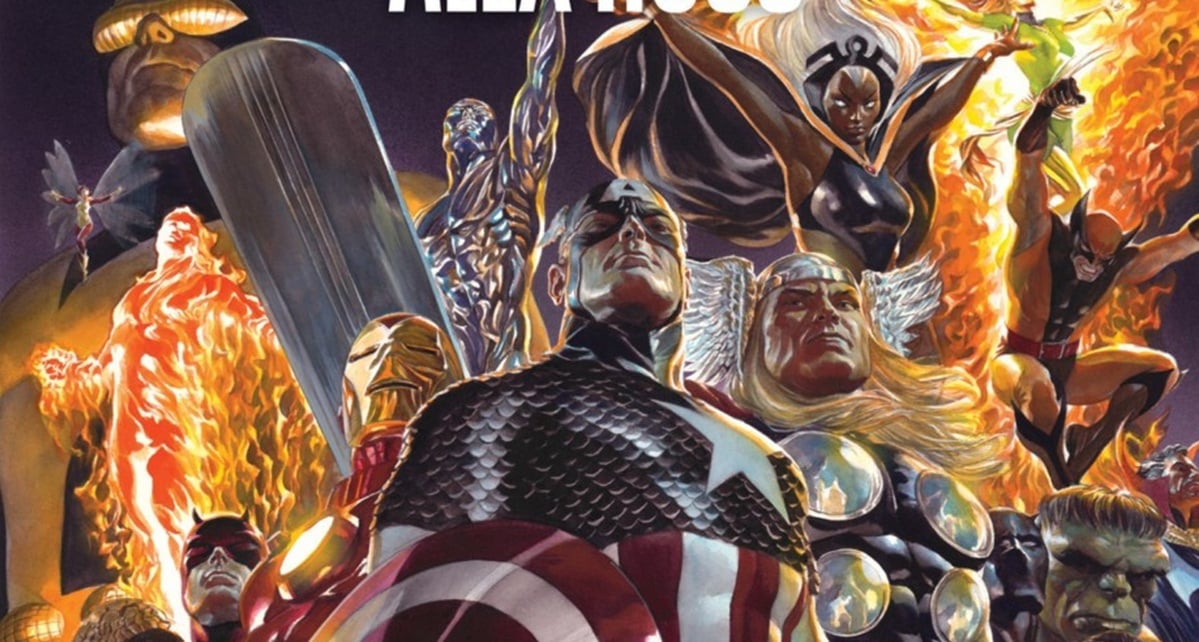
Yet Ross the artist continues to push his ideas of how to use the comics form. He fills the first half with double page spreads with portraits and montages of familiar Marvel heroes with accompanying narration about their origins.Then things get interesting when the book shifts into the meat of the story. He relays the history of Marvel’s villain universe with a 32 page comic stapled into the middle of the book. This choice seems inspired by his pal Chris Ware and their exploration of the physical object of a comic as storytelling device.
He fills the second half with the kind of things that made him a megastar. He fills this section with action and page layouts clearly inspired by Ross’ heroes George Perez. Ross hasn’t drawn and painted this kind of massive action scene with multiple characters, most of whom feature entirely new designs, since maybe Kingdom Come. There remains a thrill in seeing him work his particular magic once again this time with the funky color schemes he’s been utilizing more recently.
Still as much as Ross the artist continues to push himself, Ross the traditionalist remains in the story here to its detriment. Marvel Dimensionsshows an artist at war with himself. An artist clearly not at a loss for ideas on how to use the comics art form. But certainly an artist whose conservative views on the superhero genre look outdated in comparison to some of the more contemporary ideas of peers.
Read more reviews from The Beat!
