

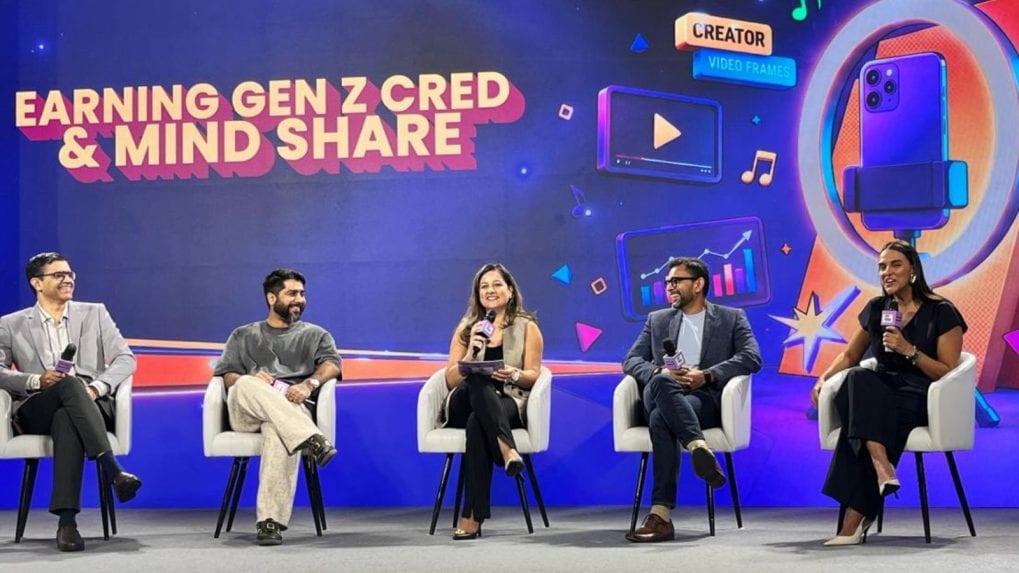
At the Storyboard18 Global GenZ Summit 2026, leaders from JioStar, Superkicks, Plum and entrepreneur Neha Dhupia
The battle for Gen Z attention is increasingly shifting from simply being present on the right platform to creating enough cultural relevance for consumers to stay, participate and advocate. At the Storyboard18 Global GenZ Summit 2026, a panel featuring Alok Jain, Head – Hindi & English Entertainment (Streaming, TV & Studios), JioStar; actor and entrepreneur Neha Dhupia; Sangeet Paryani, CEO & Founder, Superkicks; and Shankar Prasad, Founder & CEO, Plum, moderated by Sakshi Dhingra, Assistant Editor, Storyboard18, examined how brands and entertainment businesses are navigating a generation with unprecedented choice.
The discussion, titled “From Sleep to Success – Scaling a Legacy Brand in the D2C Age”, brought together perspectives from entertainment, fashion and sneakers, beauty and entrepreneurship to examine a common challenge: how to remain culturally relevant when consumer behaviour, platforms and conversations are changing continuously.
For Jain, the fundamental shift is that attention itself is no longer the primary constraint. “Attention is not the problem statement. I think the problem statement is how to build fandom,” he said.
The distinction is significant for an entertainment business operating across an increasingly fragmented media environment. Jain said JioStar views its competition not simply as another media company but as “time”, because consumer behaviour changes as audiences move through different stages of life. The response, he explained, is to accept and adapt to those changes rather than resist them.
JioStar reaches “almost around 80-90 crore people” on a weekly basis across its different offerings. But scale alone does not guarantee loyalty. The company is therefore looking to expand the “surface area” of its content, making it available across television, digital, connected TV, mobile, social platforms, music services and live experiences
The approach was illustrated through the example of Hustle, for which the ambition is to extend the property beyond a single screen or format. Jain pointed to Spotify, social media, live experiences, television and digital platforms as parts of that broader ecosystem.
The same principle applies to established entertainment franchises. Jain cited Roadies, which is heading into its 21st season, as an example of how a long-running property can retain its core identity while adapting to changing audience behaviour. “Fandom also means that you are something for some people, everything for some people, not something for everyone,” he said.
Dhupia’s experience across acting, entrepreneurship, social media and television offered another perspective on the same challenge. She said the expansion of her professional identity has been driven by the recognition that audiences increasingly want to see different facets of a person rather than a single, fixed identity.
“I think you have to keep evolving all the time, but never forget where you actually come from,” Dhupia said.
Her entrepreneurial portfolio includes Black Carrot, a brand focused on bone-free and lead-free crockery and cutlery; a period chocolate being developed as a cramp-relief product; the parenting community Free To Feed; and GoFloRuns, a women-focused running initiative. She also continues to work in entertainment, including on Roadies.
For Dhupia, the common thread across these activities is not trying to manufacture a persona for a particular audience. Instead, she said authenticity needs to remain consistent even as the platforms, formats and professional roles change.
That becomes particularly important when influencers and public personalities are also acting as brand-building channels. Dhupia said she evaluates potential associations partly through whether she would personally consume or use the product. She also highlighted the risk attached to consumer feedback, saying brands and personalities need to be cautious because a negative consumer response can quickly gain visibility through social platforms.
She cited categories such as fat burners and similar products as areas she would not endorse because she would not consume them herself. “You have to be very careful,” she said, pointing to the consequences of consumer feedback, trolling and negative reactions in an environment where content travels rapidly.
The panel’s conversation around community-building was particularly relevant to Superkicks, where Paryani described community as the foundation of the business rather than a marketing layer added later.
Superkicks began in 2018 with a focus on sneakers and a broader culture encompassing football, basketball, running and skateboarding. Paryani said the company’s early strategy involved acquisitions, events, store experiences and other initiatives designed to create a sense of belonging around sneaker culture.
As the business evolved, its cultural focus expanded towards music and the Indian hip-hop scene. The shift reflected the changing context of the community rather than a departure from the original objective of building one.
Paryani also cited a recent Superkicks collaboration with Adidas around a Samba, which he said sold out within 24 hours, despite his expectation that it would take considerably longer to sell through. While he attributed part of the response to the product’s design, he also linked the result to years of community-building.
The lesson from Superkicks intersects with Prasad’s experience at Plum, although the categories are markedly different. Plum has been operating for 13 years, with Prasad describing the brand as having entered its 14th year as an entrepreneur and recently turning 12 as a brand.
For a skincare and beauty business, Prasad said the underlying consumer requirement remains trust, even as the language used to communicate with consumers changes.
“The more things change, the more they stay the same,” Prasad said, arguing that while the way Plum communicates needs to evolve frequently, the core of what the brand stands for cannot constantly change.
That tension between consistency and reinvention is increasingly relevant to legacy and established brands attempting to remain credible with younger consumers. Prasad said brands cannot afford to remain static for long, with the “how” of communication needing to evolve almost continuously while the underlying identity remains intact.
The discussion also challenged the assumption that Gen Z’s digital behaviour means physical retail is losing relevance. Prasad said Plum moved to an omnichannel model in 2017 and that the experience of COVID reinforced rather than diminished the importance of physical retail. He pointed to the continued relevance of the corner shop, modern trade and malls alongside online shopping.
“I’m very, very optimistic about physical trade,” he said, adding that even developed economies have not seen e-commerce move beyond roughly 50-60%, leaving a significant role for physical retail.
Paryani similarly said the headroom for Superkicks’ growth is offline. The business started with physical stores in Bengaluru and Mumbai in 2018 and moved online in 2020 as the pandemic forced a change in how consumers could be served.
The broader picture emerging from the panel is one where the media-to-commerce journey is no longer linear. Entertainment properties need to travel across platforms; creators increasingly operate across professional identities; consumer brands are building communities around culture rather than only products; and omnichannel strategies are becoming relevant even for digitally native audiences.
For Gen Z, the panelists argued that the opportunity is not simply to find another platform on which to place a message. It is to create multiple points of interaction while retaining a recognisable identity. Whether that identity is a long-running entertainment franchise such as Roadies, a sneaker community, a beauty brand built around trust or an entrepreneur’s personal voice, the challenge remains consistent: adapt to changing behaviour without manufacturing a new identity for every new platform.
As Jain put it, the objective is to increase the number of places where a brand or property can exist. But the conversation made clear that presence alone is not the end goal. The larger shift is towards creating the conditions in which audiences have enough reasons to return, participate and form a relationship with what they are consuming.
Follow Storyboard18 on Google for the latest and breaking advertising news and industry updates, along with in-depth coverage of digital media and agency news. Stay informed with the latest perspectives only on Storyboard18.
Tags
First Published on September 3, 2026, 08:25:08 IST
