

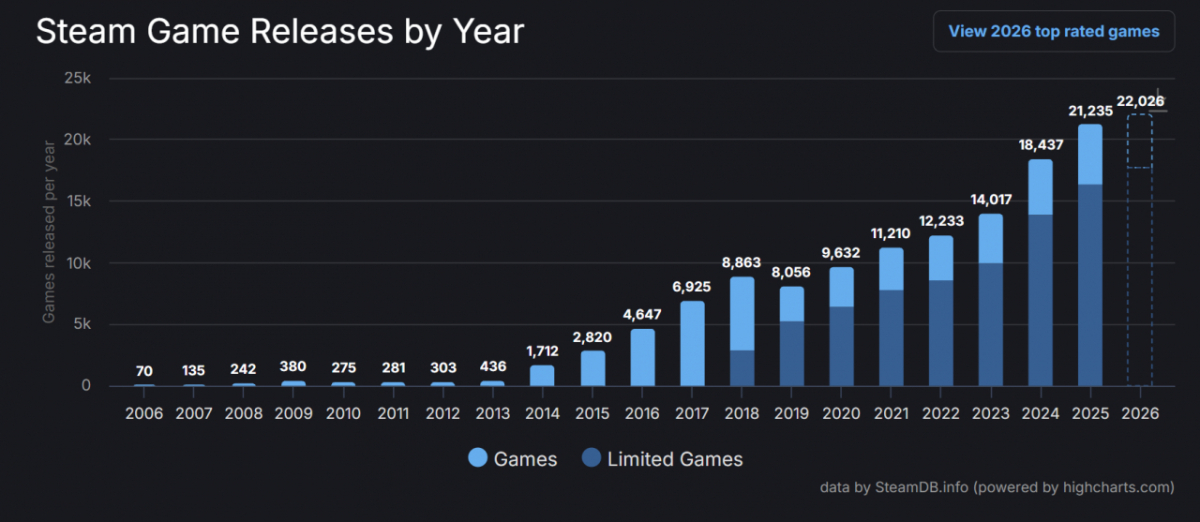
The gaming industry is abuzz over AI coding agents. As game development has become easier, the number of new releases has surged significantly, and it has also become easy to replicate similar games. Some have raised concerns about copyright infringement due to the destruction of the indie game ecosystem and the unauthorized appropriation of ideas.
On the 24th, the gaming industry is buzzing over “Steam Next Fest,” a free demo festival running until the 26th of this month. According to Steam database (DB) tallies, 2,595 out of 7,145 titles are games made with AI. A survey by a Steam analytics firm found that among the approximately 50,000 games released on Steam from 2023 to mid-this-year, the proportion of games labeled as AI-made rose to 10.9% in 2024, 19.9% last year, and 30.8% this year.
As new titles have proliferated like mushrooms after rain, the gaming industry has been gripped by fear. In particular, low-budget, small-scale indie game companies worry that their games will be buried by another new release immediately upon launch. While major game companies can burn through marketing budgets to promote across multiple channels, it is difficult for indie studios to do so. AI has thus become both a new weapon and a new enemy for small game companies.
The issue of plagiarism is also a source of fear. As the barrier to entry in game development has lowered, popular games are being copied and released via what is called “AI click.” Posts already appear on game developer communities claiming that their ideas have been plagiarized. This is a problem not only for indie game companies whose performance hinges on a single title, but also for major game companies, as it could be fatal if a game is released that directly copies a version they put out for pre-launch testing.
The gaming industry argues that platform responsibility should be strengthened. This includes banning indiscriminate AI use or separately managing games created with AI. While Steam currently mandates labeling of AI usage, voices are emerging in internet communities calling for the revival of the Greenlight system, which was abolished in 2017. This refers to a method where release decisions are made through user voting and feedback.
Meanwhile, opinions also emerge that view this phenomenon as a simple fad and not something to worry about greatly. The argument is that it is merely a temporary phenomenon arising from the AI development boom, and that properly made games will ultimately survive. They cite the gaming industry’s negative perception of AI as evidence. Domestic gamers harbor an aversion to AI, and according to a survey of 2,300 people at this year’s GDC (Game Developers Conference), 52% of respondents answered that AI has had a negative impact. In Western countries, it is known that resistance to AI is very strong due to job losses caused by AI.
The gaming industry predicts that once the flood of AI games passes, only fun games will remain in the end. It notes that when one game does well, similar games have always appeared in droves, and this is still a common occurrence today; it is just that the speed has increased. Analysts suggest that if users who are wary of AI naturally distinguish “AI Slop” games, the value of truly creative and fun games will increase further.
Changes brought about by AI cannot be rejected. While it is important to protect the ecosystem built thus far, building competitiveness in preparation for the approaching future is even more important.
