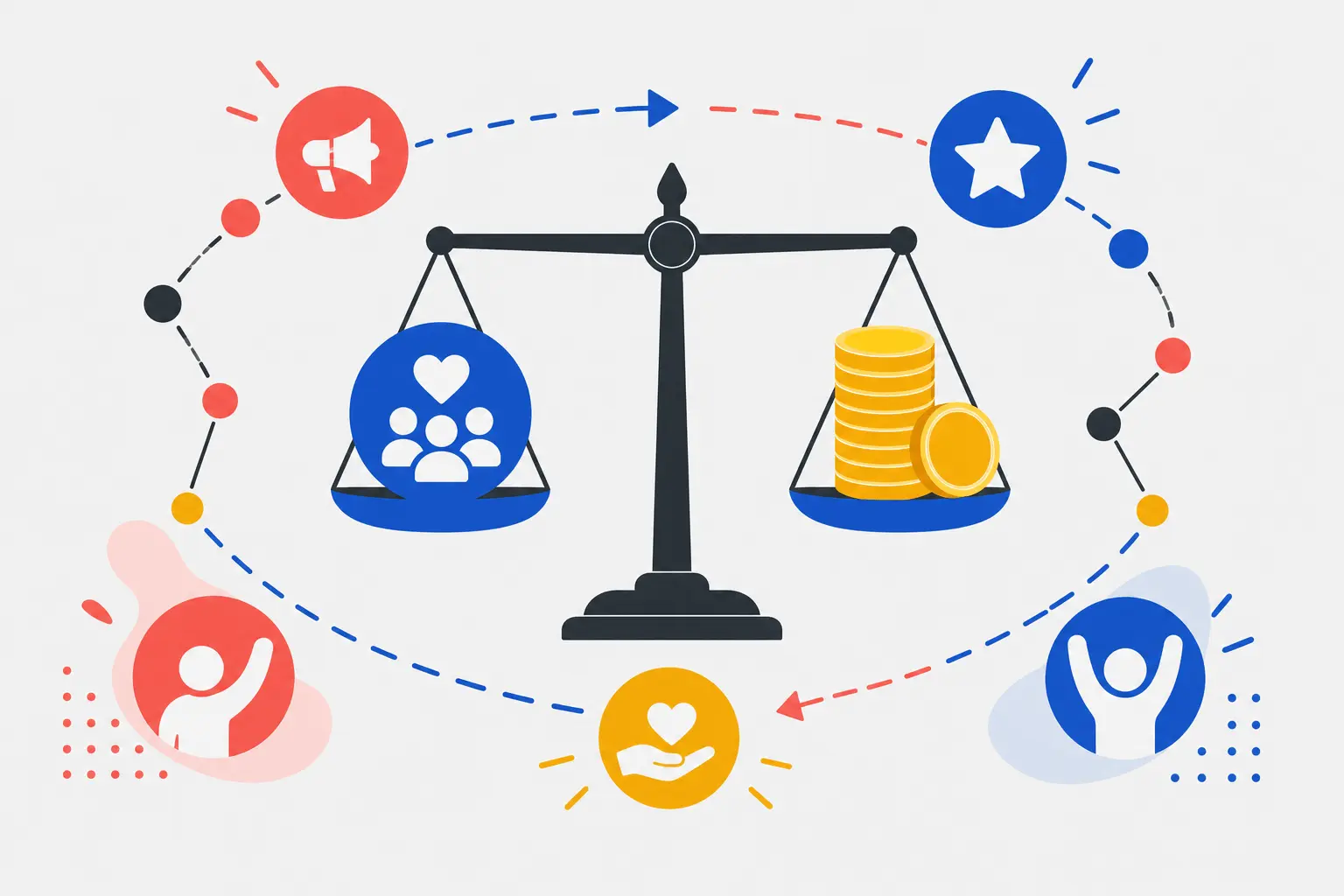
Fandom marketing is usually approved as a campaign and judged like media. That accounting choice makes the investment look expensive at the exact moment it starts becoming valuable.
A fan partnership can produce immediate sales, but its harder commercial work happens across a longer horizon. People collect, create, return, recruit others, and identify themselves through the experience. A last-click dashboard recognizes the transaction and discards most of the behavior that made the next transaction more likely.
The answer is not a softer set of engagement metrics. Marketing leaders need a finance-defensible model that separates temporary attention from durable fan assets, then tracks whether those assets compound after the launch window closes.
Table of contents
Why campaign ROI undervalues fandom
Traditional campaign measurement assumes a relatively clean exchange. A brand buys distribution, attracts attention, and tries to convert that attention before it decays. Fandom behaves differently because the audience already has a relationship with the person, story, game, team, or cultural object at the center of the campaign.
The brand is entering an existing system of identity and ritual. It can add value to that system, extract value from it, or damage the relationship by treating fans as an unusually responsive media segment.
Deloitte’s 2026 Digital Media Trends survey of 3,575 US consumers found that 49% of fans said the time and money they devote to fandom had remained consistent across different phases of life. Thirty percent had bought fandom merchandise in the previous six months. Those findings make a one-quarter return window look less like discipline and more like a measurement mismatch.
Short windows also reward the most extractive mechanics. A discount, a scarce product drop, or a heavy retargeting sequence can produce a visible spike. It may say little about whether the brand earned permission to participate again.
The recent Molly Tea collaboration with Wang Sulong shows the other side of scarcity. Fast sellouts created proof of demand, but resale backlash exposed how quickly a collectible can turn fan energy into frustration. Revenue arrived; relationship quality became harder to read.
Campaign ROI measures what the launch harvested, not what the brand left alive.
Fandom compounds through participation
Fandom becomes commercially interesting when people do more than receive a message. They make playlists, trade objects, remix creative, organize check-ins, play inside an IP world, and bring new participants into the community.
A 2025 study from Fandom and Carat surveyed 1,500 US entertainment and gaming fans and found that 87% participated in activities connected to their fandoms. The headline is not simply that fans are active. It is that fan behavior produces observable steps between exposure and purchase that ordinary reach metrics compress into one vague engagement rate.
That participation can travel across environments. The Spider-Man: Brand New Day partner ecosystem stretched through film placement, retail products, live experiences, and playable game integrations. Each surface gave fans a different way to act, which also means each surface should have had a distinct job in the measurement plan.
Spotify offers a useful example of a platform measuring action rather than mere exposure. During a major football tournament, the company reported a 235% global increase in related playlist creation. That is a platform-reported directional signal, not proof of incremental brand revenue. It still reveals something an impression count cannot: fans were extending the event into a repeatable behavior on their own time.
Physical collectibles can play the same role. Coca-Cola’s V merchandise activation in the Philippines linked purchases and receipts to redemption, giving the brand a trail from participation to repeat buying. The valuable design choice was not celebrity visibility alone. It was a mechanic that made continued action measurable.
The asset is not attention borrowed from an IP owner; it is the behavior the brand earns after attention arrives.
A better measurement model for fan value
Fandom lifetime value should be treated as a cohort model, not a single composite score. Start by defining the behavior that qualifies someone as a participating fan in the campaign context. A playlist creation, redemption, repeat visit, user-created post, event check-in, or opt-in may qualify. A video view usually should not.
Then compare participating fans with a matched non-participating audience over a period long enough to capture repeat behavior. The model should connect four layers without pretending they are interchangeable.
- Acquisition value tracks the incremental margin from the first purchase or conversion, net of rights, media, production, and incentive costs.
- Participation value tracks meaningful actions such as creations, saves, redemptions, referrals, or return visits. These are leading indicators until they demonstrate a relationship with commercial outcomes.
- Retention value measures repeat purchase, reactivation, subscription continuity, or reduced churn against an appropriate control or baseline.
- Relationship value measures permissioned audience growth and the share of participants the brand can reach directly after the partner media disappears.
The finance version of the model is deliberately conservative. Count incremental contribution margin. Add observed repeat margin and measurable referral value. Subtract rights fees, production, incentives, community operations, and expected risk costs. Keep earned distribution as a separate evidence line unless a defensible replacement-cost method and quality threshold exist.
Deloitte found that merchandise buying rose from 30% of fans overall to 37% among fans who wanted their fandom content aggregated in one place. That does not prove aggregation caused spending. It does suggest that connected fan experiences and commercial behavior belong in the same analysis, with causality tested rather than assumed.
This structure also prevents participation metrics from becoming decorative. If saves and creations rise while repeat behavior and direct audience access remain flat, the program generated activity but did not build a durable asset. If sales rise while sentiment, return participation, or permissioned reach falls, the launch may have monetized the community faster than it strengthened it.
A fandom dashboard becomes credible when every soft signal is either linked to future cash flow or clearly labeled as an unproven leading indicator.
The budget question is who owns the relationship
Most fandom proposals focus on the size of the borrowed audience. Finance should focus on what remains when the licensing period, creator contract, media support, or cultural moment ends.
An IP owner may retain the community. A platform may retain the behavioral data. A retailer may retain the transaction history. The brand can finish the campaign with strong reported reach and no practical way to recognize, serve, or learn from the people it paid to engage.
That ownership question changes budget allocation. Programs deserve a premium when they create repeatable mechanics, permissioned relationships, and observable movement from participation to margin. They deserve tighter limits when the brand is paying mainly for a temporary association whose audience data and future access stay elsewhere.
The strongest fandom investments do not need every interaction to convert immediately. They do need a clear theory of how fan action becomes a brand-owned advantage over time.
Without that ownership, fandom marketing is rented attention with unusually persuasive reporting.
This article is created by AI with human assistance, powered by ContentGrow. Ready to automate your content marketing? Book a discovery call today.
Thanks for booking a call with ContentGrow. We provide scalable and tailored content creation services for B2B brands and publishers worldwide.Let’s chat a bit about your content needs and see if ContentGrow is the right solution for you!IMPORTANT: To confirm a meeting, we need you to provide your

Calendly