

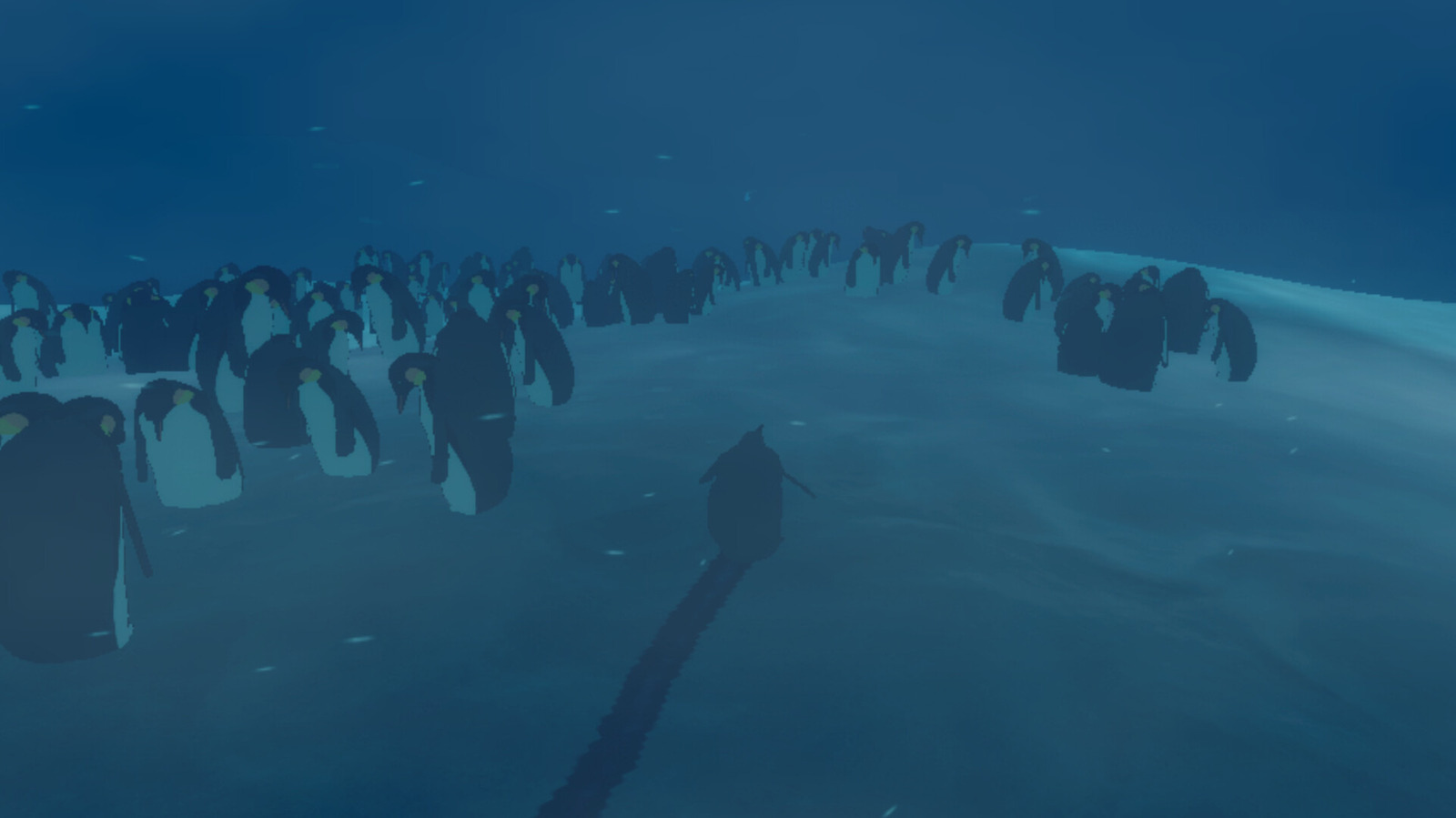
Engadget Indie Pitch: Penguin Colony
“You won’t know until you do and then it is too late.”
By Jessica CondittJuly 11, 2026 8:30 am EST
There are so many rad and important games coming out from smaller studios all the time, and the Engadget Indie Pitch is here to highlight some that you simply must see
We’ve been around long enough to remember the days when Steam was curated by hand, with 20 or so titles added to the storefront in any given month. Today, roughly 2,000 games go live every month on Steam, and that’s not counting all of the console, mobile and VR titles we have to consider. A vast majority of these games come from smaller teams, solo creators, artist collectives and independent studios who don’t have immediate access to shiny showcases or marketing teams — which brings us to the Indie Pitch. We can’t cover every excellent new game here, but we can offer a curated slice of indie pie every now and then.
The Engadget Indie Pitch features a Q&A with the developer of an in-production or recently released game that’s caught our eye. Today, it’s a chat with ORIGAME DIGITAL founder Naphtali Faulkner about their next project, Penguin Colony — a Lovecraftian horror story that highlights the similarities between cosmic and colonial indifference, as witnessed by a waddling Antarctic penguin. It’s ORIGAME’s second title, following the award-winning dystopian photography sim Umurangi Generation, which landed in 2020.
Here’s to your backlog
Penguin Colony by ORIGAME DIGITAL
What is Penguin Colony about?
It is a sincere attempt to bring into existence a Lovecraft renaissance. The game harkens back to the PS2 era of games which were experimental and weird. It’s been difficult to explain to people what the game is without them just playing it. There is some genre bending and direct homage to things which to me encapsulate Lovecraftian horror, but also new elements which are my own.
The central idea is to examine and re-evaluate themes present throughout all the works: The game is about the inherent colonial themes (Invasion, Annexation, Indifference, etc.) of Lovecraft, and the author’s problematic history of racism and pseudo-science. We read not only Lovecraft’s fictional works but also his political reading in The Conservative. Some may say you can separate the art from the artist — but with Lovecraft is it really a surprise that an author who popularized the “fear of the unknown” was a xenophobe? Rather than re-interpreting Lovecraft into something it isn’t, we want to go back to the past which informed the writing and examine these themes.
There is a tendency in Lovecraft adaptations to do historical negationism to make them palatable to today’s audiences, because the assumption is that the narrators are the protagonists. For our game Penguin Colony, the Penguin is a neutral vessel for the story but the narrator isn’t — we learn about the expedition through the perspective of a man who is complicit and unaware of the point of history he belongs in. We then see a dueling perspective from the Kaitiaki, which presents a different history which has been passed down for generations.
How big is the development team?
It is a mostly solo project with additional contractors and guest art made up mostly of Indigenous people
How long have you been working on it?
Two years full-time
What’s the origin story ofPenguin Colony?
The original sketch for Penguin Colony was created after watching Happy Feet with my daughter. The concept of letting players slide around on the ice was very appealing
ORIGAME DIGITAL
Why reinterpret Lovecraft at all? Talk about your goal to reframe weird fiction through the lens of indigenous storytelling
Lovecraft has cultural osmosis which has reached a point where characters like Cthulhu appear in children’s shows. This creature of unknowable cruelty reduced to a cute easter egg for dads to smirk at. The stories themselves are vaguely known about, but often never go past gills and tentacles. The concepts of madness and insanity rarely scrape the surface.
Ten years ago I played Bloodborne and had a realization of what the genre could be. At the time I was learning rapidly what colonization was, where it came from and how it was orchestrated. I sounded insane to some people — a raving lunatic. I learnt a history not taught in schools and the true intentions of all empires. It made me think about how cosmic indifference felt similar to colonial indifference. How the colonial empires would destroy centuries of human knowledge without any concern. The old ones in the Lovecraft mythos would conspire to destroy or enslave the humans with little care about the humans. They would do so through blunt force, religious ceremony and cruelty. Lovecraft unknowingly captured the horror of colonization and the indifference of empire.
When we hear about the non-white characters in Lovecraft, they are usually cultists worshiping blood magic and crescent moons. To me, this made me think of how British explorers made presumptions about Indigenous medicine practices. Before the Europeans understood sanitation, they saw Māori funeral rights as primitive spiritual affairs, not realizing that washing the body in a river — or not using one’s hands to eat while touching a corpse — were done so to prevent disease.
Let’s presume that the stories in Lovecraft were real. Would the non-white people know more about these creatures than the Europeans who learnt about them last week? What if, just like those Europeans who observed our culture and got it wrong, the Lovecraft protagonist did as well?
ORIGAME DIGITAL
What lessons fromUmurangi Generationare you applying to your current development process?
We learnt with Umurangi the big thing is to move on quickly. To plan ahead. We spent too much time porting the game and this gave us not enough time to focus on what we wanted to do next. Our project we tried juggling was about the Biden era of complacency. Well, that went too quick to be relevant.
With Penguin Colony we have set up a trilogy of games which will borrow the deities and lore of the Lovecraft mythos. We want to explore these concepts which don’t seem to be going anywhere quickly. The second game in this trilogy explores the decay of small towns and the secrets hidden just down the road, behind a closed door.
We wanted to start things off slow in this trilogy and not go to comfortably recognizable places. No Cthulhu. No Dagon
Why are video games your chosen form of expression?
Video games are the greatest art form mankind has ever known. There is no dispute to anyone who has done multiple art forms. Video games are the only art form where participation in the artwork is compulsory.
Film had a similar trajectory to games in its struggle to gain artistic legitimacy. Film was known as the 6th great art form. Games are known as the 10th great art form and must never lose sight of this inevitable acceptance. We should not make games safely with the times, but always push the medium forward like those films did 50-70 years ago
ORIGAME DIGITAL
What’s the biggest roadblock you’ve faced as a smaller developer?
As a small studio we are seen as risky. As an Indigenous studio we are seen as even riskier. As an Indigenous studio doing works which reflect contemporary political realities we are seen as far too risky for anyone. For this reason we’ve realized that doors don’t stay open for long. That opportunities have to be taken. True indie sustainability is having your studio comfortably set up where you can make art indefinitely. That you understand how to distribute your games and get them in front of an audience. That your works can stand on their own two feet.
What can larger companies and publishers do to better support developers like yourself?
Larger companies who can take risk should actually do it. I am not a moron, I know why the shareholder value is all they are looking at. But if these larger studios want to survive into the future, they must look at the history of film and realize that film only survived because of its risk. Larger companies should spin up risky smaller studios where they hire two to four non-first-time indies to experiment — treat it like an art residency. They should go look who was on the runner-up list for every indie awards show and send them a DM. Give them a one to two year window of time to make something for 10 percent of the budget of one of the big AAA games, and then sell this with the vast resources and distribution available.
This is all wishful thinking, they won’t do any of this. I have no faith that the mostly American AAA games industry is capable of learning anything
Let’s bring it back home. SellPenguin Colonyin one sentence:
You won’t know until you do and then it is too late
ORIGAME DIGITAL
Penguin Colony is coming to PC and Switch 2 in 2026, developed by ORIGAME DIGITAL and It’s available to wishlist on Steam now
