

Download PDF
Abstract
Traditional flipped classrooms often fail to sustain young EFL learners’ engagement due to passive pre-class tasks and high self-regulation demands. While Artificial Intelligence (AI) and Virtual Reality (VR) offer potential solutions, their combined impact and the moderating role of technological literacy in primary education remain underexplored. Grounded in Self-Determination Theory and Self-Regulated Learning theory, this study examined the comparative effects of an integrated AI–VR enhanced flipped classroom on English achievement, metacognitive self-regulation (MSR), and learning motivation, and whether AI–VR technological literacy moderated these effects. Using a quasi-experimental pretest–posttest control-group design, 60 fifth-grade Chinese EFL learners were assigned to either an AI–VR enhanced flipped classroom (n = 30) or a traditional video-based flipped model (n = 30). The same instructor delivered both conditions under a fully scripted protocol, with structured classroom observations confirming fidelity. ANCOVA revealed a robust effect on achievement ((upeta_{{text{p}}}^{2}) = 0.252, Hedges’ g = 0.96, 95% CI [0.43, 1.49]; surviving Holm–Bonferroni adjustment), and smaller, preliminary effects on MSR ((upeta_{{text{p}}}^{2}) = 0.082, g = 0.46, 95% CI [− 0.05, 0.96]) and motivation ((upeta_{{text{p}}}^{2}) = 0.072, g = 0.53, 95% CI [0.02, 1.04]) that did not survive multiple-comparison adjustment. Critically, technological literacy moderated all three outcomes (all moderation effects robust under adjustment), with intervention benefits concentrated among higher-literacy learners; bootstrap confidence intervals indicated that precise Johnson–Neyman thresholds were not reliably estimated, so moderation is reported as directional. The findings suggest that AI–VR enhanced flipped instruction is conditional rather than universal: strongest gains accrue to achievement, while affective and metacognitive benefits depend on learners’ technological literacy.
Acknowledgements
The authors thank all team members for their dedicated effort throughout the study
Authors and Affiliations
-
Centre for Instructional Technology and Multimedia, Universiti Sains Malaysia, Gelugor, Penang, Malaysia
Jiawei Shao
-
School of Educational Studies, Universiti Sains Malaysia, Gelugor, Penang, Malaysia
Shupeng Tang
-
Universiti Sains Malaysia/School of Humanities, Gelugor, Malaysia
Jinming Ju
Authors
- Jiawei ShaoView author publications
Search author on:PubMed Google Scholar
- Shupeng TangView author publications
Search author on:PubMed Google Scholar
- Jinming JuView author publications
Search author on:PubMed Google Scholar
Ethics declarations
Competing interests
The authors declare no competing interests
Ethics approval and informed consent
All studies involving human participants were reviewed and approved by the Ethics Committee of the School of Design, Anhui University of Engineering, and strictly adhered to the ethical principles of the Declaration of Helsinki. All participants provided informed consent prior to formal participation in this study
Consent for publication
Consent for publication was obtained from the participants
Additional information
Publisher’s note
Springer Nature remains neutral with regard to jurisdictional claims in published maps and institutional affiliations
Appendix 1: Detailed design and development of the AI–VR learning application
Appendix 1: Detailed design and development of the AI–VR learning application
SDT-based motivational design
To support the psychological needs emphasized by SDT—namely autonomy, competence, and relatedness—the study implemented multiple design features to facilitate the internalization of learning motivation
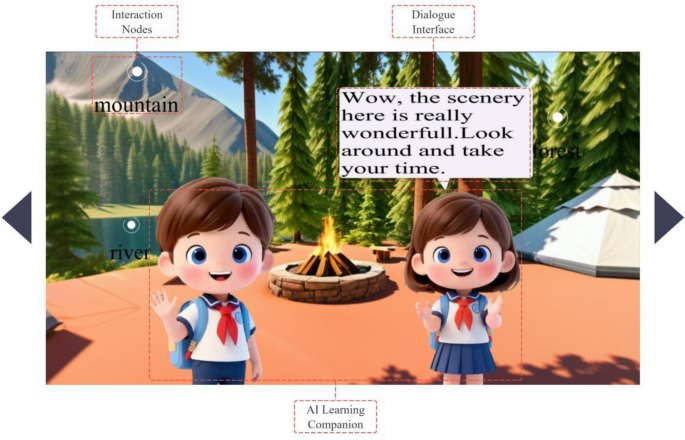
Regarding autonomy support, the system employs open-ended 3D scenarios that empower students to independently choose exploration sequences, task triggering timing, and interaction paths. Simultaneously, the use of non-immersive VR mitigates the physical burden and operational complexity associated with wearable devices, enabling students to control their learning pace with a lower cognitive load (see Fig. 7)
Overview of the AI–VR learning environment and interaction flow
In terms of competence support, the system adheres to principles of scaffolded instruction by constructing a gradient of achievable challenges through situational cues, prompts, and tiered task difficulty. This design allows students to experience a sense of capability through continuous success, while the multimodal presentation of 3D contexts reduces linguistic comprehension barriers and enhances the predictability of task completion (see Fig. 8)
Open 3D learning scene supporting learner autonomy
To support relatedness, the AI learning companion is embedded as a virtual character within the scene. Through contextualized dialogue, an encouraging linguistic style, and para-social responses, the AI creates a supportive interactive atmosphere where students feel attended to and supported, thereby fostering deeper learning engagement
SRL-based metacognitive design
In accordance with the regulatory mechanism of forethought, performance, and self-reflection within SRL theory, metacognitive support is embedded across all stages of the task chain
During the forethought phase, the system utilizes visualized scene entrances, task goal prompts, and learning path markers to assist students in setting learning goals and activating relevant prior knowledge
In the performance phase, the AI learning companion analyzes students’ speech or text input to provide multi-dimensional, real-time feedback covering vocabulary selection, syntactic structures, pronunciation, and expressive strategies. This immediate scaffolding prompts students to identify deng continuous monitoring of their own performance (see Fig. 9a and b)
a Initial elaborative feedback prompt encouraging the learner to enrich the scene description. b Learner’s revised output and subsequent reinforcement feedback from the AI learning companion
In the self-reflection phase, the system guides students to reflect on learning outcomes, compare pre- and post-task performance, and self-evaluate the strategies employed by presenting task results, reviewing key language points, and providing accessible interaction logs, thus facilitating the closure of the regulatory loop (see Fig. 10)
Metacognitive reflection prompts embedded in the AI–VR learning environment
Development process
The development of the AI–VR application was executed using a modular and iterative strategy. Initially, the team utilized the platform’s scene modeling and multimodal reassrooms, shops, and parks—that align with the life experiences of primary students. Text, audio, and 3D objects were embedded within these scenes to render language input more authentic and comprehensible
Subsequently, interaction nodes were established based on event-triggering mechanisms to guide a smooth transition between free exploration and task execution, constructing a coherent learning flow from situational comprehension to behavioral execution
Considering the platform’s characteristics and the cognitive load constraints of primary students, the study opted not to fine-tune underlying AI model parameters. Instead, a strategy of scripted dialogue configuration combined with prompt engineering was adopted. By presetting task scripts, contextual rules, and character behaviors, this approach ensured that the AI’s feedback remained aligned with task goals, contextual requirements, and educational appropriateness
Finally, adhering to the principles of Design-Based Research, the team conducted multiple rounds of testing and revision in actual classroom settings to optimize scene navigation, prompting logic, and the stability of AI responses, ensuring the system’s usability and cognitive adaptability in authentic educational environments (see Fig. 11)
Independent application of learned description strategies in a new context
In summary, the design and development of this system represented not a mere juxtaposition of AI and VR technologies but an organic fusion of SDT’s motivational mechanisms and SRL’s metacognitive regulatory mechanisms within a technological environment. By constructing a closed-loop learning ecosystem involving situational comprehension, language production, and strategy adjustment, the system effectively compensates for the lack of monitoring and feedback often found in the pre-class phase of traditional flipped classrooms.
Rights and permissions
Open Access This article is licensed under a Creative Commons Attribution-NonCommercial-NoDerivatives 4.0 International License, which permits any non-commercial use, sharing, distribution and reproduction in any medium or format, as long as you give appropriate credit to the original author(s) and the source, provide a link to the Creative Commons licence, and indicate if you modified the licensed material. You do not have permission under this licence to share adapted material derived from this article or parts of it. The images or other third party material in this article are included in the article’s Creative Commons licence, unless indicated otherwise in a credit line to the material. If material is not included in the article’s Creative Commons licence and your intended use is not permitted by statutory regulation or exceeds the permitted use, you will need to obtain permission directly from the copyright holder. To view a copy of this licence, visit http://creativecommons.org/licenses/by-nc-nd/4.0/.
About this article
Cite this article
Shao, J., Tang, S. & Ju, J. Effects of an AI–VR enhanced flipped classroom on English achievement, metacognitive self-regulation, and learning motivation among EFL learners: the moderating role of technological literacy.
Sci Rep (2026). https://doi.org/10.1038/s41598-026-58444-8
-
Received:27 March 2026
-
Accepted:15 June 2026
-
Published:09 July 2026
-
DOI
:https://doi.org/10.1038/s41598-026-58444-8
