
Close Menu

    Subscribe to Updates

    Get the latest creative news from FooBar about art, design and business.

    What's Hot

    Aream & Co: Games industry M&A generates $57.8 bn in Q3, including EA’s $55bn leveraged buyout

    October 12, 2026

    Ben Affleck admits he gets into arguments with 12-year-olds while playing Fortnite

    October 12, 2026

    Darshan Raval’s latest single ‘Naal Naal Ve’ explores love, longing, reality

    October 12, 2026
    Facebook X (Twitter) Instagram
    Facebook X (Twitter) Instagram YouTube TikTok
    Comic Vibe
    Monday, October 12
    • Home
    • Comics
      • Comic Vibe News
    • Gaming
    • Movies
    • TV
    • Anime
    • Toys & Collectibles
    • Cosplay
    • Tech
    • Digital Culture
      • Creators & Fan Culture
      • Creator Economy & Fan-Driven Platforms
      • Digital Fandom & Online Communities
      • Metaverse & Virtual Worlds
      • NFTs & Digital Collectibles
      • Virtual Events & Online Conventions
      • Virtual Identity & Avatars
    • Shop
    Comic Vibe
    • Home
    • Contact Us
    • Terms & Conditions
    • Advertise With Us
    • DMCA Policy
    • Privacy Policy
    • About Us
    Home»Digital Culture»Web3 Culture»Digital coins vs. Crypto: What’s the difference?
    Web3 Culture

    Digital coins vs. Crypto: What’s the difference?

    JamesBy JamesSeptember 22, 2026No Comments4 Mins Read
    Facebook Twitter
    Digital coins vs. Crypto: What’s the difference?
    Share
    Facebook Twitter

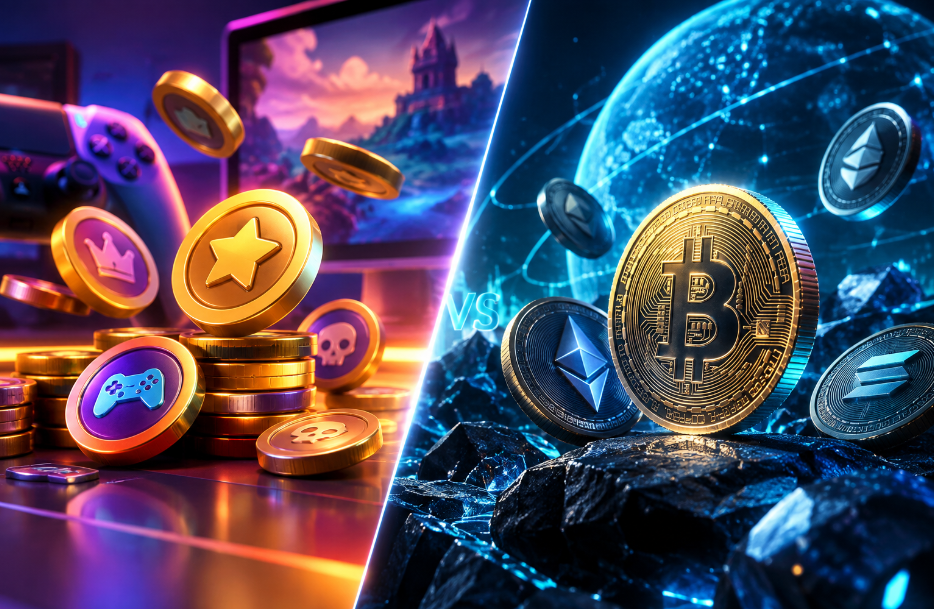
    Digital currencies now appear almost everywhere online, but they don’t all work the same way. A cryptocurrency such as Bitcoin operates very differently from the coins used in a mobile game or the virtual currency found on aSocial Casino. They may all appear as numbers beside a wallet or account balance, yet the technology, ownership rules, and purpose behind them can be completely different.

    That distinction matters as gaming, entertainment and digital finance continue to overlap.

    Virtual currency existed long before crypto

    Games were using their own currencies years before Bitcoin arrived.

    The reason is straightforward. A game needs an easy way to represent progress, access features, or manage its internal economy. Coins, points and credits give players a familiar system without requiring real-world financial infrastructure.

    Most of these currencies operate inside a closed system.

    The coins collected in one game usually can’t be transferred to another platform. Their supply, value, and permitted uses are determined by the company running the game.

    Cryptocurrency works differently. Bitcoin, for example, isn’t tied to one entertainment platform. Ownership is recorded on a distributed blockchain, and users can transfer it between compatible wallets.

    The word “coin” may appear in both systems, but that doesn’t make the underlying assets comparable.

    The key question is what the currency can actually do

    A better way to understand any digital currency is to ignore its name for a moment and look at its rules.

    Can users move it outside the platform? Can it be sent directly to another wallet? Is ownership recorded publicly on a blockchain? Does a single company control the currency and its supply?

    The answers quickly reveal whether you’re dealing with a conventional in-game currency, a blockchain token, or something else entirely.This distinction is particularly useful in online entertainment, where familiar financial language is often used for systems designed primarily around gameplay.

    Blockchain changed the meaning of digital ownership

    Traditional games generally keep digital items inside their own ecosystems. A player may spend hundreds of hours collecting equipment, characters, or virtual currency, but those assets usually remain attached to the game account.

    Blockchain-based gaming introduced another model.

    A digital asset can be recorded on-chain and, depending on how it is designed, held in a separate wallet. That can make ownership less dependent on the developer’s own database.It also creates possibilities that don’t exist in most conventional games, such as transferring an asset between wallets or trading it through compatible marketplaces.Those possibilities helped fuel the early growth of blockchain gaming and play-to-earn projects.But adding blockchain technology also introduces complexity.

    A tradable asset changes the game

    Once a game asset can have an external market price, players may begin treating it differently.Someone playing purely for entertainment may care about the design, mechanics, and progression. A token holder may instead focus on supply, demand, and market value.

    Those interests don’t always align.If developers concentrate too heavily on token economics, the game itself can become secondary. If they prioritize gameplay without considering the token economy, the financial model can become difficult to sustain.This tension is one reason blockchain gaming has continued to experiment with different approaches rather than settling on one universal model.

    Closed economies still make sense

    Not every virtual currency needs a blockchain.A closed system can actually be an advantage when simplicity matters. Players don’t need to understand wallets, network fees, private keys, or blockchain confirmations.Developers also have more control over balancing the economy. If too much virtual currency enters circulation or a reward system isn’t working as intended, changes can be made directly.

    For entertainment platforms where the currency mainly supports gameplay, that flexibility can be more useful than decentralization.Blockchain becomes more relevant when portability, independent ownership, or public verification are central to the product.

    The terminology will keep overlapping

    As gaming and financial technology continue to evolve, users will encounter more coins, credits, tokens, and digital assets.Some will live entirely inside entertainment platforms. Others will exist on public blockchains. A few may combine elements of both.That makes understanding the underlying system more important than recognizing the terminology.

    A digital balance may look familiar on the screen, but the real questions are who controls it, where it can be used, and what ownership actually means.The label tells you what the platform calls it. The rules tell you what it really is.

    Disclaimer: This is a paid post and should not be treated as news/advice.

    Coins Crypto difference digital Whats
    Share. Facebook Twitter
    Previous ArticleFortnitemares 2026: All known and leaked Halloween collabs, start date and more
    Next Article Xbox Working Toward Closing Hellblade Studio Ninja Theory After Multiple Deals Fall Through
    James

    Related Posts

    What’s Coming to Netflix This Week: October 12th to 18th, 2026

    October 12, 2026

    You Might Be Surprised at What’s Collectible

    October 12, 2026

    PlayStation Issues Official Statement On PS6 Digital Ownership

    October 12, 2026

    NEXUS Dubai Entity Selected for UAE Future 100

    October 12, 2026
    Leave A Reply Cancel Reply

    Our Picks

    Aream & Co: Games industry M&A generates $57.8 bn in Q3, including EA’s $55bn leveraged buyout

    October 12, 2026

    Ben Affleck admits he gets into arguments with 12-year-olds while playing Fortnite

    October 12, 2026

    Darshan Raval’s latest single ‘Naal Naal Ve’ explores love, longing, reality

    October 12, 2026

    The Nice House by the Sea #12 Preview: World

    October 12, 2026
    • Facebook
    • Twitter
    • Instagram
    • YouTube
    • TikTok
    • Telegram
    Don't Miss
    Movies

    ‘3 Worlds/3 Moons: Foundations’ #1 is world

    By JamesJuly 16, 20260

    Most comic book writers have taken to announcing their upcoming and current projects on Substack, but the 3 Worlds/3 Moons collective has taken it a step further by creating whole comics. It’s even more impressive when you consider who founded this collective: writers Jonathan Hickman (East of West, Secret Wars) and Nick Spencer (Superior Foes…

    Logitech stock shows steady performance as the peripherals maker focuses on long

    July 16, 2026

    What To Watch Wednesday: Ride Or Die Premiere, Marcello Hernández Hosts The ESPYS, And More

    July 16, 2026

    Sailor Moon Is Officially Returning to the Big Screen on August 1

    July 16, 2026

    Subscribe to Updates

    Get the latest creative news from SmartMag about art & design.

    About Us
    About Us

    Comic Vibe is a pop-culture destination created for fans who live and breathe comics, movies, anime, TV shows, gaming, tech, cosplay, and collectibles.

    Our mission is to deliver engaging news, reviews, features, guides, and opinions that celebrate geek culture in all its forms. From the latest comic releases and blockbuster films to anime trends, gaming updates, cutting-edge tech, and collector culture, Comic Vibe brings everything together in one vibrant hub.

    Our Picks

    Aream & Co: Games industry M&A generates $57.8 bn in Q3, including EA’s $55bn leveraged buyout

    October 12, 2026

    Ben Affleck admits he gets into arguments with 12-year-olds while playing Fortnite

    October 12, 2026

    Darshan Raval’s latest single ‘Naal Naal Ve’ explores love, longing, reality

    October 12, 2026

    Subscribe to Updates

    Get the latest comics, anime, movies, TV, gaming, cosplay, and pop culture news delivered directly to your inbox. No spam—just the stories every fan should know.

    Facebook X (Twitter) Instagram YouTube TikTok
    • Home
    • Contact Us
    • Terms & Conditions
    • Advertise With Us
    • DMCA Policy
    • Privacy Policy
    • About Us
    © 2026 Comic Vibe. Designed by Comic Vibe.

    Type above and press Enter to search. Press Esc to cancel.