

The following is an analysis report by a GMA researcher. The views are for discussion only and do not constitute investment advice.
FWA uses “NFT + ETH backing + random purchase” to establish a new trading pool for illiquid NFTs. Early data after launch is impressive, but growth is clearly driven by the concentrated token release over 15 days, and a pullback trend has already appeared. The real test is whether users and backing can be retained after the release ends next week, and whether the planned buyback of protocol revenue can generate sufficient demand for $FWA.
On July 21, Fake World Assets (FWA) announced the launch of a new version. Seven days later FWA had risen to first place in daily fees among Ethereum protocols, with single-day revenue of approximately $388,000, ranking 11th overall, and nearly $1 million in revenue over the past 7 days
According to official FWA disclosures, by the 7th day after launch, FWA had completed 76,000 cumulative NFT purchases with trading volume reaching 7,700 ETH; the pool contained approximately 6,300 NFTs and locked about 1,950 ETH in margin (Backing). The platform’s token $FWA once reached a market cap of around $33 million.
The key behind these numbers is not just “spending ETH to randomly draw an NFT.” In a sluggish NFT market, what FWA truly changes is the supply and liquidity dynamics of NFTs: users deposit idle NFTs along with a sum of ETH as a buyback margin; traders can then use a lower amount of ETH to randomly draw an NFT from the pool and can choose to take either the NFT or ETH.
From this perspective, FWA is not just an on-chain gacha machine. It is also trying to revitalize existing NFTs through a new mechanism, creating new liquidity for assets that have long lacked buyer demand.
1. How FWA Works
FWA (Fake World Assets) is a random trading and liquidity protocol for NFTs deployed on the Ethereum mainnet. Through the “asset + ETH backing” approach, it pools illiquid assets provided by users into a unified trading pool. Notably, with the recent introduction of the Token Packs mechanism, FWA’s market-making targets are no longer limited to traditional NFT images, but have expanded to broader ERC-20 token bundles such as PEPE and MOG. It leverages “backing lock-up” and “random blind box draws” to transform previously illiquid digital assets into financial instruments that can be traded at high frequency.
According to the official documentation, FWA’s original intent is to connect two types of participants: depositors who supply NFTs to the pool, and buyers who pay ETH to randomly draw NFTs.
1. Depositors: Provide NFTs and Prepare Buyback Funds
Depositors need to place one NFT and a sum of ETH into the protocol together. This ETH is called backing, and this article refers to it as the “buyback margin.”
The buyback margin serves three functions.
- It affects the probability of the NFT being drawn: the lower the margin, the more likely the NFT will be drawn; the higher the margin, the lower the probability.
- It is a buyback quote set in advance by the depositor. If a buyer draws an NFT and does not want to keep it, they can return the NFT to the original depositor and receive a portion of the ETH margin.
- It is the depositor’s staked funds, which are released once the NFT is taken. However, note that if a depositor chooses to withdraw the NFT, there is a delay / cooling-off period.
This ETH is pre-locked in the contract, so each NFT has its own independent buyback funds and does not rely on post-hoc platform redemption. According to the latest official update on July 30, the minimum margin is set at 0.05 ETH, currently set manually by the team, and will later be dynamically adjusted at the contract level.
In return for providing NFTs and margin, depositors can:
- Share the protocol’s draw surcharge. As long as the NFT remains in the pool, i.e., has not been drawn, they continuously accumulate ETH earnings.
- During the first 15 days after the new version launch, depositors also receive $FWA token rewards: all depositors share 1% of the total token supply each day, with each individual share calculated based on the square root of the buyback margin.
This means that increasing the margin both raises the weight of token rewards and lowers the probability of the NFT being drawn, but the rewards do not grow linearly with the amount staked. Depositors also bear randomness: even with a high margin, the NFT could still be drawn early; once the NFT leaves the pool, subsequent fee and token rewards stop.
According to official website data on July 30, the platform has accumulated 8,093 NFTs deposited and 2,357 ETH, with the distribution as shown below.
2. Buyers: Randomly Receive an NFT at a Uniform Price
Buyers pay the current uniform price of the pool, and Chainlink VRF randomly selects a specific NFT from the pool. Buyers cannot specify an NFT collection or a specific number. Details on the drawing and pricing mechanism can be found in the official buying mechanism description.
The uniform price consists of the following three components (observed on July 30, the uniform price is displayed as 0.1135–0.1221 ETH):
- Expected Value: refers to the harmonic mean of all ETH backing in the current pool, not the market value of the NFTs themselves. According to the platform’s algorithm, this average is dominated by a large number of the cheapest, least-funded positions in the pool, so the overall price is pulled lower, mitigating the influence of high-value NFTs. This mechanism results in a “flat split” of surcharges among depositors: regardless of how expensive the deposited asset is, each depositor receives the same ETH per draw.
- Surcharge: On top of the expected value, the platform charges a default 10% surcharge. After a platform fee (1%) is taken, this surcharge is dynamically allocated between depositors (as a reward for providing NFTs and ETH margin) and buyers (as a subsidy in the form of $FWA). This dynamic allocation depends on how hot or cold the pool is (the time since the last purchase), details below.
- VRF Service Fee: used exclusively to pay the network costs of obtaining on-chain verifiable randomness from Chainlink.
If extreme circumstances occur, such as an empty pool, price deviation, or slow/missing response leading to settlement failure, the platform will refund the expected value and surcharge paid by the buyer, but will not refund the VRF service fee. This is because it is used to secure the Chainlink subscription balance, cover actual callback costs, and subsidize necessary backend processing; it is not an instant, per-request, equal payment to Chainlink. As of now, approximately 34.6 ETH remains in the VRF service fee contract as a safety surplus, and the team has extraction rights under restricted conditions.
In other words, FWA prices the average expectation of the buyback funds in the pool, not the fair market value of the NFTs. This design sidesteps the NFT pricing oracle problem, but it also means there can be significant discrepancies between the draw price, the NFT’s market value, and the buyback margin.
According to official settlement rules, after drawing an NFT, buyers have four options:
- Directly take the NFT: The buyer gets the NFT, and the original depositor gets back the ETH margin (the platform deducts a small portion as a protocol fee).
- Keep the NFT and re-deposit it into the pool: This is done in a single transaction, requiring a new ETH margin to be deposited simultaneously, while the original depositor also receives their original ETH margin after deduction of the protocol fee.
- Sell the NFT back to the original depositor at a discount and receive ETH: The buyer receives a large portion of the ETH margin as a return (default ratio 85%), and the NFT is returned to the depositor.
- Sell the NFT back to the original depositor at a discount and receive $FWA: The same settlement logic as option 3, but the ETH equivalent is used to buy $FWA and pay it to the buyer.
Therefore, buyers are actually faced with two layers of judgment: whether the drawn NFT is worth keeping, and whether the buyback margin associated with that NFT can cover their purchase cost. The pre-existing buyback quote provides an exit path for buyers, but does not guarantee that they won’t incur a loss.
According to official website data on July 30, out of 75,472 settlements, 78% chose to receive FWA, far higher than keeping the NFT or receiving ETH. This indicates that under the current incentive and price environment, users prefer to convert randomly obtained NFTs into $FWA exposure rather than continue holding NFTs; however, whether this choice stems from a bullish view on FWA’s long-term value or from short-term arbitrage and liquidity preference still needs to be observed after the token release period ends.
3. FWA Protocol: Earned from Asset Flow and Settlement
The protocol plays the role of a neutral rule-maker and “toll” collector in the entire ecosystem. FWA does not use its own capital to purchase NFT inventory, nor does it need to actively quote a price for each asset like a traditional platform. The NFTs in the pool and the buyback margin are provided by users, while the protocol’s smart contracts handle custody, random allocation, and settlement. The protocol only charges a clearly capped fee when users’ draws, settlements and trades expose the gap between the “actual value of the NFT”, the “ETH backing” and the “buyer’s choice”.
According to the official documentation, protocol revenue mainly comes from four types of fees:
- Drawing fee cut: The official documentation clearly states that the protocol takes an amount equal to 1% of the value of each blind box acquisition from the surcharge paid by buyers as platform profit (unrelated to the VRF oracle fee).
[GMA On‑Chain Logic Deduction]: Although the front end shows that the surcharge paid by users is 10%, according to the underlying pricing formula disclosed by the official side, acquisitionFee = EV × (BPS + surchargeBps) / BPS, and the 100 bps protocol extraction parameter, we deduce that this 1% platform cut is calculated on the absolute basis of the blind box principal (Expected Value, EV). This means that within the 10% surcharge basket, the platform implicitly takes exactly a share equivalent to 1% of EV (i.e., one‑tenth of the total surcharge), while the remaining funds are injected into the ecosystem’s internal cycle (returned to depositors or used as $FWA ice‑breaking subsidies).
- Retained NFT fee: When a buyer draws and chooses to take the NFT, the protocol deducts 1% of the ETH margin returned to the depositor as a handling fee (corresponding to the smart contract setting ownerSettlementFeeBps = 100).
- Settlement discount spread: When a buyer gives up the NFT and chooses to take ETH, the buyer only receives a default 85% of the principal. The remaining 15% discount spread, by default, goes entirely to the protocol. (Note: The protocol retains a toggle and may choose to share it with depositors in the future.)
[GMA On‑Chain Logic Deduction]: In the underlying contract, the direction of this profit is controlled by the retainedToProtocol boolean value. Currently, the mainnet configuration is true, meaning it is retained by the platform.
- $FWA trading tax: A 1% trading tax is charged when buying or selling $FWA tokens.
Protocol Revenue Distribution and Token Buyback
The revenue earned by the protocol (the first three types of ETH revenue) does not flow directly into a single project wallet, but is redistributed on‑chain through a splitter deployed on mainnet:
Basic split: Currently, approximately 70% goes to Primary and Secondary receivers designated by the project, and 30% is distributed to the 264 TokenWorks S02 NFTs that were snapshot at the time of protocol deployment. S02 is a creator‑support NFT previously issued by TokenWorks through FundingWorks, where holders support the team by locking ETH and retain the right to burn the NFT to reclaim funds that have not yet been released.
- Token buyback and burn flywheel: The protocol’s smart contract incorporates a buyback switch, allowing the team to allocate a portion of the protocol’s ETH revenue to a permissionless buyback process at any time. The $FWA tokens obtained through buyback are planned to be distributed as follows: 40% to depositors, 40% injected into the daily buyer prize pool, and 20% sent directly to a black hole for permanent burn, thereby forming a long‑term deflationary closed loop after the 15‑day early mining period ends (however, the actual activation time and the proportion of revenue allocated still need to be confirmed by subsequent on‑chain transactions).
This explains why FWA was able to surge onto the revenue leaderboard in a short time: it places NFT supply, random drawing, buyback, and token rewards into the same cycle, and every user participation generates new protocol revenue.
On‑chain data analysis shows that the protocol has cumulatively received approximately 1,332 ETH, of which about 854 ETH have been claimed, accounting for 64%, and approximately 478 ETH remain in the contract unclaimed. By attribution, Primary and Secondary have cumulatively been allocated about 932 ETH, and the snapshot NFTs have cumulatively been allocated about 400 ETH; of this, snapshot NFT holders have claimed about 186 ETH, with about 213 ETH still pending.
Among the 264 eligible FundingWorks snapshot NFTs, 146 IDs have already claimed, distributed across 113 wallets. Of these, 75 wallets have participated in buying or depositing in the new FWA, accounting for 66.4%; 57 wallets have participated on both the supply and demand sides simultaneously, accounting for 50.4%. This shows that a significant portion of the early supporters who actively claimed their split subsequently participated in the new FWA, with noticeable overlap between the two groups. The supporter community previously accumulated by TokenWorks lowered, to some extent, the difficulty of acquiring first‑wave users and asset supply during FWA’s cold start phase.
II. How Does FWA Crack the “Cold Start” Problem Through Game Mechanisms?
The reason FWA was able to top the Ethereum protocol daily fee leaderboard within just 7 days after its restart, and still maintain the 10th position on July 30 after the initial heat subsided, while producing explosive business data of nearly 95,000 cumulative purchases and 9,692 ETH trading volume as of July 30, does not lie in the surface‑level “random draw” gameplay. Its growth mainly comes from three mutually reinforcing sets of pricing and incentive mechanisms, which simultaneously attracted asset supply and buying demand in the early stage, thereby easing the cold start problem of a two‑sided market.
1. “Cold/Hot Pool” and “Ice‑Breaking Conversion”: Breaking the Death Spiral of No One Bidding
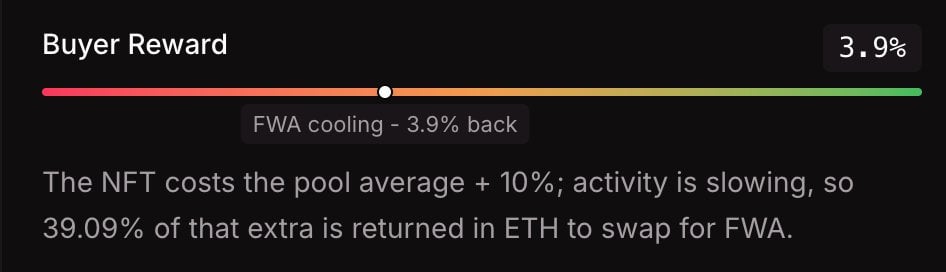
- Mechanism design: The system monitors the time interval between two purchases. Hot pool (interval less than 60 seconds): the surcharge (after protocol extraction) is entirely distributed to depositors; Cold pool (interval greater than 3600 seconds): this surcharge is intercepted by the system and automatically used to buy $FWA tokens at market price on DEX, entirely subsidizing the next ice‑breaking buyer; Warm pool (60 seconds – 3600 seconds): the surcharge is smoothly and linearly split between depositor rewards and $FWA ice‑breaking subsidies. According to official website data on July 30, the current state is warm pool, with the system intercepting funds equal to 3.9% of the average blind box price from the surcharge to buy $FWA to subsidize buyers.
-
- Design motivation: What any trading market fears most is “stagnation”. When there are no high‑premium assets or when overall sentiment is sluggish, buyers will collectively wait and watch. At this point, converting the surcharge into $FWA subsidies is equivalent to giving the ice‑breaker an option to draw a box “fee‑free” or even with “positive returns”; generous rewards will surely bring bold participants.
- Actual impact: This mechanism raises the potential return of the first purchase in a cold pool state, helping to reduce transaction idle time. Meanwhile, cold pool subsidies are directly converted into real secondary market buying pressure for $FWA, supporting the token’s demand floor when no new external capital enters. Early purchase frequency indicates it indeed created strong incentives, but given that the platform’s recent trading volume and daily active users have both weakened, whether this mechanism remains effective when subsidies decrease or the $FWA price weakens still requires long‑term verification.
2. “Common Pot” and “Crown Race”: Balancing Liquidity Between Retail and Whale
- Mechanism design: The drawing surcharge paid by buyers, after deducting the protocol extraction, is distributed to depositors according to the following two rules: The top depositor who provides the highest ETH backing in the entire venue can first take an exclusive 1% Crown cut (the early whitepaper had 5%, the official website shows 1%, this article uses the latest official website data), and the remainder is split equally among all active NFTs in the pool by default; To compete for the top depositor spot, a challenger must exceed the current leader by a 10% premium to claim the crown.
- Design motivation: If dividends were distributed pro‑rata based on capital, depositors of low‑value NFTs would earn nothing, causing the pool to lose “cheap items”, the blind box Expected Value (EV) to skyrocket, and directly scaring off buying demand. The equal‑split mechanism ensures a low average blind box price, encouraging long‑tail assets to enter the venue; but equal split dilutes the capital efficiency of large funds. Hence, the protocol introduces the “Crown Arena”, using the 1% exclusive cut to incentivize whales to enter and compete.
- Actual impact: This design rapidly increased the depth of the capital pool in a very short time. To compete for the 1% exclusive right, whales continuously raised the Backing threshold, while retail investors used a vast amount of long‑tail assets to lower the pool’s average price. According to the latest official website data, the top spot has even accumulated over 13.66 ETH in single‑point rewards. This competition increased the marginal return on large margins and stimulated large players to compete for the top spot.
3. Two‑Sided Violent Airdrop in the First 15 Days: Trading Tokens for Early Scale
- Mechanism: During the first 15 days after the new version goes live, the protocol releases 2% of the total token supply each day — 1% distributed based on the square root of depositors’ margins, and the other 1% split proportionally among that day’s successful buyers.
- Design motivation: The core task of the $FWA token is to solve the “no sellers, no buyers” deadlock of two-sided networks. In the most fragile early stage, the protocol uses clear token expectations to cover the security risks and liquidity costs borne by users. It is particularly worth noting that the square-root distribution to depositors both compensates large players and uses non-linear decay to prevent whales from establishing an absolute monopoly over early token shares.
- Actual impact: This is the most direct catalyst for FWA’s short-term data explosion. These 15 days amount to a network-wide “trade mining” event — high expected returns triggered a frantic influx of capital. The platform token’s FDV once surged to approximately $33 million, using short-term inflationary costs to successfully — and more than — complete the initial capital accumulation for the protocol ecosystem.
4. On-Chain Data Trends: Cooling Sentiment and Stepwise Decline
According to Dune on-chain dashboards and public contract on-chain data, FWA’s core operational metrics during its launch period exhibited a distinct phased trajectory:
- Significant contraction in trading volume and frequency: After the platform’s blind box draw volume hit a single-day peak of $4.67 million on July 25, it did not consolidate at the next-highest level. Instead, as the marginal effect of the early high-intensity subsidies diminished, it declined in a stepwise manner for several consecutive days, falling to around $1.04 million by July 29. This indicates that the market’s marginal attention to the early mechanics is rapidly cooling.
- Concurrent decline in active addresses: From a full-cycle perspective, the protocol recorded a cumulative total of 3,611 unique participating addresses. Since it is deployed on the Ethereum mainnet with relatively high Gas friction costs, its user profile leans toward on-chain active capital with higher per-transaction value. However, temporally, after daily active participants peaked at 1,500 to 1,700 on July 25–26, they have recently fallen back in tandem to the 700 to 1,000 range, with a clear slowdown in the willingness of incremental capital to enter.
High stickiness in token settlement ratio: Despite the overall decline in activity, the proportion of historical settlements opting for $FWA token settlement remained within the 66% to 82% range. This shows that remaining incumbents in the arena are still locking in mining rights through token settlement, but the weakness of incremental liquidity is an indisputable fact.
3. $FWA Tokenomics: Zero Inflation and a Deflationary Flywheel after 15 Days
If the token release over the first 15 days is the “marketing cost” the FWA protocol pays to overcome the cold start, then the token model after those 15 days truly determines whether the protocol possesses long-term economic sustainability. Unlike the vast majority of Web3 games or NFT market-making platforms that rely on long-term inflation to maintain activity, FWA’s tokenomics display extremely restrained and “open-card” game-theoretic characteristics.
1. The “Open-Card Game” of Chip Distribution: Zero VC, Zero Team Reserves
$FWA has a fixed total supply of 1 billion tokens, and its initial chip structure completely abandons the traditional “institutional round + long-term team unlock” model:
- 50% Initial Liquidity: Injected into the FWA/ETH pool on Uniswap V4 as base liquidity.
- 30% Early Bilateral Mining: Released at high intensity within the first 15 days of the new version’s launch (2% daily, released to depositors and purchasers respectively).
- 20% V1 Legacy User Snapshot: Reserved for early participants at Ethereum block 25,452,023.
This distribution model means there are no hidden long-term sell pressures on $FWA. Fifteen days after launch, except for legacy user snapshot claims, all circulating chips will have been generated through either real-money market-making or blind box draws, making the chip structure extremely transparent.
On-chain data shows that FWA currently has approximately 2,482 holding addresses, with the top 100 addresses controlling 67.84% of the supply, and a Gini coefficient reaching 0.8971, presenting a superficially highly concentrated chip structure. However, the largest address is the FWA Rewards contract, and the fourth largest is the Uniswap V4 Pool Manager; together they hold 15.56% and cannot be directly viewed as whale holdings. After excluding these two known protocol addresses, the top 10 user-type addresses still collectively hold about 19% of the total supply, indicating that FWA is not controlled by a single address, though early chips remain notably concentrated among a few high-frequency participants. Notably, FWA core developer Adam’s public address, rhynotic.eth, ranks 11th with a 1.25% share.
With V1 snapshot tokens essentially fully claimed (430 addresses cumulatively claiming 98.35%, leaving only 3.3 million tokens in the contract), roughly 130 million tokens remaining in Rewards that will continue to be released and become the primarylingness of early holders to realize gains will be a key variable in whether the price can stabilize
2. Supply Side: The 15-Day “Output Cliff” and the End of Inflation
During the first 15 days, depositors and purchasers split up to 2% of the total supply in tokens each day. This is essentially systemic issuance under high inflationary pressure.
However, once the 15-day deadline arrives, the system’s “money printer” will be completely and physically shut off. The protocol will face an extremely dramatic “output cliff,” and all token rewards based on systemic issuance will instantly drop to zero. $FWA will transition from a “high-inflation market-making token” to a “zero-inflation hard-cap asset.”
3. Demand Side: The 40/40/20 Revenue Buyback Engine
When the 15-day systemic issuance ends, users will still receive $FWA rewards, but the: from “printing out of thin air” to “value recirculation from the protocol’s real revenue.”
The protocol’s smart contract has a built-in, permissionless buyback trigger. In the stabilization phase, the official team can configure a certain percentage of the protocol’s net ETH profits (derived from the previously mentioned blind box draw fees, retained NFT commissions, and settlement spreads) to be directly routed to the Uniswap V4 pool to sweep $FWA at market price, distributed according to the following strict ratios:
- 40% back to depositors: continues to be distributed to users providing liquidity via the “square root of ETH margin” mechanism, maintaining the depth of the base asset.
- 40% back to purchasers: injected into the daily prize pool, continuing to subsidize players who draw blind boxes, maintaining transaction velocity.
- 20% permanently burned: sent directly to a burn address.
4. Liquidity Unlocking and Asset Pricing Revaluation
To prevent speculative capital from “stealing the show” in the protocol’s early days, FWA restricted external buying and transfers between regular walletsrsonally participate in the protocol (providing assets or drawing blind boxes) to acquire tokens
The Market Game After Unlocking
When the 15-day release ends and the external buying restriction is lifted, $FWA will face a complete market revaluation.
- Selling Pressure Side: After losing the 2% daily release subsidy, some low-loyalty liquidity that existed purely to “farm airdrops” may withdraw, while early profit-takers will generate selling pressure.
- Buying Side: According to the official plan, external buying will be opened after the 15-day release period ends. The token will then enter a fuller phase of price discovery. If the protocol revenue buyback is initiated simultaneously, it will form a portion of buying demand tied to actual business income; however, its scale depends on trading revenue and the actual buyback ratio, and cannot be preset as a stable price floor.
- The peak market cap of $33 million, previously reached under restricted liquidity, will be tested by real supply and demand. At that point, $FWA’s price trend will no longer be dominated by early-stage marketing sentiment, but will strictly depend on the market’s pricing of the protocol’s “true fee-capture capability” and “cross-cycle capital efficiency.”
The “Token Pack” Mandatory Lock-Up Gambit
Before the end of the 15-day concentrated release period (July 30), the official team played an aggressively game-theoretic chess move: allowing users to bundle 10,000 to 100,000 $FWA into NFTs and then deposit them into the FWA pool to earn fees.
What’s truly noteworthy is that these Token Packs cannot be unpacked or transferred before the $FWA external buying channel opens. To earn ETH fees, users proactively pack $FWA that could otherwise be sold into NFTs, through which the protocol temporarily converts a portion of potential selling pressure into in-pool assets.
If the scale of tokens absorbed by Token Packs is large enough, it may ease the concentrated selling pressure at the beginning of external buying and reduce the supply of $FWA available for immediate trading on the market. However, this is closer to delayed selling pressure rather than eliminated selling pressure: the strength of the lock-up effect depends on the actual amount packed, the unpacking conditions, and whether holders choose to stay in the pool after external trading opens.
5. Early FOMO and Real-Time Price Discovery
Combined with the latest 4-hour market cap trend chart as of July 30, we can clearly divide FWA’s market dynamics since launch into three phases:
- Phase 1: Subsidy-driven absolute FOMO (July 21 – 26): Under the dual stimulus of a “sell-only, no-buy” one-way gate and a high daily 2% release, market sentiment soared. Large amounts of capital rushed in to earn yield, quickly pushing the market cap of $FWA to a phase high of nearly $33 million. The price during this phase reflected more of a “greenhouse premium” under restricted liquidity than pure market supply and demand.
- Phase 2: Extreme pressure from profit-taking (July 27 – 29): As the concentrated selling pressure from early snapshot veteran users and the high output “mine-withdraw-sell” activity of the preceding days emerged, the token market cap underwent a deep value reassessment, experiencing a violent pullback that briefly touched around $12.5 million. This pullback was linked to the early concentrated release of tokens, profit-taking, and restricted liquidity.
- Phase 3: Short-term consolidation after a high-level pullback (July 30): After the market cap retreated more than 60% from its high, trading volume declined and the market cap temporarily hovered around approximately $16.6 million. However, a single day or short-cycle sideways movement is not enough to confirm that the price has bottomed out, especially since the 15-day release had not yet ended at that point, and external buying as well as the long-term buyback mechanism had not been fully validated.
IV. Team Background and New Version Relaunch
FWA is developed by TokenWorks, a studio that positions itself as experimenting with on-chain financial mechanisms. Previously, it launched Ten Thousand Tokens and PunkStrategy, both included in FWA’s initial NFT pool. The current publicly known core contributors mainly include Adam and Teto, and no VC funding has been disclosed. FWA’s terms of service indicate that the website and protocol are operated by Token Workshop, Inc., registered in Delaware, USA.
July 21 was not FWA’s first launch. The old version (V1) opened for purchase on July 2, but a security vulnerability was discovered the next day: an attacker could front-run Chainlink’s callback, altering the ultimately selected NFT, and thus obtained CryptoPunk #5450.
The team subsequently paused purchases, opened asset withdrawals, and stated they would cover approximately $66,000 in losses; FWA holders from the old version and unclaimed rewards were also snapshotted on-chain. Thereafter, the team rewrote the draw process and deployed new contracts, so July 21 is more accurately described as the “new version relaunch.”
The new version requires random requests to be settled in the order they are initiated. When a request has not yet completed, newly deposited NFTs first enter a waiting queue and cannot alter the prize pool faced by the previous buyer. Related security designs can be found in the official security notes. Before the new version officially opened, there were already over 750 NFTs in the pool; about 30 minutes after opening, 800 purchases were completed, and the first-day purchase volume reached 3,000 times.
The team completed compensation, process revision, and new version relaunch in a relatively short time, demonstrating strong execution capability. However, the old version incident also shows that FWA’s contract risk is not a theoretical issue. For a protocol that involves NFT custody, random draw, fund settlement, and token distribution, the new version still requires a longer period of operational verification.
V. Spontaneously Emerging Ecosystem Derivatives
One of the most core indicators for judging whether a decentralized protocol has long-term value is whether it can attract external developers to spontaneously build “composability.” With the explosive growth in FWA’s trading volume, third-party products developed around its purchase process have already appeared.
Take PULL POOL, deployed by independent developer ripe0x, as an example. It addresses the high single-purchase threshold of FWA by providing a group-buy participation method, filling a missing piece of FWA at the micro-transaction level.
- “Fragmented Reduction” of Retail Threshold: Native FWA draws require paying the average price of the entire pool (e.g., ~0.117 ETH), which is not friendly to small amounts of capital. PULL POOL splits a single draw into 28 equal-priced tickets (each only 0.005 ETH), allowing small retail investors to participate in FWA draws at extremely low cost and split the rewards equally.
- Unattended Automated Buy Orders (Standing Orders): PULL POOL introduces a “pre-deposit subscription” and “keeper bounty” mechanism. After users pre-deposit ETH, on-chain bots will permissionlessly trigger transactions automatically when the group buy is filled.
The significance of PULL POOL lies in its construction of an autonomous traffic pipeline outside FWA. This automated group-buy flow not only lowers FWA’s participation threshold by nearly 25 times, but also the Standing Orders can automatically trigger purchases when the group-buy funds meet the conditions, potentially increasing FWA’s transaction trigger frequency. However, its actual contribution still depends on the scale of group-buy funds, the number of users, and continued usage.
FWA’s transaction process has a certain degree of external composability, but the number and usage scale of third-party applications are still limited, and more cases are needed to determine whether a complete ecosystem can form.
VI. How is FWA Different from Traditional TCG Gacha Platforms?
From the front-end user experience, FWA bears an extremely close resemblance to physical Trading Card Game (TCG) gacha platforms (such as Courtyard): users pay to pull a card, and if they are not satisfied, they can sell the asset back to the platform at a preset “guaranteed price.” However, in terms of underlying asset supply and liquidity operation mechanisms, FWA has achieved a subversion of the traditional model.
1. Decentralization of Inventory and Market Making Entities
Traditional TCG platforms are typical “heavy-asset centralized businesses.” The platform purchases, authenticates, warehouses cards itself, and serves as the sole market maker and counterparty. In FWA, the project does not use its own funds to purchase inventory. NFTs in the pool are provided by users and custodied by the protocol contract. This “User-Generated Liquidity” greatly releases the capital pressure on the platform.
2. “Emergent Pricing” That Sidesteps Oracles
Traditional TCG or collectibles platforms often need to procure, authenticate, and estimate inventory value themselves, and set repurchase or trading prices for different cards. Facing a large number of non-standardized assets, this pricing and inventory management cost is relatively high. FWA, very cleverly, uses the depositor’s own ETH Backing as a “subjective long-term bid.” Through the harmonic mean of the global fund pool, the protocol calculates a unified purchase price based on all Backing, without an oracle, thereby avoiding the need to evaluate NFT prices individually. However, this price reflects the structure of repurchase margin in the pool, not the fair market value of the NFTs.
3. Transfer of Credit Risk to Smart Contract Risk
On traditional gacha platforms, if a run occurs, the platform may refuse redemptions due to cash flow disruption (redemption default). In FWA, the repurchase funds for each NFT are rigidly locked in the smart contract from the first day of entry. The risk is no longer “whether the platform has money to compensate,” but becomes purely “whether the smart contract code is secure.”
VII. Potential Risks and Summary
FWA has proven with stunning 7-day post-launch data that the market is extremely eager for a new NFT trading method that “does not require precise valuation, comes with a guaranteed exit path, and has high speculative attributes.” But these 7 days happen to be the period of high token rewards, which is not enough to prove that demand can be sustained long-term. Beneath the hype, FWA still faces three core risks that will determine whether it can cross the subsidy cycle.
- Incentive cliff and liquidity contraction: The protocol’s early bilateral activity clearly benefited from the concentrated release of $FWA. After the 15-day emission ends, if depositing returns and purchase returns decline simultaneously, NFTs, Backing, and active users may all flow out. If coupled with falling ETH and $FWA prices, the attractiveness of cold pool subsidies will also weaken. Reduced transactions, weakening token price, and capital withdrawal could mutually reinforce each other, ultimately pushing the fund pool into liquidity contraction or even a death spiral.
- Adverse asset selection and pricing mismatch: The repurchase margin represents the exit price the depositor is willing to offer, not the market value of the NFT; the protocol’s uniform purchase price is also calculated based on Backing, without evaluating asset quality individually. This could lead to adverse selection of “bad money driving out good”: NFTs with poor liquidity or lower market value have greater incentive to enter the pool. If the quality of assets in the pool continues to decline, purchasers may demand higher token subsidies to participate, further increasing the protocol’s reliance on incentives.
- Smart contract security and admin privileges: FWA involves NFT custody, Chainlink VRF randomness, sequential settlement, fee splitting, and token buyback simultaneously. The complex interaction among multiple modules expands the potential attack surface. The V1 security incident in early July already demonstrated that risks may not necessarily come from randomness itself, but from logical loopholes among random requests, asset entry into the pool, and settlement ordering. Furthermore, the contract retains adjustment permissions for parameters such as fee distribution, buyback, and fund routing. If key permissions lack multi-sig, timelock, or adequate information disclosure, users also bear the risk of single-point control and rule changes.
In summary, FWA’s significance is not just about putting gacha on-chain. By requiring depositors to provide both NFTs and ETH buyback margin, it establishes a unified random trading and exit mechanism for assets that lack sustained buying interest. Compared to traditional order-book markets, this design increases the frequency with which assets are traded and settled, but at the cost of introducing randomness, asset quality mismatch, and reliance on token incentives.
Regarding $FWA’s subsequent market performance, the next two weeks will be the ultimate make-or-break period. What is truly worth watching is no longer the cumulative trading volume during the emission period, but the price performance after external buying opens, the transaction volume and active address retention after the daily 2% airdrop stops, and whether the protocol revenue buyback is initiated as planned.
PULL POOL and Token Pack indicate that FWA has already attracted some external development and mechanism innovation. But to develop from a short-term hotspot into a sustainable illiquid asset protocol, FWA still needs to prove: after subsidies decline, purchasers are still willing to trade, depositors are still willing to provide NFTs and Backing, and protocol revenue is sufficient to support subsequent token buybacks.
A more reasonable current assessment is that FWA has completed a remarkably effective cold start and proposed an NFT liquidity model worth continued observation; but whether it possesses cross-cycle value can only be answered by data from the non-token reward incentive period starting next week.
