

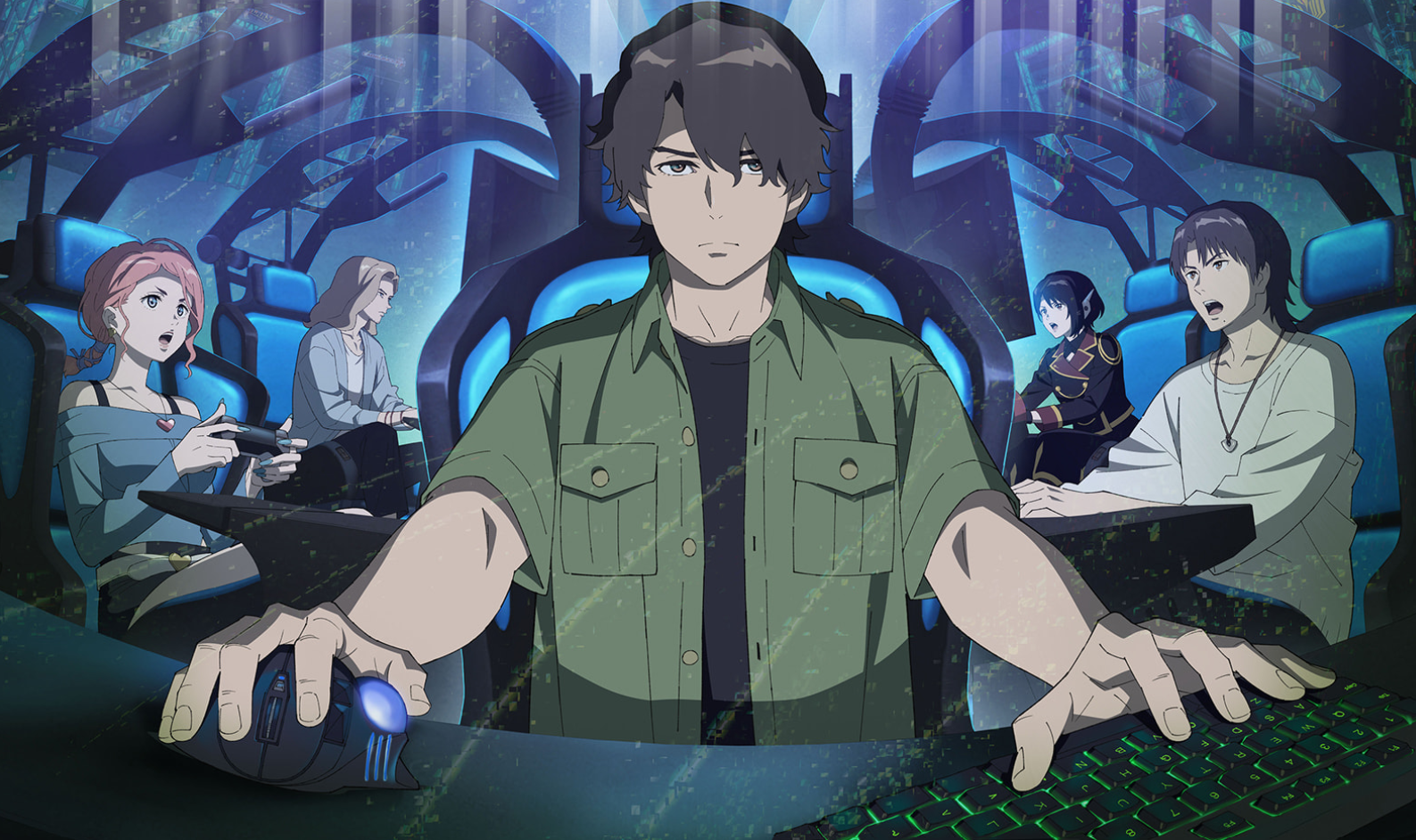
Dark Machine THE ANIMATION has confirmed fourteen voice cast members — not the ten listed in earlier coverage — following a third cast wave announced by the official X account on August 19, 2026, and now receiving wide English-language coverage. The additions bring into focus a Fall 2026 premiere that carries unusual weight: the series opens with the first anime theme song BUCK-TICK has performed as a band since the death of vocalist Atsushi Sakurai on October 19, 2023. Confirmation of the Wave 3 additions appeared across anime outlets, completing a cast roster assembled across three announcement periods over ten months.
Sakurai died of a brainstem hemorrhage at age 57, collapsing during a concert at KT Zepp Yokohama. The band’s four survivors have continued making music and touring in the years since. “Sonzai Riyū Kai” — their opening theme for Dark Machine, written by guitarist Hisashi Imai — is their first major anime tie-in since the Gegege no Kitarō ending theme in 2018, and the first to arrive after Sakurai’s death. The title, which translates roughly as “Reason to Exist, Revised,” is hard to read as anything other than a statement of continuation.
The show is <a href="https://realsound.jp/2026/08/post-2496041.html” rel=”nofollow noopener” target=”_blank”>scheduled to debut on Fuji TV, Kansai TV, and BS Fuji in October 2026. Global streaming rights have not yet been announced.
Who Is in This Cast?
The fourteen confirmed voice actors are organized across three announcement waves.
Wave 1 (November 23, 2025): Kenshō Ono voices protagonist Kairi; Miyuki Sawashiro voices Rudora; Kōki Uchiyama voices Shinn; Riho Sugiyama voices Bran; Saya Aizawa voices Isana; and Yūichi Nakamura voices Ajima, the series antagonist. These six were revealed at the project presentation that November.
Wave 2 (April 10, 2026): Four rival-faction characters — Kazuyuki Okitsu as Myōjin, Ryōta Suzuki as Ryō, Genta Nakamura as Kinji, and Sōhei Horikane as Hiru — were confirmed
Wave 3 (announced Japan August 19, 2026; English coverage this week): Ryūnosuke Watanuki as Nyūdō, Jun Kousaka as Hachiman, Minori Suzuki as Bianca, and Rikuya Yasuda as Weiss. Bianca and Weiss are members of the rival Esmeralda team.
The casting ambition is visible in the roster. Nakamura is currently the voice of Gojo Satoru in Jujutsu Kaisen, one of the highest-profile antagonist roles in contemporary anime. Sawashiro, a veteran of Noragami and Demon Slayer, adds a tier-one presence to what is otherwise a protagonist-heavy cast.
What Is Dark Machine About?
Set in near-future Japan — specifically in a scenario where rising sea levels have separated Chiba from the Kanto region — Dark Machine THE ANIMATION centers on Kairi, a young man who arrives in Golden Valley following his grandfather’s dying instruction: “Find Senki.” The project’s cross-media framing was introduced at the November 2025 presentation, which positioned the game and anime as parallel narrative systems.
Golden Valley is Japan’s only designated Dark Machine special economic zone — a city whose entire economy and social hierarchy are organized around the titular esports game. The “Senki” title, held by the seventh in a line of supreme champions, belongs to Ajima, who effectively controls the region through competitive dominance. When Kairi encounters Rudora — a young woman being pursued by Ajima’s faction, the Aldabil — he is drawn into the game himself. The central dramatic question is whether an untested outsider can develop enough talent to challenge the sovereign player and forge his own destiny, in an arena where losing means losing more than just a match.
The emotional register is underdog sports drama with a dark political interior: competitive skill is not just personal achievement but civic power, and the city’s population lives under the Senki’s authority as a function of the game’s rankings.
What Code Geass and Macross Brought to This Project
The creative team is not assembled from generic anime industry talent. Staff details appear on the Dark Machine Wikipedia page, which reflects official production documentation.
Gorō Taniguchi, credited as creative producer, directed Code Geass: Lelouch of the Rebellion — the 2006 political mecha series in which chess strategy and giant robots were instruments of colonial resistance and geopolitical power. His involvement signals that Dark Machine’s esports-as-governance premise is not window dressing: Taniguchi has spent his career making mecha stories about who controls the machine and what that authority costs. He also produced One Piece Film Red (2022).
Hidetaka Tenjin, the chief mechanical designer, is most associated with the Macross franchise — whose transformable valkyrie fighters are among the most iconic mecha designs in the medium. The Dark Machine “shift-up” system, in which pilots evolve their mech through small, medium, and large configurations during matches, inherits this philosophy directly: in both franchises, reconfiguration is a narrative event, not merely a mechanical one.
Animation is handled by Production +h., the Tokyo studio behind Dead Dead Demon’s Dededede Destruction and The Orbital Children. Director Kazumi Terada served as assistant director on The Orbital Children. Character design is by Kō Yoshinari, known for Made in Abyss creature design. Series composition is credited to Team Carbuncle, a writing team including Takaaki Suzuki (High School Fleet) and Tatsuhiko Urahata (Muv-Luv Alternative).
SUGIZO, of X Japan and Luna Sea, is composing the score.
How the Web3 Game Architecture Works
Dark Machine THE ANIMATION is the narrative half of a cross-media project whose other component is a live blockchain-based game. The game raised over $8.7 million from more than 6,000 investors, including Tencent, Web3 gaming platform Immutable, and the Sui blockchain.
The game is a seven-versus-seven third-person mech shooter built in Unreal Engine 5. Players control mechs in three size classes — small, medium, and large — with the ability to “shift up” configurations mid-match as a strategic option. Maps are described as spanning two parallel universes, The Light and The Dark, which maps onto the series’ central lore about dark energy embedded in Palmer crystals.
The game’s economic architecture is the MACHINA token ($MXNA), a blockchain-based in-game currency. Players can participate without purchasing NFTs — the game provides free starter NFTs to new players — and an NFT marketplace enables direct sales and peer-to-peer exchanges. The project also features NFT staking, decentralized tournament infrastructure, and the stated goal of global distribution.
The most structurally ambitious aspect of the project is its stated cross-media design: Project Carbuncle has described it as a system where “the player’s experience in the game intersects with the story of the anime.” If executed at scale, this would mean in-game events and player-owned asset histories influence anime canon — a design goal that has been theorized in media studies but rarely achieved commercially. BloomZ Inc. (NASDAQ: BLMZ), a Japanese anime production company, announced its sound production role in November 2024.
What Does ‘Sonzai Riyū Kai’ Mean for BUCK-TICK?
BUCK-TICK — the Japanese rock band that formed in 1983 and performed without a lineup change for 38 years — has contributed opening and ending themes to Shiki, xxxHOLiC, Trinity Blood, and Gegege no Kitarō over the course of Atsushi Sakurai’s tenure as vocalist. Their most recent anime work, the Gegege no Kitarō ED, aired in 2018.
Sakurai died in October 2023. In the time since, the band has released new music — including a full studio album under guitarist Hisashi Imai’s creative direction — and has resumed touring. “Sonzai Riyū Kai,” the Dark Machine opening theme, marks the first time they have provided an original anime theme since Sakurai’s death. Imai wrote and composed the song, which Real Sound Japan described as built around a feeling of speed and exhilaration. The title — translatable as “Reason to Exist, Revised” or “Updated Reason for Being” — is transparently elegiac for anyone familiar with the band’s history. A national tour is scheduled for November and December 2026, culminating at Nippon Budokan on December 29.
When Does Dark Machine THE ANIMATION Premiere?
The series will premiere in October 2026. No specific date within October has been officially announced. The broadcast schedule is: Fuji TV, Tuesdays at 1:45 AM JST; Kansai TV, Thursdays at 2:45 AM JST; BS Fuji, Tuesdays at 12:30 AM JST. Real Sound Japan’s August 2026 broadcast announcement also confirmed the BUCK-TICK theme and national tour dates. Global streaming has not yet been announced.
The anime is planned for international distribution, per official descriptions, but no streaming partner has been named as of this writing.
Frequently Asked Questions
When does Dark Machine THE ANIMATION premiere on Fuji TV?
The series will premiere in October 2026 on Fuji TV, Kansai TV, and BS Fuji. A specific premiere date has not yet been announced. No international streaming partner has been confirmed, though the project has been described as planned for global distribution.
What is the connection between the Dark Machine anime and the Web3 game?
The game and anime are designed to run as parallel media with intersecting narratives. The game — a seven-versus-seven mech shooter built in Unreal Engine 5 — uses a blockchain token (MACHINA/$MXNA) and NFT asset ownership, but players can participate without purchasing NFTs. The project raised $8.7 million from investors including Tencent, Immutable, and Sui. The stated goal is for player experiences in the game to intersect with the anime’s story — meaning in-game events and player-owned asset histories could influence anime canon.
Why is BUCK-TICK’s involvement in Dark Machine THE ANIMATION significant?
BUCK-TICK — one of Japan’s founding visual kei bands, active since the mid-1980s — provided anime opening and ending themes throughout vocalist Atsushi Sakurai’s career. Sakurai died on October 19, 2023, from a brainstem hemorrhage at age 57. “Sonzai Riyū Kai,” the Dark Machine opening theme written by guitarist Hisashi Imai, is the first anime theme the band has released since his death. For fans, it represents the surviving band’s first public commitment to carry their work into anime culture without their founding vocalist.
Who is the creative team behind Dark Machine THE ANIMATION?
Creative producer Gorō Taniguchi directed Code Geass: Lelouch of the Rebellion (2006), the defining political mecha anime. Chief mechanical designer Hidetaka Tenjin is best known for the Macross franchise’s transformable fighters. Director Kazumi Terada led the animation at Production +h. — the studio behind Dead Dead Demon’s Dededede Destruction. Character design is by Kō Yoshinari (Made in Abyss). Composer SUGIZO is a member of both X Japan and Luna Sea. Team Carbuncle handles series composition and scripts.
ⓒ 2026 TECHTIMES.com All rights reserved. Do not reproduce without permission.
