

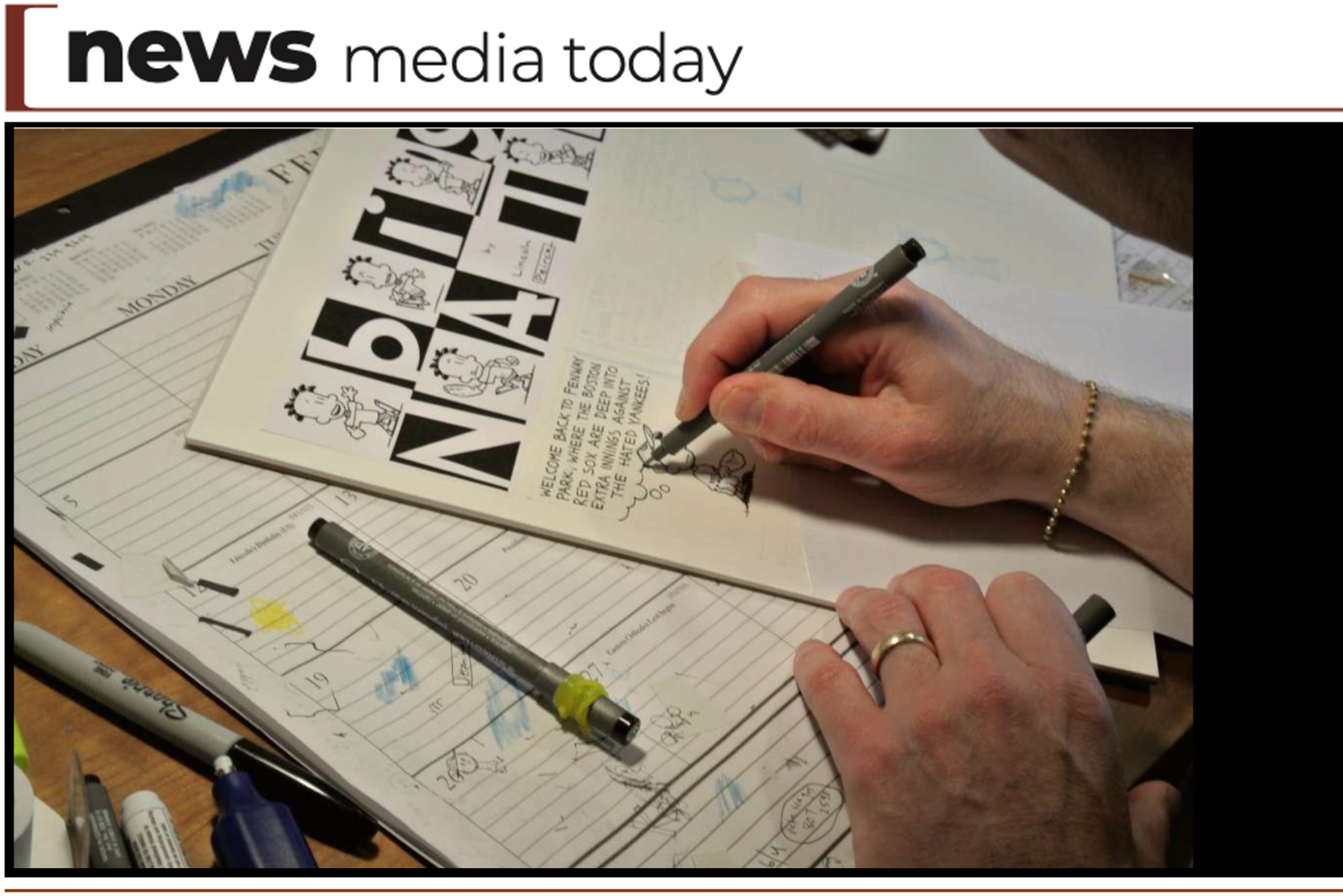
Lincoln Peirce’s “Big Nate” strip first appeared in newspapers in 1991. The central character, Nate, is forever young — decades later, still 11 years old, navigating the sixth grade. (Photo courtesy of Lincoln Peirce)
Posted
Thursday,September 17, 202612:00 am
Cartoonist Lincoln Peirce may have retired his daily comic strip, “Big Nate.” But young Nate continues to live on in a syndicated Sunday strip. (Photo courtesy of Lincoln Peirce)
It’s been more than 35 years, but Lincoln Peirce still isn’t ready to say goodbye to the sixth grade.
Peirce, the creator of “Big Nate,” recently retired the daily version of the comic strip, which first appeared in newspapers on Jan. 7, 1991. He’s still drawing new Sunday “Big Nate” strips (syndicated by Andrews McMeel) from his studio in Portland, Maine, but the final daily strip ran months ago on June 13.
At its peak, “Big Nate” appeared in more than 400 newspapers across the country, spawning a massively successful line of children’s books and an animated series on Nickelodeon. But in recent years, Peirce said it’s been a challenge to come up with new storylines for Nate Wright, the rebellious 11-year-old at the center of his strip.
“He’s a character who doesn’t age. He’s been in sixth grade for 35 years, and I think I’ve done just about every bake sale, school dance, soccer game, storyline there is to do,” Peirce said.
Peirce’s decision to end the daily run comes as newspapers continue their slow march online, where the industry has done a terrible job migrating what remains one of its most-popular print features. Even on the printed pages “Big Nate” vacated, some newspapers weren’t in a hurry to reward readers with a new offering. As readers pointed out, Advance Newspapers properties such as The Oregonian and The Plain Dealer didn’t fill the blank space for several weeks. That may sound bleak, but Peirce doesn’t think the decline of newspapers is having a big impact on comics because people are reading them elsewhere, online and in books.
“It is a cultural loss,” Peirce said. “That ritual of getting the Sunday paper, spreading it out on the living room floor, and drinking that all in. … It’s not the same reading comics on your phone or laptop. It just isn’t.”
How long does Peirce plan to continue “Big Nate” as a Sunday-only strip? He doesn’t have an end date in mind, but he wants to keep drawing Nate and his friends for years to come, as long as newspapers continue to subscribe.
Peirce spoke to E&P about his comics influences, the state of the comic strip industry, and why he’s against newspapers rerunning old “Big Nate” strips. This conversation has been edited for length and clarity.
E&P: Who were your biggest cartooning influences?
Peirce: Of course, Sparky, Charles Schulz, is the number one. Everyone in my age group grew up when “Peanuts” was everywhere, and reading those 50-cent reprint books, I just absorbed that content into my DNA.
There’s another cartoonist I’d like to mention because he’s almost completely forgotten now. His name was Francis W. Dahl, and he was a New England cartoonist in the 1930s to 1950s who drew for the Boston Herald. Obviously, I wasn’t alive during that time, but he had collections of comics which I discovered at my grandparents’ house when I was a boy. He was a keen observer of the New England social scene and current events, especially World War II, and I liked his drawing style and his gentle sense of humor.
“He’s a character who doesn’t age. He’s been in sixth grade for 35 years, and I think I’ve done just about every bake sale, school dance, soccer game, storyline there is to do.” — Cartoonist Lincoln Peirce, speaking about the main character of his “Big Nate” comic strip. (Photo courtesy of Lincoln Peirce)
E&P: Reprints of “Peanuts” are still syndicated to newspapers, but you’re not doing that with “Big Nate?”
Peirce: I never wanted any newspapers to do reruns of “Big Nate,” so that’s not happening.
Even though I love some of the strips that are in rerun, like “Peanuts” and “For Better or For Worse,” I’m just opposed to it. I think you’re taking a spot that could be filled by a young, up-and-coming cartoonist who might have something great to offer.
In my local paper, the Portland Press Herald,‘“Big Nate” got replaced by a great strip called “Wallace the Brave” by Will Henry. He’s a genius, man. I love the way he draws. He’s a New England guy, so I’m really happy on those occasions when a strip like that steps in and takes my place.
E&P: I assume at this point most of your readers come from your books rather than newspapers?
Peirce: That’s definitely the case. Even back when newspapers were thriving, I think the way young people discover comics is through the books. “Calvin and Hobbes” is a classic example. I think the adults who love “Calvin and Hobbes” knew it from newspapers, but I think kids largely discovered it through reprint books.
“Big Nate” had been around quite a while before it took off. The first two “Diary of a Wimpy Kid” books had come out, and all of a sudden there were a lot of publishers thinking, “Wow, these hybrid books that use comics in such a prominent way could be a thing.”
So, I did some chapter books, and my timing was good. The first “Big Nate” novel came out in 2010. By that stage the strip had been around 18 or 19 years, but a lot of kids didn’t know anything about “Big Nate,” so those books got him in front of those kids’ eyeballs. That was a really huge turning point in my whole career.
E&P: Did you ever think “Big Nate” could be this successful when you started?
Peirce: I had hopes and aspirations, but when I look back at the early days of the strip, I don’t think it’s all that strong. It took me quite a while to find my footing.
As I went along, I was focusing more and more on Nate’s school adventures, but I wasn’t writing it for kids — I never did that with the comic strip. But I remember thinking, it’s too bad kids don’t read newspapers, because I think they would like this. As it turned out, that was the case.
One of my pet peeves in all forms of entertainment is I think a lot of times kid characters seem really inauthentic. Take a standard sort of Spielberg movie, like “Jurassic Park” or something like that. The kids are just so plucky and have a clever thing to say at every turn in the story. A real-life kid in a similar situation would be running for their life.
I wanted these kids to seem like real kids, not miniature adults. So, one of the most gratifying things for me over the past 15 years or so is to meet kids who really identify with Nate — his struggles, his relationships with his teachers. They’ll say something like, “Oh, that teacher is just like my teacher,” and that always makes me feel great, because kids can smell out when a kid character just doesn’t seem like a real kid.
E&P: What suggestions do you have for editors who put together comics pages?
Peirce: It runs counter to most newspapers’ business models, because they’re desperately trying not to upset readers by dropping their favorite strips, but I think the most interesting comics pages are the ones continually bringing new stuff in. There are way fewer new comic strips debuting in papers these days, and I really think the comics pages are in danger of becoming fossilized.
My advice for any editor would be: go look for what’s new. It may be a shock to the system for readers who are used to seeing the same strip for 40 or 50 years, but from a content standpoint, it’s going to make your comics pages more readable.
Rob Tornoe is a cartoonist and columnist for Editor & Publisher, where he writes about trends in digital media. He is also a digital editor and writer for The Philadelphia Inquirer. You can reach him atrobtornoe@gmail.com.
