

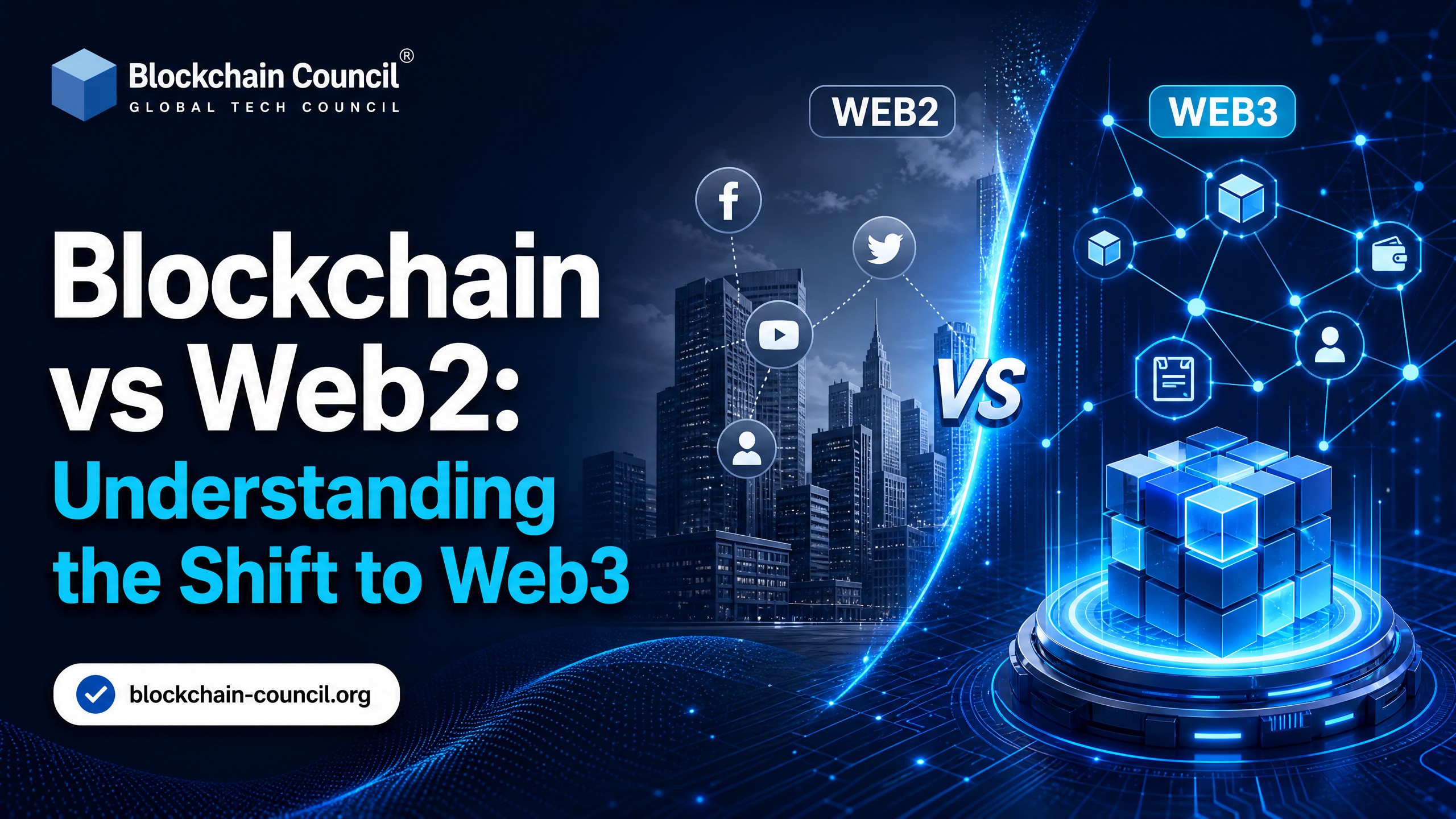
Blockchain vs Web2 is really a question about control. Web2 gave users publishing, social media, cloud apps, and easy payments, but most of that activity sits inside company-owned databases. Web3 uses blockchain networks to move parts of identity, ownership, payments, and governance onto shared infrastructure that users and communities can verify directly
That does not mean every app should be decentralized. To be blunt, a blockchain is a poor choice for many high-speed consumer products. But when the use case involves digital ownership, settlement, auditability, or reducing dependence on one platform operator, Web3 changes the architecture in a serious way

Web2 vs Web3: The Core Difference
Web2 is the read-write internet. You can create content, rate products, upload videos, join groups, and run a business through online platforms. The catch is that identity, data, monetization, and moderation are usually controlled by the platform
Google, Meta, Amazon, Apple, and other large platforms provide useful services, often at low direct cost. In return, they gather behavioral data, sell advertising, set API rules, and decide how visibility works. If an account is removed, an API is restricted, or a policy changes, users have limited recourse
Web3 is often called the read-write-own internet. In blockchain-based Web3, applications run on public or permissioned ledgers such as Ethereum, BNB Chain, Algorand, and Avalanche. Smart contracts define the rules. Wallets hold the assets. Tokens can represent money, voting power, collectibles, credentials, or claims on real-world assets
How Control Changes
-
Web2 control: Companies manage accounts, databases, monetization, identity, and content rules
-
Web3 control: Protocols, smart contracts, wallets, and community governance distribute some of that control
-
Web2 data: User data sits in platform silos and is governed by terms of service
-
Web3 data: Asset ownership and transaction history can be verified on-chain
-
Web2 identity: Login is tied to email, phone numbers, OAuth, or social accounts
-
Web3 identity: Wallets, decentralized identifiers, and verifiable credentials can make identity more portable
The Ethereum Foundation describes Web3 as a model where anyone can participate without personal data becoming the product. PwC frames it as a shift in ownership and incentives, not just another crypto trend. McKinsey takes a balanced view: many Web3 components already exist, but Web3 has not replaced Web2
How Blockchain Enables Web3
Blockchain changes the trust model. In Web2, you trust a platform to update records correctly. In Web3, you can verify state through consensus and cryptographic signatures. The phrase “don’t trust, verify” is overused, but it captures the point
Distributed Ledgers and Consensus
A blockchain stores transactions across many nodes. Ethereum, for example, uses Proof of Stake after its 2022 Merge. The Ethereum mainnet chain ID is 1, a small detail that matters when signing transactions or configuring wallets. If you have ever pointed MetaMask at the wrong network during testing, you know how quickly theory becomes debugging
Consensus makes it difficult for one party to rewrite history. That is useful for payments, registries, tokenized assets, and audit trails. It is less useful for a photo feed where users expect instant updates and cheap storage
Smart Contracts and Programmable Ownership
Smart contracts are programs deployed to a blockchain. On Ethereum, developers commonly write them in Solidity 0.8.x. One practical detail: arithmetic overflow reverts by default in Solidity 0.8 and later, while older versions often required the SafeMath library. Certification candidates and new developers still get tripped up by this version difference
-
Automated token swaps on decentralized exchanges such as Uniswap
-
ERC-20 tokens for fungible assets
-
ERC-721 tokens for unique NFTs
-
DAO voting and treasury rules
-
Programmatic settlement for tokenized funds or deposits
Developers working with Hardhat or Foundry learn the less glamorous parts fast. A failed deployment with “insufficient funds for intrinsic transaction cost” usually means the wallet lacks native gas tokens, not that the contract code is broken. These small frictions are part of why Web3 onboarding still feels harder than Web2
Real-World Examples of the Shift
Finance: DeFi and Tokenization
Finance is where Web3 has the clearest product-market fit. Decentralized exchanges let users trade tokens through smart contracts rather than a centralized order book. Uniswap is the standard example: liquidity pools, automated market makers, and on-chain settlement replace the traditional exchange operator for certain trades
Institutional use is growing too. McKinsey has highlighted JPMorgan Chase’s first cross-border blockchain transaction under Project Guardian in November 2022, involving tokenized Singapore dollar and Japanese yen deposits with DBS Bank. KKR also partnered with Securitize to make a tokenized private fund available on Avalanche. These are not meme coin experiments. They are signs that shared ledgers are being tested for capital markets and settlement
Digital Ownership: NFTs and Brand Platforms
In Web2, digital goods often live inside one company’s database. A game skin, subscription badge, or platform collectible may have value, but its transferability depends on the platform’s rules
In Web3, NFTs can make ownership verifiable outside the original application. Nike’s .Swoosh platform, launched after Nike acquired RTFKT in 2021, is one example of a major brand testing blockchain-based digital collectibles. McKinsey has also cited consumer campaigns where more than 300,000 people redeemed NFTs, which shows that users will interact with Web3 assets when the experience is simple enough
Creators and Communities
Creator platforms are another test case. Academic work published by SAGE has examined blockchain-based video platforms such as Theta.tv and Odysee, comparing creator expectations around ownership, monetization, and control with Web2 platforms like YouTube and Twitch
The promise is direct compensation, portable audiences, and governance participation. The problem is scale. Web2 creator platforms still win on discovery, reliability, audience size, and payment simplicity. Web3 creator tools need better UX before they become a daily default for most creators
Why Web2 Still Wins in Many Cases
Blockchain vs Web2 should not be framed as a simple replacement story. Web2 remains faster, cheaper, and easier for many applications
-
Performance: Centralized databases can process updates with low latency. Blockchains must propagate and validate transactions across a network
-
User experience: Password reset is familiar. Seed phrase recovery is not. Lost keys can mean lost assets
-
Cost: On-chain transactions may require gas fees. EIP-1559 changed Ethereum’s fee market, but it did not make blockspace free
-
Compliance: Tokenized funds, DeFi, and cross-border payments must address KYC, AML, securities law, and jurisdiction-specific rules
-
Moderation: Censorship resistance is valuable, but consumer platforms still need safety tools, spam control, and legal compliance
This is why many products are becoming Web2.5. The user sees a normal website or app. The blockchain runs in the background for settlement, ownership, or audit trails. For enterprise adoption, this hybrid model is often the practical path
What Professionals Should Learn Next
If you work in product, compliance, software, finance, or enterprise architecture, the practical question is not “Will Web3 replace Web2?” A better question: “Which parts of my workflow need shared trust, programmable assets, or user-owned identity?”
Developers should start with wallet flows, smart contract basics, ERC standards, gas mechanics, and security testing. Product leaders should understand token incentives, custody models, governance design, and when decentralization adds unnecessary complexity. Compliance teams should study how tokenization, DeFi, and identity systems interact with existing law
For structured learning, consider Blockchain Council programs such as Certified Blockchain Expert™, Certified Blockchain Developer™, Certified Smart Contract Developer™, and Certified Web3 Expert™. Pair the coursework with a small build: deploy an ERC-20 token on a testnet, connect it to a wallet, write one unit test, and document the failure cases. You will learn more from that than from reading another abstract Web3 thread
The Practical Future: Coexistence, Not Replacement
The most credible future is coexistence. Web2 will keep powering high-performance apps, search, streaming, social feeds, and enterprise SaaS. Web3 will grow where ownership, settlement, transparency, and shared governance matter enough to justify the added complexity
Start with one concrete skill. If you are technical, learn Solidity 0.8.x with Hardhat or Foundry and study common smart contract vulnerabilities. If you are non-technical, map a Web2 process in your organization that depends on reconciliation between multiple parties. That is where the blockchain vs Web2 discussion becomes useful, specific, and worth your time
BlockchainWeb2Web3
Browse All Articles
Related Articles
View All
Blockchain
The Future of Blockchain Wallets: Smart Wallets, Account Abstraction, and Web3 Identity
Explore the future of blockchain wallets through smart wallets, account abstraction, gas abstraction, recovery, and Web3 identity
Blockchain
The History of Blockchain: From Bitcoin to Web3 Innovation
A clear history of blockchain, from cryptographic research and Bitcoin to Ethereum, Web3, DeFi, NFTs, enterprise adoption, and future skills
Blockchain
Blockchain Mechanism Design and Game Theory: How Incentives Secure Web3
Learn how Blockchain Mechanism Design and Game Theory shape consensus, DeFi, validator incentives, PBFT systems, and Web3 governance
Trending Articles
View All
AI & ML
AI & ML1
AWS Career Roadmap
A step-by-step guide to building a successful career in Amazon Web Services cloud computing
DeFi2
Top 5 DeFi Platforms
Explore the leading decentralized finance platforms and what makes each one unique in the evolving DeFi landscape
Claude Ai
Claude Ai3
How to Install Claude Code
Learn how to install Claude Code on macOS, Linux, and Windows using the native installer, plus verification, authentication, and troubleshooting tips
