


With more people reading manga and webtoons (aka vertical scroll comics) than ever before, Beat’s Bizarre Adventure gives three writers an opportunity each week to recommend some of their favorite books and series from Japan, Korea, and elsewhere. This week we have sugar daddies, Batman, and, of course, islands.
Love for Sale
Writer/Artist: Dal Hyeonji
Platform: Lezhin
“How much would you need to be happy?“
While Namwoo’s friends sitting around the casual drinking party table all come up with extravagant answers to this question, he himself declares he’d be content with $1000. No point in dreaming big, right? Since high school, Namwoo has had to juggle at least 2 part-time jobs and be frugal down to every penny. So later when he wants to treat himself and his friend to a late night snack for covering his shift at the convenience store, but comes up short, the waterworks start running uncontrollably.
The next day, he wakes up in his room with the $1000 he dreamed of scattered around the room. As the drunken night’s memories come back to him, it dawns on Namwoo that he’s in big trouble. How could he have dragged a much older man to his room for sex to extort him for money, when he only wanted to help Namwoo pay the remainder for the snacks? And why is that older man now asking to date a young and broke guy like him?
Love for Sale is Dal Hyeonji’s commercial debut, and what a debut it is! Their character designs don’t fit the usual beauty standards of the Boys’ Love genre—lines are thick, angles are sharp, and characters do not embody generic androgynous beauty. It also takes considerable time for the style to really settle. The last may be a shortcoming and the others a matter of preference, but I’m not exaggerating when I say: don’t let anything stop you from giving this series a chance.
On the surface, this is your generic rich older man x broke university student sugar dating that BL is rife with. The romance genre is filled with multi-million dollar rich CEOs, waiting for their own debt-ridden, desperate guys to fall into their traps and eventually melt their hearts, after all. What sets Love for Sale apart is the execution. There aren’t many series that approach this trope in a grounded way without losing the charm of romance, and it’s astounding to me that Dal Hyeonji pulled it off with their very first work, all without missing a week during its serialization.
The trick to a story like Love for Sale is that when characters are presented with logical solutions instead of being backed into impossible corners and unimaginable lows where the only way is up, the creator needs to come up with plausible motivations for characters to follow genre tropes. Nothing here is dialed up to 100; Namwoo’s family is more stable now and his older sister even suggests financial help. So why is he so adamant to not turn to them for help when misfortune befalls him, and instead agrees to date Sieon? And why does Sieon, for all the kindness, accommodation, and attentiveness he shows to Namwoo, still say he can’t return the younger boy’s feelings the way he expects him to?
All this and more, of course, is for you to experience. I hold my BL lover friends who haven’t read Love for Sale yet at gunpoint (the only time I’m pro-coercion) but I’d recommend this webtoon to everyone who enjoys reading a good character study
Batman: The Jiro Kuwata Batmanga
Writer/Artist: Jiro Kuwata
Translation: Sheldon Drzka
Lettering: Wes Abbott
Publisher: DC Comics
The year is 1966. A massive cultural invasion sweeps the airways across the world: the television show Batman. No one is safe from the Caped Crusader and his partner the Boy Wonder. Not even the people of Japan are immune to the power of Adam West and Burt Ward appearing on their screens.
That April, 8-Man co-creator Jiro Kuwata began a manga adaptation of Batman. With his bold sense of action and dynamic panel layouts, Kuwata was a natural choice to create Batman comics for Japan. After all, 8-Man was a costumed superhero and a mega hit. So why not have Kuwata create a Japanese version of the hero?
These stories would not see release in the United States until the publication of Chip Kidd’s book Bat-Manga!: The Secret History of Batman in Japan in 2008, which included several of them alongside photos of other Japanese Batman memorabilia. DC eventually reprinted them in their entirety in 2013.
And folks, these comics are a wild take on the concept of Batman. Kuwata follows the basic gist of the Batman TV show and structures each story like multi part TV-episodes. But given the freedom of the comics medium, and the fact that DC apparently did not know about these comics, Kuawata puts them through truly strange adventures.
Take for example the villains Batman fights. Other than Clayface, Kuwata has the Dark Knight challenge entirely new villains with names like Lord Death Man and Go Go the Magician. He wrestles with a super powered highly intelligent gorilla. One bad guy, who is fittingly named The Human Ball, bounces around like a ball. The stories also become increasingly science-fiction-oriented as the series progresses.
Even 60 years on, there’s still nothing like these manga Batman stories. There have even been other manga Batman series released in the interim. Yet nothing else quite captures the spirit of the Adam West TV series quite like these. Batman may never again fight a super intelligent gorilla
The Strange Tale of Panorama Island
Writer/Artist: Suehiro Maruo
Original Creator: Edogawa Rampo
Translation: Kyoko Nitta, Ryan Sands
Cover Design, Touch-up Art, Lettering: Evan Hayden
Editing: Colin Turner, Ryan Sands
Publisher: Last Gasp
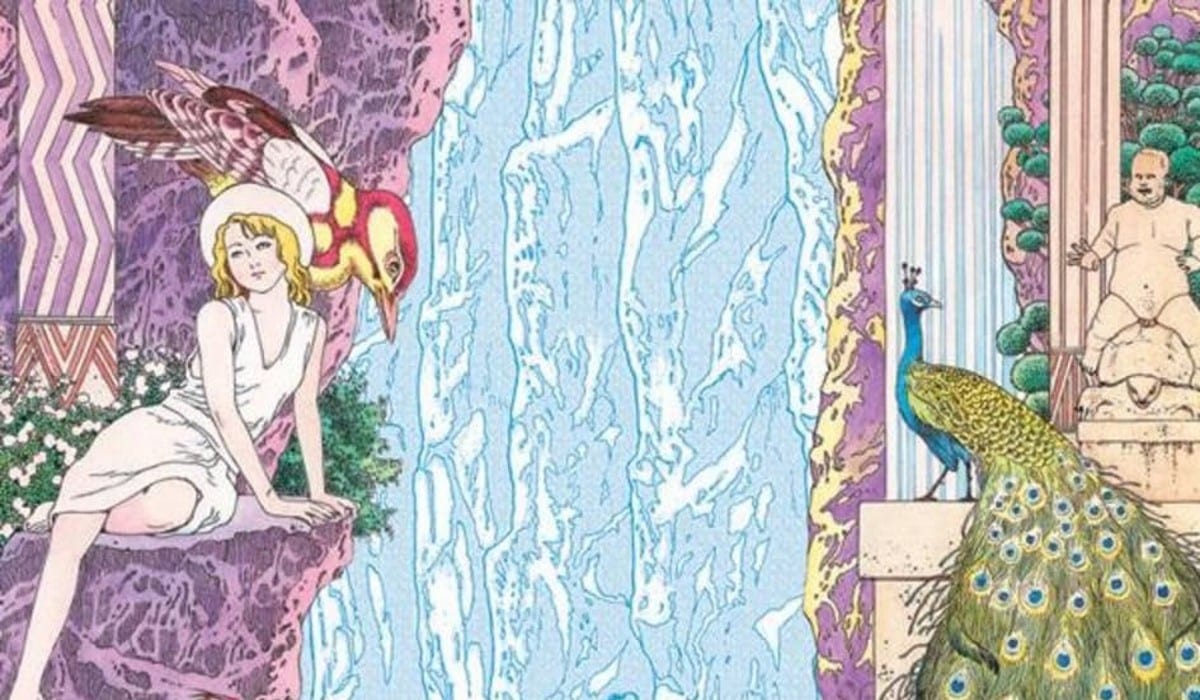
When he discovers that his wealthy former classmate from boarding school, Genzaburo Komoda, has died, novelist Hitomi Hirosuke comes up with the perfect scheme. Exhume Genzaburo’s corpse, take his place, and inherit his riches–including his beautiful wife, Chiyoko. The plan goes without a hitch, because Hitomi looks just like Genzaburo. But then, the question: what to do when you have more money, land and power than any one person could use in a lifetime? Another man might build a school, get into politics, or travel across the world. Hitomi instead decides to redevelop a nearby island as an outrageous pleasure place, where any dream no matter how vile or base may be fulfilled. It fulfills the spirit of his old novel The Tale of RA, and it is called Panorama Island.
This adaptation of The Strange Tale of Panorama Island combines two great talents from Japanese literature. The first is the story’s original author Edogawa Rampo (say that out loud), who created such grotesque short narratives as “The Human Chair.” The second is Suehiro Maruo, a master of “ero-guro” manga best known in the United States for his series Shojo Tsubaki (or as it is known in English, Mr. Arashi’s Amazing Freak Show.) Maruo in particular is infamous for pushing the envelope, drawing beautiful and yet rancid retro comics for porn magazines since the ‘80s.
Adapting classic works of literature as comics can be a risky proposition. There are plenty of cut-and-paste adaptations out there which staple lines from the source material to illustrations, dilute a story’s power with boring art, and/or do not understand that prose and comics are different mediums with specific affordances. The Strange Tale of Panorama Island in particular is a story that lives or dies by its portrayal of the titular setting as a beautiful and grotesque hellscape. It crumbles to pieces if the reader cannot buy in.
Maruo takes his time laying the road to reach Panorama Island. Once you get there, though, it lives up to the billing: overripe, oversexed, an impossible landscape of world monuments, costumed dancers and cavorting circus dwarfs. (I recommend Mangasplaining’s episode on the book for a deep dive into its many references to art history and sculpture.) You grimace and avert your eyes from decadent details such as a forest in the shape of Hitomi’s face, or an assembly of enormous yet useless machines. Yet everybody on the island at least appears to be enjoying themselves. Right?
The Strange Tale of Panorama Island is powerful because it gives us the fantasy and the nightmare of egotistical self-indulgence. Panorama Island was made with incredible expense for the sole reason of being beautiful. You could say it embodies Maruo’s own ethos, in how it exhibits a stubborn dedication to one’s aesthetic in defiance of those who do not understand. If Panorama Island is flawed, it is not so because it is too sexy or too violent. It is because it is brief. A dream extinguished in the burst of a firecracker, as a spent Hitomi Hirosuke dyes his manufactured country in his blood. For all his stolen money and power he dies a little death. — Adam Wescott
Follow Beat’s Bizarre Adventure to get weekly manga and webtoon recommendations!
