

Posted in: Comics, Heritage Sponsored | Tagged: Alex Schomburg, Kin Platt, Ned Pines, Standard/Better/Nedor
Alex Schomburg & Blackbeard in Startling Comics #8, at Auction
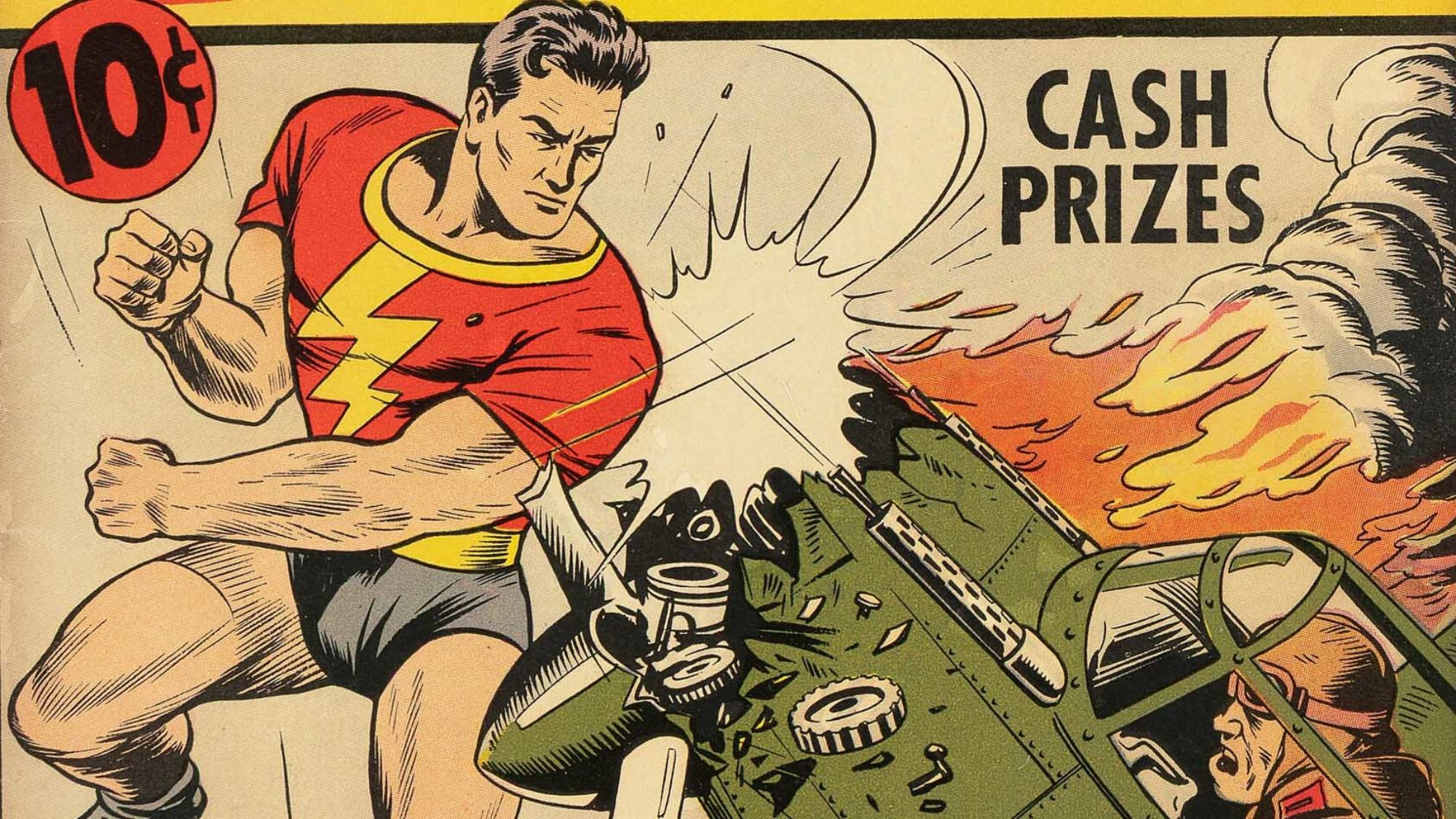
Alex Schomburg covers an issue that includes Blackbeard history, Panama Canal fears, and the Heaviside Layer-based science run completely amok.
Article Summary
- Startling Comics #8 features a dynamic Alex Schomburg cover, blending pre-Pearl Harbor war fears with Golden Age action.
- An Ace Buckley tale by Max Plaisted closely follows Blackbeard’s 1718 last battle, using real names, places, and tactics.
- Leonard Sansone’s stories tap 1941 anxieties, from Panama Canal Nazi spies to a wild Heaviside layer radio-wave weapon.
- Startling Comics #8 is a surprisingly scarce Golden Age comic in high grade, with just 14 Universal copies on the CGC Census.
Startling Comics #8 is a Golden Age comic book built around the events of its day and more distant history. On the cover, Alex Schomburg turns the European air war into pre-Pearl Harbor war-era superheroics. Inside, one story is closely inspired by Blackbeard’s last battle, using real names and tactics, and another uses worries over the Panama Canal into a Nazi spy saga. This is a pretty common Golden Age recipe, but it wouldn’t be complete without science run amok, and we have that here too, as another tale uses the real Heaviside layer to create a radio wave weapon. Per copyright records, the issue was on sale by May 6, 1941, seven months before the United States entered World War II. The cover is unmistakably Schomburg, with just a hint of the precise machinery that his Marvel covers made famous, combined with the more prominent figure work more commonly seen on his Standard/Better/Nedor work for Ned Pines.
Blackbeard and Panama
The most surprising feature here may be the five-page Ace Buckley story by Max Plaisted. Ace and Toni send their time machine to North Carolina in 1718 because Ace doubts that Blackbeard “was half as bad as history tells.” By the last panel, after swimming back to the machine, he admits that “Historians didn’t lie about Blackbeard.” What happens between those lines is remarkably attentive to the historical record. The story identifies Blackbeard as Edward Teach and places him around Bath and the Carolina coast. Governor Charles Eden protects him, so Ace travels to Virginia Governor Alexander Spotswood. Spotswood sends Captain Maynard after the pirate with two small sloops capable of navigating shallow water. During the battle, Maynard hides half his men below deck, allowing Blackbeard to board what appears to be a weakened ship. Blackbeard keeps fighting through worsening wounds before Maynard kills him, and his head is then put on display. The National Park Service account of Blackbeard’s final battle confirms the central sequence: Eden’s accommodation with the pirate, the appeal to Spotswood, Lieutenant Robert Maynard’s two vessels, Blackbeard’s death, and his head displayed from the bowsprit.
Leonard Sansone‘s Don Davis story is based on more recent events. War Department plans for canal fortifications disappear from a time-locked vault. Don discovers that Nazi agents tunneled into the building, follows them through a riverfront house to a dynamite-filled ship, contacts a U.S. cruiser, and recovers the plans after the enemy vessel is destroyed. This was clearly inspired by January 1941 headlines urging just such fortifications for the Panama Canal. In March 1941, the War Department was reorganizing American defense while making specific plans for the Panama Canal and its Atlantic approaches. One of the spies of the story is named Fritz Kuhnlein, which looks like another real-world reference. Fritz Kuhn, leader of the German-American Bund, had become one of the most notorious American Nazis of the late 1930s before being sentenced in December 1939 for larceny and forgery involving Bund funds.
Radon Gases in the Heaviside Layer
Mystico’s “Murder By Radio Wave”, another story drawn by Sansone, turns real science references into pulpy pseudoscience. A Nazi sabotage ring receives shortwave instructions “direct from the fatherland” and announces that “radon gases in the Heaviside layer” can turn any radio tuned to 86 megacycles into a bomb. The next step is to transmit over the police wave-band and spread destruction across the city. The Heaviside layer is real. It is part of the ionosphere, and the relationship between the ionosphere and long-distance radio transmission had been understood for decades. NASA explains that changing electron concentrations in the ionosphere can reflect, refract, and interfere with radio waves. But not turn it into a radio-detonated bomb.
This issue is tougher than you’d think, especially in high grade. There are only 14 Universal copies on the CGC Census, with only three in 6.0 and three higher, and none of those have changed hands much at public sale over the past decade. An issue with a classic Alex Schomburg with interior stories that ran the Golden Age formulas to perfection, there’s a Startling Comics #8 (Better Publications, 1941) CGC FN 6.0 Off-white to white pages up for auction at the 2026 August 13 Golden Age Century Comics Showcase Auction V #40377.
Enjoyed this? Please share on social media!

Stay up-to-date and support the site by following Bleeding Cool on Google News today!
