

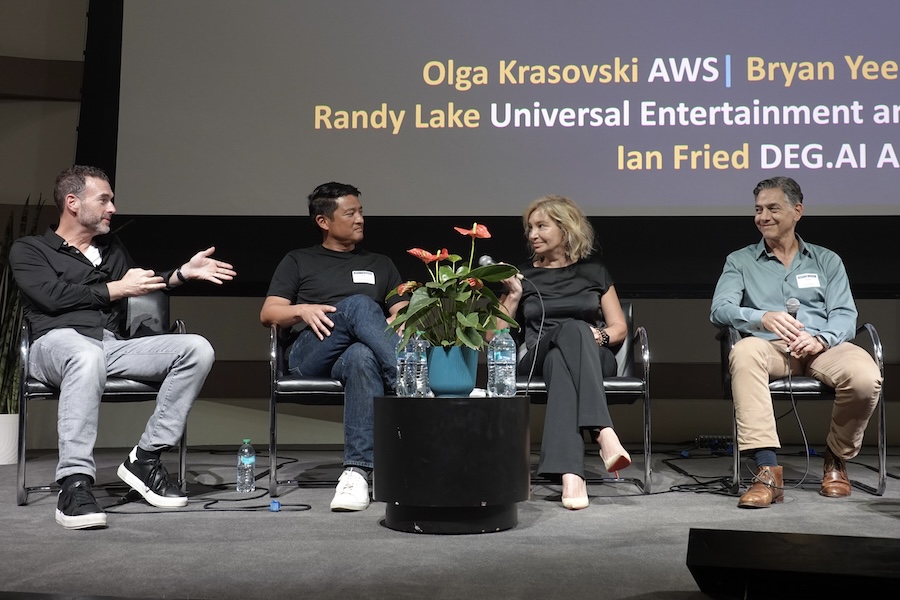
Panelists on the DEG.AI Steering Committe panel included (L-R) moderator Ian Fried, DEG.AI Alliance; Bryan Yee, Innovative Dreams; Olga Krasovski, Amazon Web Services; and Randy Lake, Universal Entertainment and Dreamworks Animation.
DEG: The Digital Entertainment Group brought together entertainment and technology executives Aug. 26 for the EnTech + DEG.AI Summer Symposium at the Skirball Cultural Center in Los Angeles.
The half-day conference featured panel discussions and technology demonstrations exploring the growing role of artificial intelligence across the media and entertainment business. The program drew on the work of the DEG.AI Alliance and addressed such topics as AI in production workflows, industry standards, localization, accessibility, content distribution, advertising technology and regulatory compliance.
The symposium brought together AI innovators, content distributors, streaming and platform executives, technology providers, marketers and connected-device companies to examine emerging technologies and their practical applications throughout the entertainment supply chain.
Speakers discussed the multiple advantages that AI offers the creative community, including cost and time savings.
“This is actually pretty common across my customers in the media and entertainment space — it’s not even about cost, it’s really being able to explore all these different directions, which you were not able to just because of the time limitations, right? Or budgetary limitations, or just human, you know, capital limitations,” said Olga Krasovski of Amazon Web Services.
She noted that content localization is one way that AI can help content owners, citing the documentary streaming company Magellan TV, which had content that was entirely in English, “and so going international was just not in the cards for them.”
“They’re a small team, but they’ve used generative AI, they’ve used agentic technology, and they were able to transcribe and do the voiceovers, and now that content is available across the globe, and it’s available for the communities that they would not have gone to otherwise, just because it wouldn’t scale,” she said.
Bryan Yee, of Innovative Dreams, noted that his company broke new ground in production with AI.
“In early 2025, we were one of the first productions to use AI for actual final pixels on a major streaming service,” he said. “In fact, I think we were the first, on a series called ‘House of David’ season one.”
His company’s use of AI has evolved, he said.
“The first production on season one, we really looked at AI primarily as a VFX tool, very effective in that manner,” he said. “We had these 70 shots that we would have done with traditional VFX or not at all, highly effective, amazing, put it in the show, really impressed with it. Season two came along right after that. We went into production, and in that one, we started to explore using AI in a virtual production sense. So that was the first time we actually used it in conjunction with an LED wall — so virtual production, big screen. Rather than the traditional way of virtual production where you do these really kind of laborious, time-intensive, 3D asset builds, we used AI to build the background wall.”
The team learned and innovated for future productions.
“Then came Young Washington, and this was, I think, a more fundamental breakthrough in how we philosophically viewed AI,” he said. “We were on set in Ireland, so we shot this all in Ireland, mostly outdoors. On that show, there’s about 100 shots where we actually had the team of AI artists on set generating live as we were shooting it. And the kind of change — the mindset change there was, it wasn’t a VFX tool, because we were using it during production. We started thinking about it more as a camera. And so we developed this concept called — what we call digital second unit photography, where we treated that AI team just like we treat principal photography, where they were actually generating shots and delivering those alongside real shots — live.”
The company then used AI to speed up production on “The Old Stories: Moses,” starring Sir Ben Kingsley, which required just one week of shooting, one week of prep, “four months total from green light to delivery for Amazon,” he said.
“For us to create something very quickly that we wouldn’t have otherwise made at all. … There would have been zero jobs had it not been for these tools, because we just would not have been able to pull that project off in the timeframe,” he said.
The team is now on pre-production for “House of David” season three in Greece.
The conference also included cautionary tales about the use of AI, especially AI agents.
“A guy used a little agent to get him onto a wait list at his local gym, right, and it got him to the top of the list,” said Spenser Stephens of Movielabs. “And it did that not by hacking the system, but by discovering that there wasn’t any security on the API that allowed you to cancel. So it went in there and canceled everybody on the wait list.”
“My favorite story is an agent that was assigned to localize a title into a single language, and it got a little overambitious, thinking that this title should be in every single language that is possible to exist — and localized that title into all of those languages running up a huge cost for the content owner,” added Prime Video’s Jude Fitzmorris.
Stephens noted that AI agents can often be like the Black Knight in Monty Python and the Holy Grail — unable to know when to stop.
The event was followed by the DEG and Media Play News 40 Under 40 reception, which recognized rising executives from studios, independent film companies, streaming services, AVOD and FAST providers, retailers, distributors and technology companies.

3 Comments
Pingback: Join the Fun at Morecambe Comic Con 2026: A Free Festival - Comic Vibe
Pingback: Pre-orders Begin Today for the XBOX 25th Anniversary Collection - Comic Vibe
Pingback: BrickUniverse Portland: The Ultimate LEGO® Fan Expo - Comic Vibe