

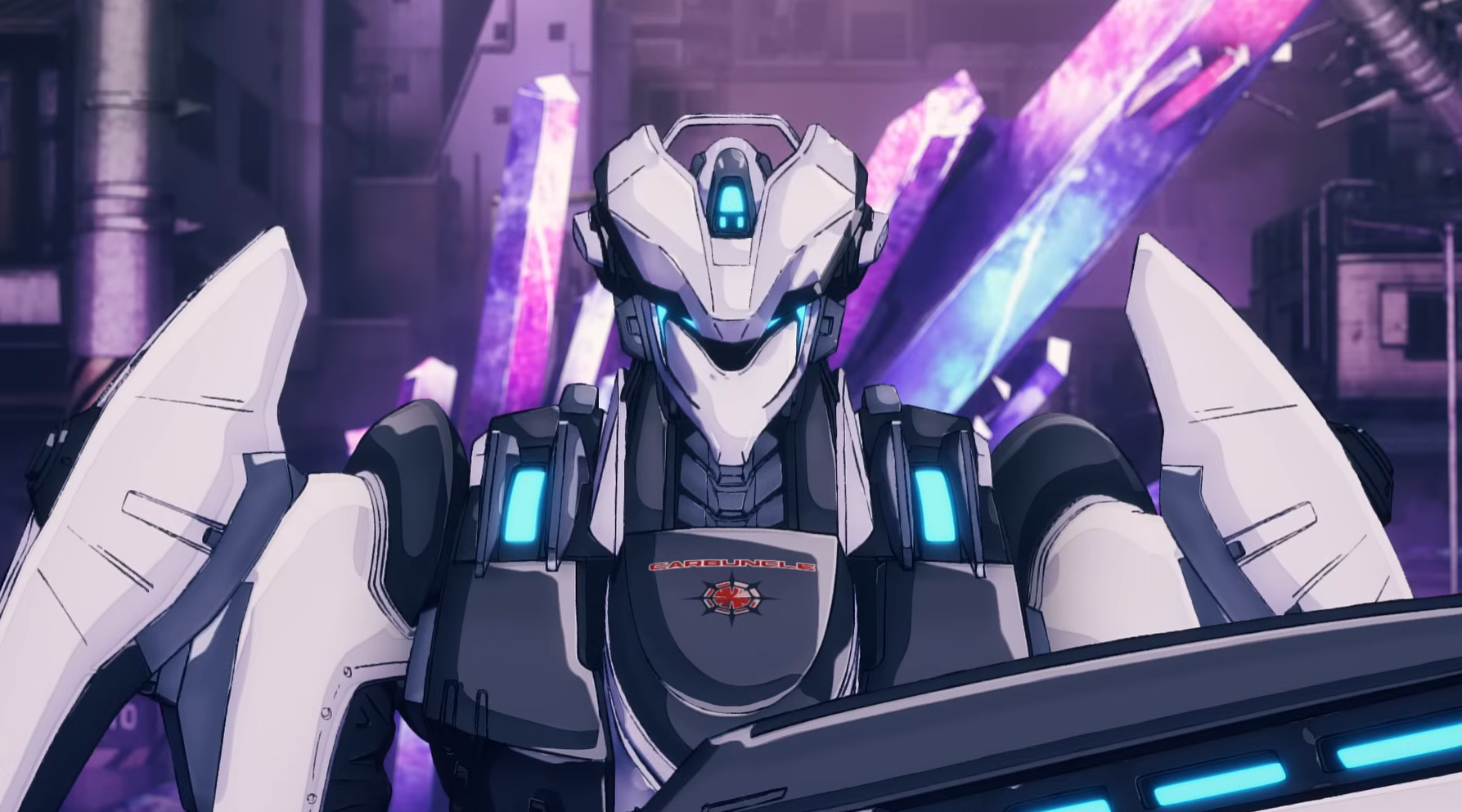
Fuji TV’s fall 2026 lineup now has a fixed anchor: Dark Machine – The Animation confirmed its October broadcast window on August 18, and with it came the most emotionally charged opening theme announcement of the season — BUCK-TICK, the Japanese gothic rock band that lost vocalist Atsushi Sakurai to a brainstem hemorrhage in October 2023, will perform the series’ opening theme, “Sonzai Riyū Kai.” The title translates as “Reason to Exist, Renewed.” The song is the band’s first major anime tie-in in its post-Sakurai form, performed by guitarists Hisashi Imai and Hidehiko Hoshino, who have shared lead vocal duties since Sakurai‘s death.
This is not an ordinary theme song selection. The kanji at the heart of the title — 改, pronounced kai — means amendment, revision, and rebuilding. It is the same character used when a law is revised or a product is upgraded. For a band now performing under the name of a group whose defining voice is gone, contributing a song literally titled “renewed reason to exist” to a series about humanity surviving an energy catastrophe is not coincidence — it is, deliberately or not, the most precise possible statement of artistic intent. The band’s Imai posted on Instagram after Sakurai’s death: “I wanted to play guitar by Acchan’s side forever. But, well. We’ll keep going, alright?” “Sonzai Riyū Kai” is the musical answer to that sentence.
Dark Machine – The Animation is scheduled to premiere on Fuji TV in October 2026. A specific broadcast date and time have not yet been announced. Global streaming distribution has not been confirmed. The series is produced at Studio Production +h. — the team behind The Orbital Children and Dead Dead Demon’s Dededede Destruction — and directed by Kazumi Terada. Creative producer is Gorō Taniguchi, director of Code Geass and One Piece Film: Red. Lead mecha designer is Hidetaka Tenjin, a veteran of the Macross franchise.
Kairi, Rudra, and Golden Valley: What the Show Is Actually About
Dark Machine the series differs from Dark Machine the Web3 game. The anime has its own self-contained world setting — one in which Dark Machine is not a video game but a real sport, a 7-on-7 mecha arena competition that has become so economically dominant it has restructured Japan’s geography. The region built around it is called “Golden Valley,” an exclusive economic zone controlled effectively by Ajima, the seventh “Senki” — a title given to the game’s top-ranked player.
The protagonist is Kairi, a young man who arrives in Golden Valley following the final instruction of his late grandfather: “Find Senki.” He is not a player, not a warrior, and not equipped for what he finds. Almost immediately he encounters Rudra — a girl being pursued by Ajima’s subordinates — and his decision to intervene pulls him into the competitive brutality of the mecha arena. The series’ dramatic question is the same one that every sports-underdog narrative builds toward, but the stakes here are not a trophy: what Kairi is actually fighting for is access to the energy infrastructure that keeps the rest of the world alive.
The tone is not soft. The game’s world-building describes factory robots “transformed to fighting mechs” by underground factions competing for Palmer crystal resources — the fictional mineral whose energy output sustains the planetary bubble. The aesthetic register is post-apocalyptic economic realism: mechs that look like repurposed industrial equipment, a sport that functions as a proxy war for resource access, and a population divided sharply between those inside Golden Valley’s prosperity and everyone else. The emotional core — Kairi’s grief for his grandfather, his attachment to Rudra, his outsider status in a world that runs on mastery — is the specific detail that makes the premise feel lived-in rather than generic.
What Palmer Crystals Would Actually Have to Be
The game’s lore establishes the central premise: in 2079, a scientist named Dr. Robert Palmer discovered a mineral crystal capable of providing all the energy humanity would ever need, sustaining a planetary-scale energy bubble. Unfortunately, not all of humanity has benefited. Underground factions fight for access. The factory robots deployed to harvest this energye science is more interesting than it initially appears
The closest real-world analog to a crystal that converts ambient conditions into electrical energy is the piezoelectric class of materials — substances that generate electric charge under mechanical stress by displacing ions within their non-centrosymmetric lattice structures. The highest-performing piezoelectric materials in current use are PMN-PT single crystals (lead magnesium niobate-lead titanate), which have demonstrated electromechanical conversion efficiencies above 80% in controlled experimental conditions, according to a 2022 review published by the American Institute of Aeronautics and Astronautics. A single PMN-PT nanobelt fabricated at Princeton University’s PRISM lab achieved a piezoelectric constant approximately 2,100% higher than comparable zinc oxide nanostructures, as confirmed in Scientific Reports in 2016.
These are impressive figures. They are also nowhere near sufficient to sustain a planetary energy bubble. The reason is that piezoelectric materials require a mechanical input — vibration, compression, bending — to generate electrical output. They harvest energy that is already there in kinetic form. A fictional Palmer crystal that sustains a containment field around the planet would need to couple to some ambient cosmological energy field without requiring that field to first do mechanical work on the crystal. That is the speculative leap the fiction makes. Whether it is physically coherent depends entirely on what ambient energy field the crystal is coupling to — and if the series is borrowing from real cosmology, the answer points toward dark energy.
Dark Energy Has No Address: Why the Crystal Science Gets Genuinely Strange
The series positions a component of “dark energy” inside Palmer crystals as the destabilizing force that makes them dangerous — something that hyper-AI systems tried and apparently failed to weaponize. This is the most scientifically sophisticated piece of the worldbuilding, and it is also where the premise runs into the most interesting actual physics.
In real cosmology, dark energy accounts for roughly 68% of observable universe energy content. It is the mechanism behind the accelerating expansion of spacetime itself — and it is, critically, not a substance. It has no address. Asking where dark energy is located is like asking where the expansion of space is located: the question presupposes a localization that the phenomenon does not have. Einstein’s cosmological constant (Λ) describes it as the intrinsic energy density of empty space itself — a property of the vacuum, not a thing inside the vacuum.
This makes the fiction’s premise of dark energy “within” a crystal a genuine cosmological puzzle — but also, as of 2025, a more interesting puzzle than it was three years ago. The Dark Energy Spectroscopic Instrument (DESI) collaboration, which produced the largest three-dimensional map of the universe ever made using data from approximately 15 million galaxies and quasars, published results in March 2025 suggesting that dark energy may not be constant over time. The ΛCDM standard model — in which dark energy is an unchanging cosmological constant — appears to struggle to explain all observations simultaneously when they are combined. UCL cosmologist Ofer Lahav, a member of the DESI team, told CERN Courier in May 2025: “The subject needed a bit of a shake-up, and we’re now right on the boundary of seeing a whole new paradigm.”
If dark energy is evolving — weakening, or varying in density across cosmic time — that opens the door, at least as a fiction premise, to models where it behaves more like a scalar field than a constant. In cosmology, these are called quintessence models: a dynamical energy field permeating space that varies in density rather than remaining uniform. A quintessence field could, in principle, have local density variations. It could, in the right science-fictional extrapolation, concentrate under specific material conditions. Dark Machine’s lore does not use the word “quintessence,” but it is describing something structurally similar: a trace component of a distributed cosmological energy that has become localizable inside a crystalline structure.
The reason this remains firmly in science fiction is that no known material can couple selectively to such a field in a way that extracts net work without violating thermodynamic laws. The fictional gap between where physics is now — DESI showing hints of dynamism in dark energy’s behavior — and what Palmer crystals would require is real, measurable, and worth understanding.
Repurposed Robots and the Debate That Is Already Happening
The series’ underground factions repurposing factory automation robots into combat mechs is not pure speculation — it is science fiction grounded in a policy argument that was publicly joined in October 2022. Boston Dynamics and five other robotics companies (Agility Robotics, ANYbotics, Clearpath Robotics, Open Robotics, and Unitree Robotics) signed an open letter pledging not to weaponize their robots, stating that attaching weapons to “widely available” robots “capable of navigating to previously inaccessible locations where people live and work, raises new risks of harm and serious ethical issues.”
The pledge did not bind competitors. Ghost Robotics, which did not sign, has actively pursued U.S. military contracts for its Vision 60 quadruped — a robot the company’s CEO described as capable of “actually destroying a target.” The U.S. Space Force and Air Force have both tested Ghost Robotics machines for base patrol.
The mecha design philosophy chosen for Dark Machine — led by Hidetaka Tenjin, a Macross veteran — places the series firmly within Japanese animation’s “real robot” tradition: machines with visible industrial heritage, maintenance requirements, and physical constraints, as opposed to the “super robot” tradition of implausibly omnipotent machines. This is an aesthetic choice that reinforces the worldbuilding’s central political claim: these combat mechs are tools that were converted, not weapons that were designed. Under existing international humanitarian law debates about lethal autonomous weapons systems (LAWS), that distinction carries legal weight — and the series, knowingly or not, is dramatizing exactly the question that UN Convention on Certain Conventional Weapons discussions have not yet resolved.
Why BUCK-TICK, Why This Title, Why Now
BUCK-TICK made their major-label debut in 1987 and went on to release 23 studio albums across four decades with their original lineup, nearly all reaching the Oricon top ten. Their prior anime tie-ins include the opening theme for Shiki (2010’s horror classic about a village’s vampire infestation), the Nightwalker and Trinity Blood themes, and contributions to xxxHOLiC and GeGeGe no Kitarō. They were one of the founding bands of the Visual Kei movement — the Japanese music genre defined by musicians using elaborate visual aesthetics as an extension of sonic identity — and their 38-year run with an unchanged lineup was, until October 2023, the kind of institutional stability that music scenes rarely produce.
Vocalist Atsushi Sakurai died October 19, 2023, of a brainstem hemorrhage, while performing at a fan club-exclusive concert at KT Zepp Yokohama. He was 57. The band performed a memorial concert at the Nippon Budokan on December 29, 2023 — 71 days after his death, with Sakurai’s spotlight left on stage — and announced their continuation. The single “Raijin Fūjin – Resonance” followed on November 20, 2024, with Imai and Hoshino sharing lead vocals. The album SUBROSA arrived in December 2024.
“Sonzai Riyū Kai” is the first time the reconstituted BUCK-TICK has attached its name to a major anime production. The fact that the title’s kanji — 存在理由 改 — means not just “reason to exist” but specifically “reason to exist, revised/rebuilt” makes it impossible to read as an ordinary theme song. It maps too precisely onto both the series’ premise (humanity surviving inside an energy bubble, fighting for its continued existence) and the band’s actual situation (a band rebuilding its reason to exist after the death of its defining voice).
Jean-Paul Sartre’s existentialism holds that existence precedes essence — that there is no pre-given purpose, and that individuals define themselves through choices made under conditions of radical freedom. Whether the creators of Dark Machine intended their energy-bubble survivors to be existentialist protagonists or simply wanted a sci-fi action backdrop, the thematic architecture lines up: the Palmer crystal bubble does not give humanity purpose; it only gives humanity survival. What they do with it — and who gets to decide — is the question the underground factions are fighting over with repurposed factory robots. BUCK-TICK, performing a song about a renewed reason to exist, is singing exactly that question.
What the Credentials Signal for October
Production +h. is a small but precision-crafted studio. The Orbital Children (2022, directed by Makoto Shinkai collaborator Mitsuo Iso) and Dead Dead Demon’s Dededede Destruction (2024) both demonstrated a capacity for high-quality sci-fi production with genuine thematic substance. Bringing that studio together with Code Geass’s Gorō Taniguchi as creative producer, Macross’s Hidetaka Tenjin on mecha design, and a sound production team including BloomZ Inc. sound production team (NASDAQ: BLMZ) signals an adaptation with ambitions beyond game promotion.
The series was first announced at Comic-Con International in July 2024, when the pilot trailer screened at the project’s panel. The game itself — a Web3-based 7-on-7 mecha arena shooter built on Unreal Engine 5, developed by Project Carbuncle with backing from Tencent, blockchain platform Immutable, and blockchain company Sui — raised more than $8.7 million from more than 6,000 investors. The game has been in full release since 2025. The anime has its own distinct world setting rather than a direct adaptation of the game’s lore, which is a production decision that typically signals the creative team has a specific story to tell rather than simply a promotional vehicle to produce.
Dark Machine – The Animation will premiere on Fuji TV in October 2026. A specific date has not been announced. Global streaming rights have not been confirmed.
Frequently Asked Questions
What is Dark Machine – The Animation about?
The anime follows Kairi, a young man who arrives in “Golden Valley” — an economic zone in Japan dominated by the esports arena game Dark Machine — following his late grandfather’s dying wish to “find Senki,” the title given to the game’s most powerful player. After an encounter with Rudra, a girl being pursued by the current Senki’s subordinates, Kairi is drawn into the mecha arena battles that effectively control access to the Palmer crystal energy resources keeping the rest of humanity alive. The series is set in 2079, where an energy crisis forced humanity into a dependency on a fictional crystalline energy source, and underground factions fight for access using repurposed factory robots converted into combat mechs.
Is BUCK-TICK still making music after Atsushi Sakurai’s death?
Yes. Following Sakurai’s death from a brainstem hemorrhage on October 19, 2023 — at age 57, during a live performance — the remaining four members chose to continue the band. Guitarists Hisashi Imai and Hidehiko Hoshino share lead vocal duties. The band released the single “Raijin Fūjin – Resonance” on November 20, 2024, followed by the album SUBROSA in December 2024. “Sonzai Riyū Kai,” the opening theme for Dark Machine – The Animation, is their first major anime tie-in as a reconstituted band.
If dark energy makes up most of the universe, why can’t it be harvested like the Palmer crystals in the show?
Real dark energy is not a substance that occupies space — it is a property of spacetime geometry itself. Einstein’s cosmological constant describes it as the intrinsic energy density of empty space, uniformly distributed rather than concentrated in any material. You cannot put it in a crystal because it has no location to extract it from. The Dark Energy Spectroscopic Instrument (DESI), using data from approximately 15 million galaxies, released results in 2025 suggesting dark energy may not be constant over time — it may be weakening — which opens theoretical room for models where dark energy behaves more like a dynamical scalar field (called “quintessence”) that could theoretically have local density variations. Dark Machine’s Palmer crystal is best read as a speculative quintessence concentrator operating in a physics far beyond what current science can produce or even describe coherently.
What is the real-robot design philosophy, and why does it matter for Dark Machine?
In mecha anime, “super robots” are implausibly omnipotent machines that operate outside physical constraints, while “real robots” — a tradition pioneered by Yoshiyuki Tomino’s Mobile Suit Gundam in 1979 and continued through Macross — are machines with industrial heritage, maintenance requirements, and physical limitations. Dark Machine’s lead mecha designer, Hidetaka Tenjin, is a veteran of the Macross franchise, and the premise of factory robots repurposed into combat mechs is definitionally real-robot: these are converted tools, not purpose-built weapons. That distinction matters beyond aesthetics, because under international humanitarian law debates on lethal autonomous weapon systems (LAWS), the question of whether a machine was designed for combat or converted to it carries legal and ethical weight that is currently unresolved in UN negotiations.
ⓒ 2026 TECHTIMES.com All rights reserved. Do not reproduce without permission.
