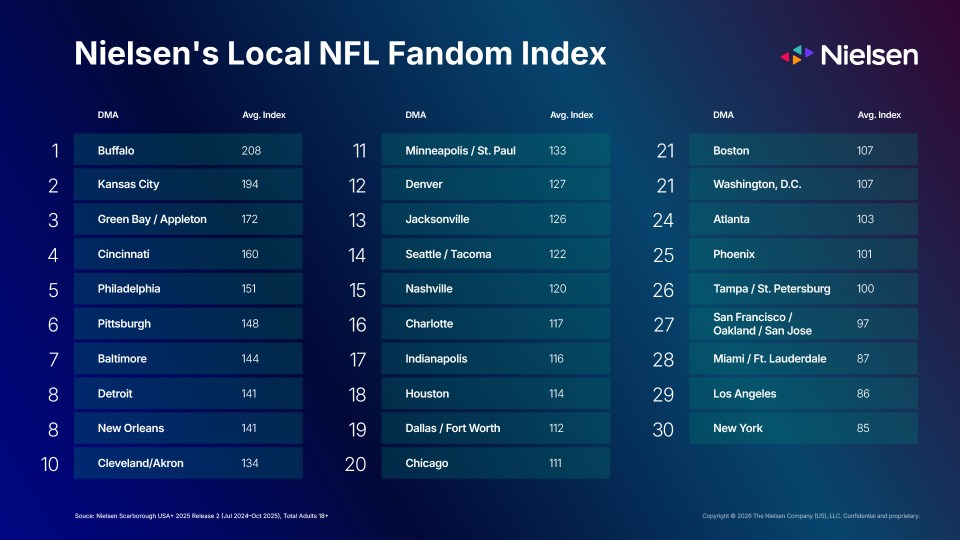
As the NFL prepares to kick off another season following record-breaking viewership in 2025, Nielsen has officially launched the inaugural “Nielsen Scarborough NFL Fandom Index.” This comprehensive study moves beyond simple headcount to identify where the sport’s pulse beats strongest, revealing that America’s most avid fans are often found in the heart of its mid-sized legacy markets.
The data identifies Buffalo, Kansas City, and Green Bay as the top three most passionate markets, followed closely by Cincinnati and Philadelphia.
Unlike traditional rankings that rely solely on ratings, Nielsen’s methodology utilizes eight distinct metrics to capture the full spectrum of modern fandom: apparel purchases, general interest levels, live event attendance, betting intent, social media engagement, radio listenership, streaming habits, and linear TV viewership.
A striking trend emerges: the “small market, concentrated loyalty” pattern. Legacy markets like those in the AFC North—Cincinnati, Baltimore, Pittsburgh, and Cleveland—form a high-intensity cluster; all four finish in the top 10 overall, and their strength is driven primarily by conventional, localized factors like local radio, TV, and live-event attendance rather than betting or streaming.
The pattern extends well beyond the AFC North. Radio listenership is especially concentrated: aside from the “big three” of Buffalo, Green Bay, and Kansas City, Cleveland/Akron, Cincinnati, Minneapolis/St. Paul, and Pittsburgh index the highest for listening to games on the radio. Broadcast and cable viewership tells a similar story, with Cincinnati, Minneapolis, and Pittsburgh joining Green Bay, Buffalo, and Kansas City at the top. That same cluster, plus Baltimore, also dominates live-event attendance. These are one-team markets with strong local identity and fewer competing entertainment options — a combination that inflates per-capita engagement well beyond what market size alone would predict.
Philadelphia and Cincinnati earned their spots not by dominating any single behavior, but by showing up everywhere. Neither market leads a single metric outright, yet both land in the top five on five of the eight questions the index tracks. That breadth, rather than any one standout behavior, is what pushes the two cities to #5 and #4 overall — well ahead of markets that post a single eye-catching number but little consistency elsewhere.
Merchandise tells its own regional story. Detroit (#5 in apparel) and Green Bay (#4) both rank in apparel purchases far ahead of what their market size would suggest — Detroit riding the momentum of the Lions’ recent on-field success, and Green Bay drawing on generations of Packers fan culture that has made the Green and Gold a wardrobe staple well beyond Wisconsin.
Conversely, large multi-option media hubs such as New York, Los Angeles, and Miami underperformed. In these saturated markets, a wealth of entertainment options and split team loyalties often dilute per-capita intensity, leaving New York at the very bottom of the index.
The study also highlighted specialized digital behaviors. While Indianapolis emerged as a social-media-forward market, Denver and Jacksonville showed a significant skew toward streaming, suggesting younger or more digitally-native fan bases.
Whether through generational loyalty in Green Bay, digital engagement in Denver, or the broad-based intensity of Philadelphia and Cincinnati, the Nielsen Scarborough NFL Fandom Index proves that while the NFL is a global powerhouse, its true strength lies in its local cultural footprint.