

Posted in: Comics, Heritage Sponsored, Vintage Paper | Tagged: Bill Parker, C.C. Beck, Fawcett Publications, Ned Pines, Pete Costanza, Ralph Daig
Sivana Invades America in Whiz Comics #3 (#2), at Auction
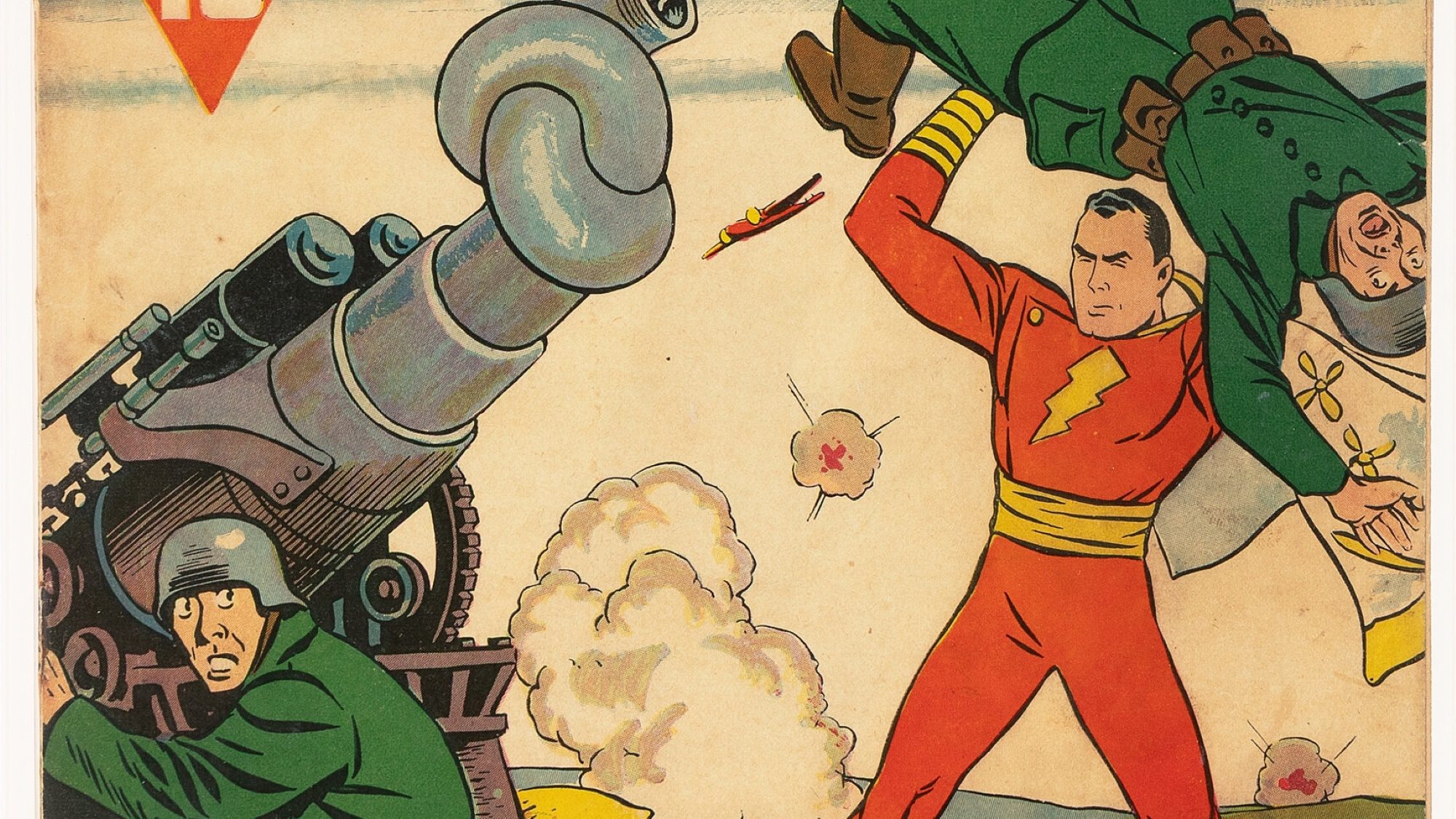
The second issue of Whiz Comics jumps head first into a United States invasion plot masterminded by Captain Marvel supervillain Sivana.
Article Summary
- Whiz Comics #3 (#2) is the second newsstand issue, with Fawcett’s early numbering quirks tracing Captain Marvel’s launch.
- Bill Parker’s testimony and Fawcett’s ashcan history explain how Whiz Comics evolved from Flash and Thrill Comics plans.
- In “Sivana Strikes Again,” Captain Marvel battles Sivana’s full-scale bid to conquer the United States with super-weapons.
- C. C. Beck’s crisp storytelling and Pete Costanza’s feature work make Whiz Comics #3 (#2) a key early Fawcett milestone.
Taken by its cover, Whiz Comics #3 is another one of those Golden Age comic books whose number does not quite mean what it seems to mean. It is the second newsstand issue of the series and the second publicly published release featuring Captain Marvel, following the Whiz Comics #2 debut. The issue itself carries no number on its C. C. Beck cover, while the indicia identifies it as volume 1, number 3. That is why collectors often describe it as Whiz Comics #3 (#2), but what Fawcett did over the next three issues is what makes that numbering clarification necessary.
The explanation for all of this reaches back to Fawcett’s entry into comic books. In his 1948 trial testimony, as published in Alter Ego #199, editor and writer Bill Parker recalled the moment Ralph Daigh handed him the assignment: “Mr. Daigh then told me he wanted to put out a comic magazine and he asked me if I would be interested in doing it.” Parker went on to connect that choice to his experience editing Fawcett’s detective and science-fiction magazines. As is well-settled history at this point, Parker also testified that Fawcett prepared Flash Comics and Thrill Comics ashcans containing the first Captain Marvel story with the character called Captain Thunder at that point, used to establish rights but never offered for sale. DC Comics’ All-American branch had gotten there first on the Flash Comics title, while Thrill Comics risked conflict with Ned Pines‘ long-established family of “Thrilling” pulp brands. By November 27, 1939, Advertising Age announced that Fawcett would soon distribute Whiz Comics. Its name drew on the publisher’s own Captain Billy’s Whiz Bang, and the unpublished ashcans were effectively considered #1 of the series, even though there is no known Whiz Comics ashcan.
Then Fawcett began resetting the numbering. The next release says #3 on the cover and volume 1, number 4 in the indicia. The following issue says #4 on the cover and number 5 inside. With the issue after that, both cover and indicia finally agree on #5. With that sequence of events, Fawcett brought the numbering back into line with the number of issues actually sold to the public.
Sivana Invades the United States
The featured Captain Marvel story of this issue, “Sivana Strikes Again,” jumps right into its expansive plot. Sivana orders the President to resign so that he can become “Emperor of the United States.” He then unleashes thousands of super-soldiers, hundreds of tanks, long-range guns, fast combat cars, aircraft, and parachute troops. Cities come under bombardment, tanks roll through the streets, and Billy Batson reports the fighting from a news plane before transforming into Captain Marvel. Beck’s exceptionally clear storytelling keeps that abundance of machinery readable, and his friendly, direct Captain Marvel already looks distinct from the field’s many grim Superman imitators. Parker’s contributions here extend well beyond the lead. He is credited with scripting seven of the issue’s comic features, moving among superhero, western, reporter, magician, sea-adventure, and spy stories.
The issue’s other major development comes in “Spy Smasher Unmasks.” A mysterious enemy uses a phantom bombing plane to attack a U.S. Navy experimental station and steal a new destroyer. The story then piles on fantastic military tech, including a submarine that can operate like an autogyro. At the end, Spy Smasher removes his mask, revealing his identity to Eve Corby. Pete Costanza worked with Beck on both Spy Smasher and Ibis the Invincible while drawing Golden Arrow himself. Costanza had entered commercial art through the pulps and joined Fawcett as it prepared its first comics.
Whiz Comics #3 (#2) brings together Captain Marvel’s second appearance on the newsstands, the realignment of the Whiz Comics numbering, and some heavily war-influenced stories. An essential early step in the rise of the World’s Mightiest Mortal, there’s a Whiz Comics #3 (#2) (Fawcett, 1940) CGC FN- 5.5 Off-white to white pages up for auction at the 2026 August 13 Golden Age Century Comics Showcase Auction V #40377.
Enjoyed this? Please share on social media!

Stay up-to-date and support the site by following Bleeding Cool on Google News today!
