

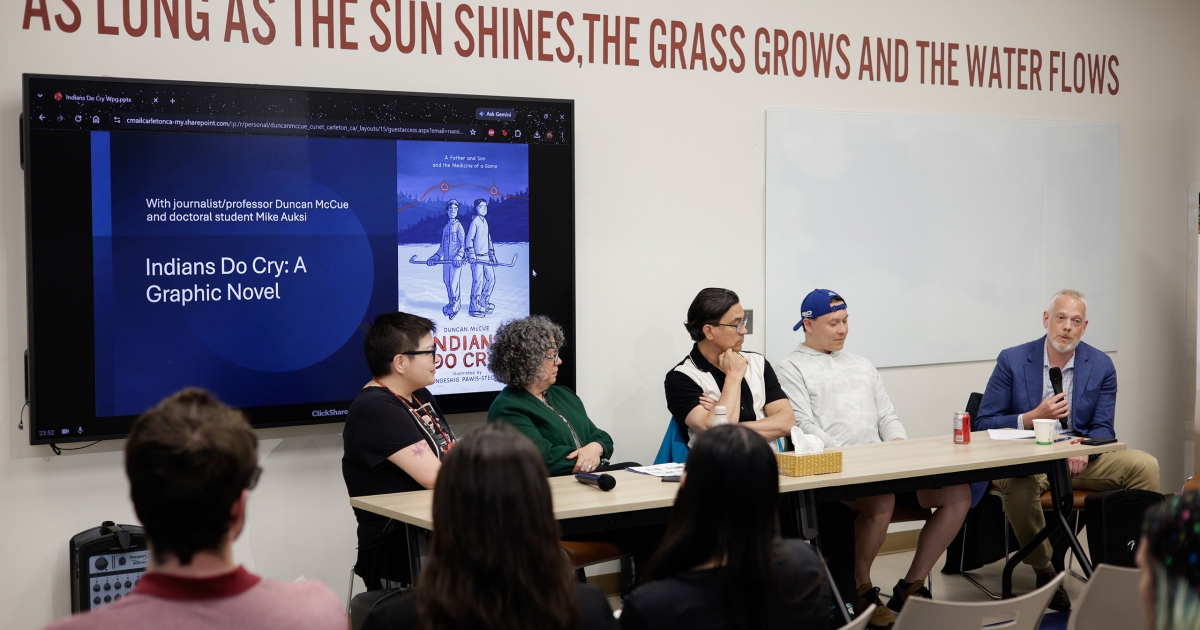
Superheroes wear many faces, sometimes that of a hockey dad who survived Residential School, and sometimes that of a Star Trek-loving Indigenous girl. Their stories, presented as graphic novels, can help readers visualize the lives of the characters in a more immediate and empathetic way. A summer research event held this past June at The Forks organized by Dr. Kjell Anderson, Associate Professor at the University of Manitoba’s Faculty of Law, brought together an engaging group of authors and visual story-tellers to share with the public, a glimpse of the impact graphic novels can have to raise awareness and empathy about traumatic experiences arising from experiences of Residential Schools, racism and genocide.
“What I love about graphic novels is how easily you can slip into the character’s shoes, said Anderson. “Academic articles keep you at arm’s length, but graphic storytelling pulls you right into the moment. These are real stories of suffering, love, loss, and perseverance—and they’re not just about survivors. They’re created alongside them.”
The public event held at Agowiidiwinan Centre (the Treaty Relations Commission of Manitoba building) featured former CBC journalist Duncan McCue (now an Associate Professor at Carleton University’s School of Journalism and Communication); Mike Auksi, a McGill University PhD student and Anishinaabe – Estonian hockey player; Sonya Ballantyne, a Swampy Cree filmmaker and graphic novelist; and Candida Rifkind, a University of Winnipeg professor who has written a book on refugee comics.
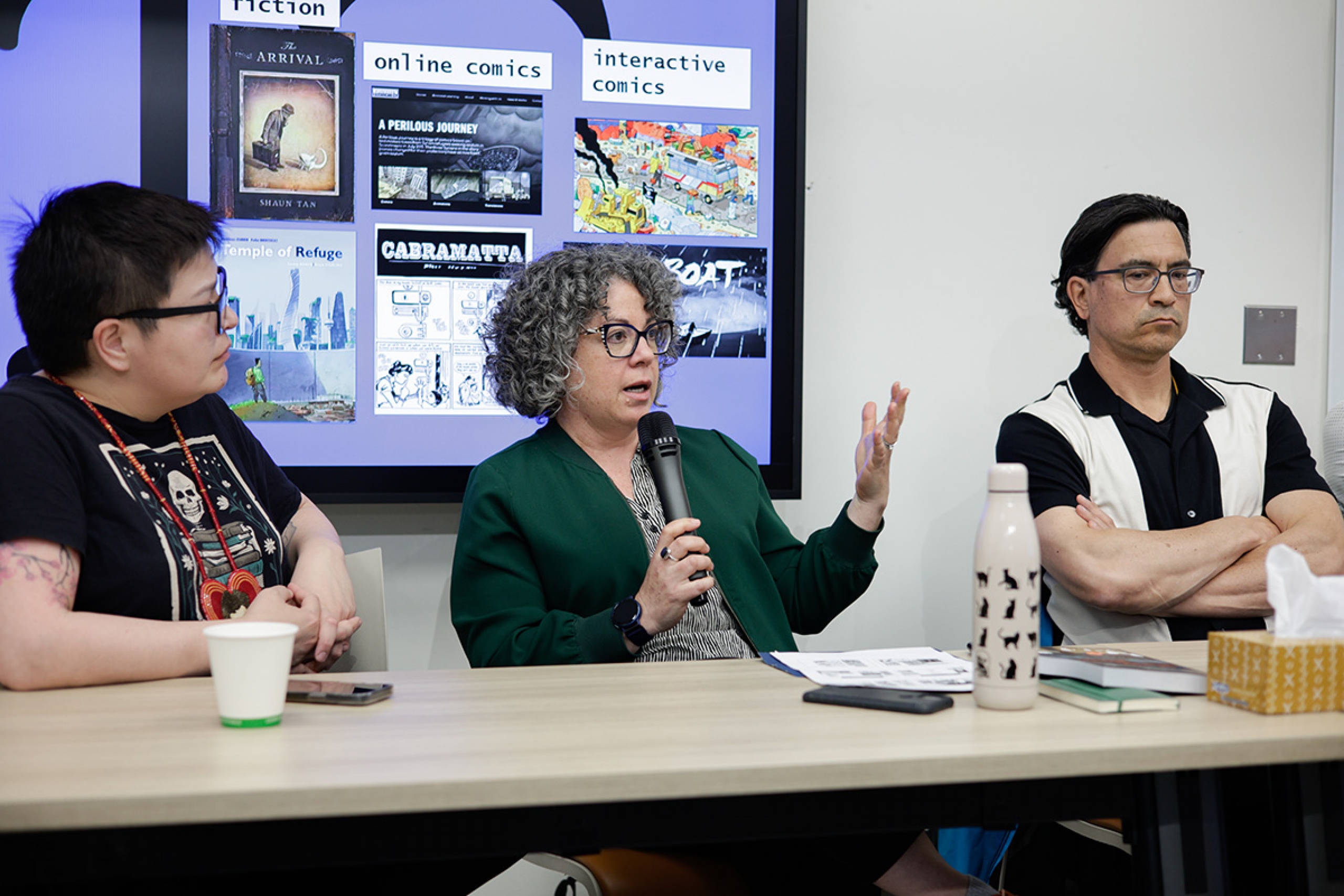
Candida Rifkind (middle), a professor in the Department of English, University of Winnipeg, discusses how graphic story-telling can help readers visualize the lives of refugees. Photo by Maddy Nowosad.
The panel discussion was part of the Annual General Meeting of “Survivor-Centred Visual Narratives,” a multi-year, international, interdisciplinary research project funded by the Social Sciences and Humanities Research Council of Canada. The project’s goal is to use graphic narratives, and other forms of visual storytelling, to educate about human rights and genocide. Specifically, the project is grounded in the co-creation of graphic novels with survivors of mass atrocities, artists, and scholars. It includes 11 graphic novels on Turtle Island (Indian Residential Schools), the Syrian Civil War, the Yezidi Genocide, the Genocide against the Tutsis in Rwanda, The Holocaust, the Bosnian Genocide, and atrocities in Kosovo. Anderson is co-lead of the project’s research cluster for Iraq and Syria, and is a social scientist and jurist whose interdisciplinary research examines mass atrocities and international crimes.
Anderson led the panel through a series of questions to examine how each of the three graphic novel creators used the visual narrative format to inform and educate readers, and to elicit empathy and emotional responses more viscerally than other story-telling formats. Anderson has co-edited, and contributed to the graphic novel, Don’t Give Up! How a young Yezidi survived the genocide, which was a collaboration between “Jilan” (pseudonym), a survivor of the 2014 genocide against the Yezidi, and graphic artist Birgit Weyhe. A corresponding documentary – I Just Keep Going – will be released soon.
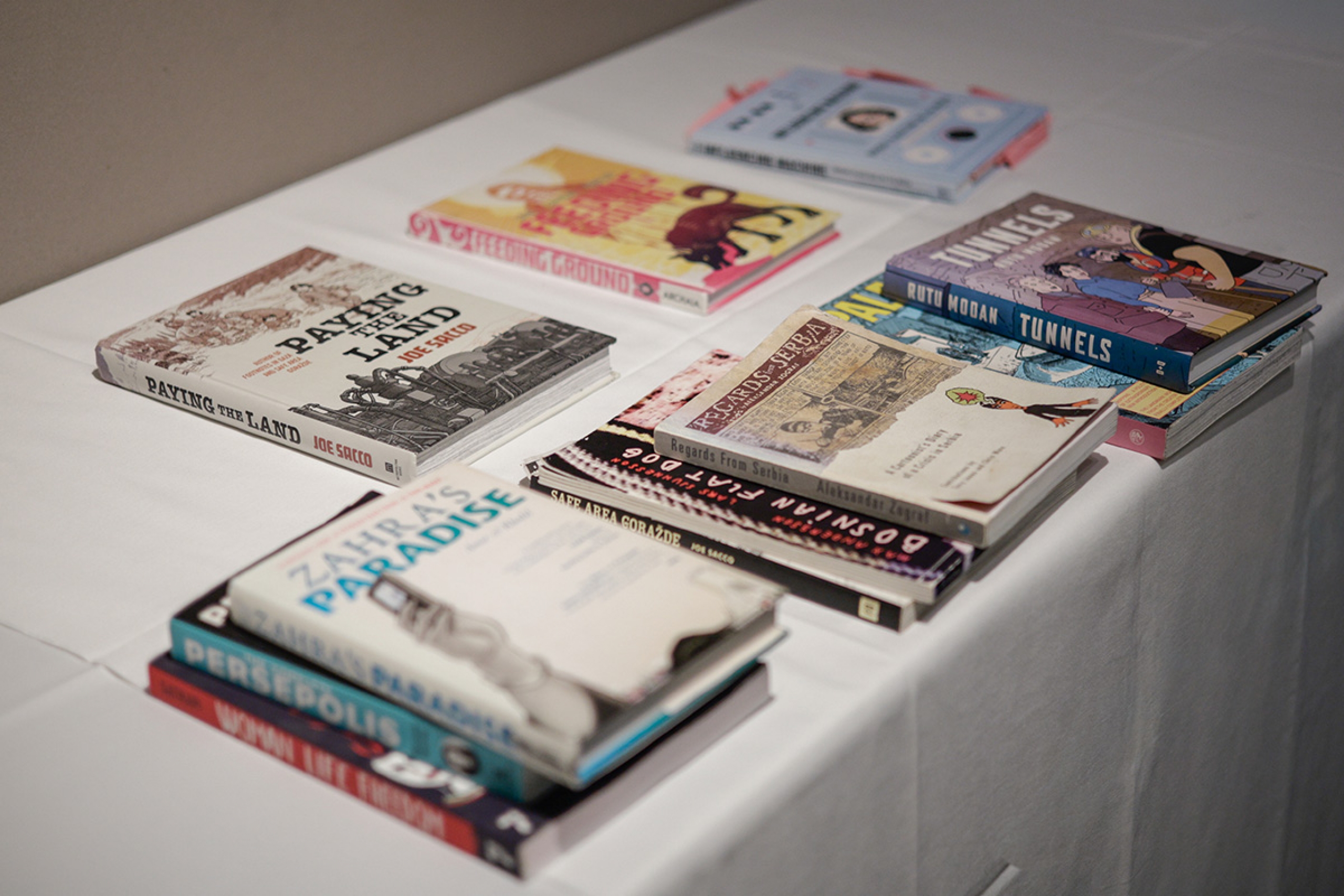
A selection of the graphic novels created as part of the Survivor-Centred Visual Narratives research project. Photo by Maddy Nowosad.
McCue had worked with Auksi to create Indians Do Cry: A Father-Son Hockey Story, illustrated by Mangeshig Pawis-Steckley, telling the story of the relationship of George Kenny, a residential school survivor, and his son, Auksi, and the healing power of hockey.
Rifkind had co-authored Graphic Refuge: Visuality and Mobility in Refugee Comics with Dominic Davies, the first in-depth study of comics about refugees, asylum seekers, migrants, and detainees. The study shows how comics challenge dominant representations of displaced persons, and help readers to visualize the lives of refugees.
Ballantyne shared her biography in comic format, The Unbeatable Sonya Ballantyne, her memoir about growing up on the rez, facing racism and bullying at school.
Information about the Survivor-Centred Visual Narratives graphic novels project can be found on the project website.
A video recording of the panel event can be seen on the UM Faculty of Law YouTube channel.
According to Anderson, curricula are currently in development for each of the project’s graphic novels for use in secondary school education.
Boilerplate: Research
For nearly 150 years, UM has transformed lives through groundbreaking research and homegrown innovation. We push the boundaries of knowledge and do the hard work here in Manitoba to move our community and the world forward. With a spirit of determination and discovery, we are shaping a better future for our province and beyond.
