

Posted in: Comics, Heritage Sponsored | Tagged: bob powell, Brookwood, harvey
Shock Gibson & the Forgotten Publisher of Speed Comics #1, at Auction
Speed Comics was one of the early Golden Age cornerstones of the Harvey Comics empire, but how it ended up there is a story in itself.
Article Summary
- Speed Comics #1 began at Brookwood before Harvey, making it a key Golden Age starting point for a major comics title.
- Shock Gibson debuts here, gaining immense power in a lightning-and-chemicals origin that echoes early Superman themes.
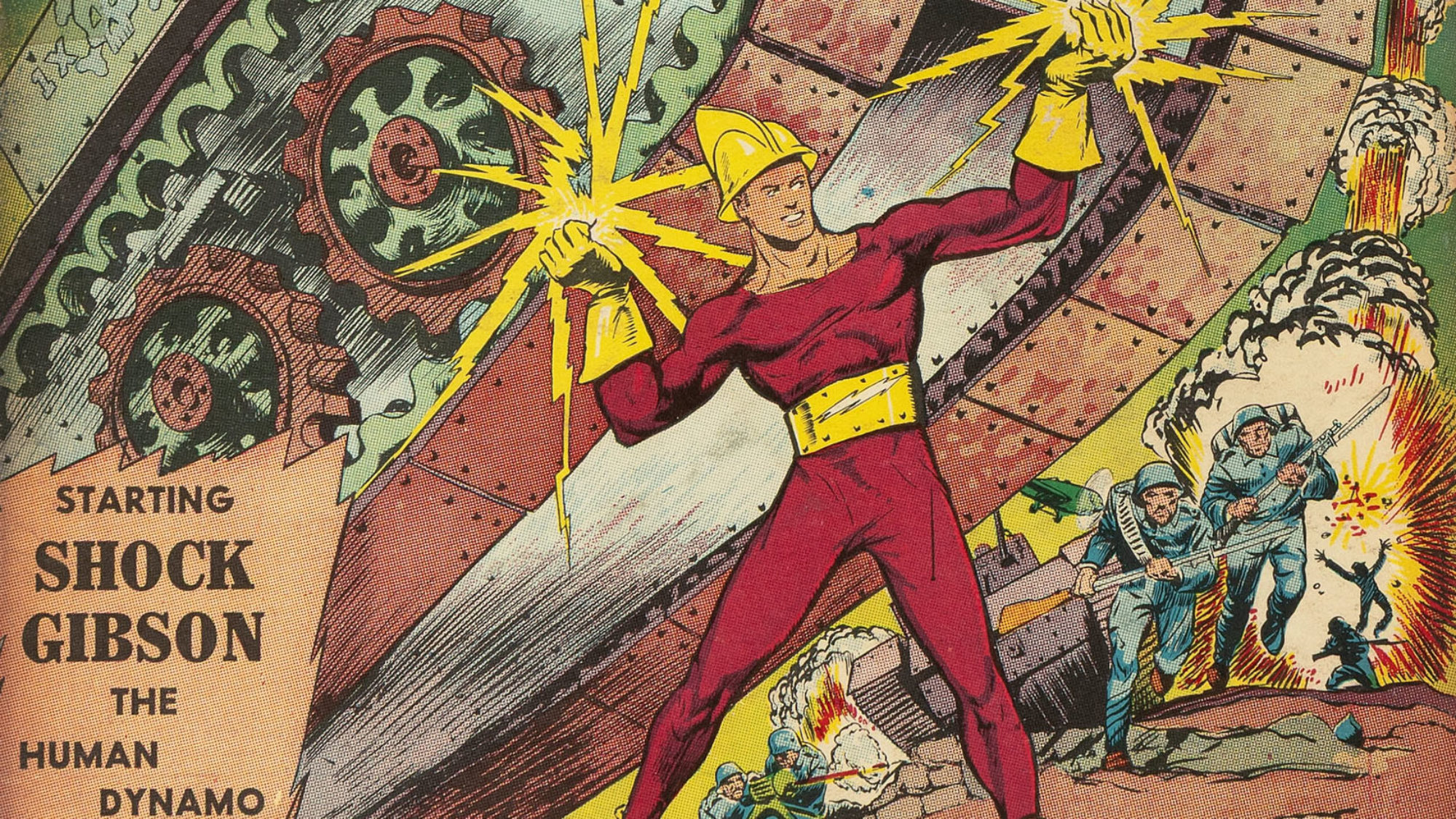
- The Bob Powell cover channels 1939 war anxiety, arriving just before World War II made battle imagery central in comics.
- With only 39 CGC copies on census, Speed Comics #1 remains a scarce and historically important early superhero debut.
A foundational and important Golden Age comic book title, Speed Comics is most often associated with the comic book publisher Harvey, but the series didn’t start there. It was launched by Brookwood Publishing Company, a short-lived operation associated with Frank Z. Temerson and editor Maurice Rosenfield. Brookwood published the first eleven issues. Harvey eventually acquired the title and began publishing it with issue #14.
Speed Comics #1 is the origin and first appearance of Shock Gibson, but it also represents the beginning of a title that Alfred Harvey and his brothers would later acquire and make an early backbone of their emerging line. The obvious war scene on the cover (possibly by Bob Powell) is interestingly similar in composition to Joe Shuster‘s cover of Action Comics #17, which was cover-dated the same month. Both issues likely hit newsstands in August 1939, seemingly tense with anticipation, along with the rest of the world, for what was to come. And then it did: Germany invaded Poland on September 1, and such themes in comics soon became more common.
Shock Gibson’s origin moment is a variation on a common Golden Age theme. Young scientist Charles Gibson is experimenting with electrical and chemical forces when lightning strikes the building, shatters his glassware, sprays him with chemicals, and passes through his body. His colleague, Dr. Blitzer, finds that he has somehow survived. Then comes the instinctual demonstration of power: when a steel girder falls, Gibson catches and bends it. Blitzer says that the accident has given him the strength of a thousand men, and Gibson vows to use that power only for humanity and fair play. Shock’s first heroic adventure is likewise pretty Superman-like. In a large eastern city, an honest contractor is being ruined by a political ring that has set an impossible construction deadline. Shock saves the man from jumping off an unfinished building, then completes a five-story steel frame himself in three hours. When one of the politicians refuses to talk, Shock tosses him into the air until he confesses. The confession leads to the final boss, a villain named Baron von Kampf, in a hidden base in the Rocky Mountains. Von Kampf has made creatures he calls zombies from animal parts.
Brookwood, Alabama
Brookwood Publishing Company’s principals were new to comics but not new to publishing itself. Temerson, Rosenfield, and Isaac W. Ullman had worked together in earlier magazine operations. An April 1940 trade notice placed Brookwood and another Temerson company at 381 Fourth Avenue after an earlier venture was being wound down. Temerson had identified Brookwood, Alabama, as his hometown in a 1913 graduation notice, and the company name appears to symbolize something personal to Temerson. He often used such personal connections when naming his companies. It’s widely known that the comics publisher Et-Es-Go, as a company name, was inspired by the shorthand for Temerson’s sisters Etta, Esther, and Goldie, and it’s less known that the publisher Helnit is named after Temerson’s nieces, Helen and Anita, who were Goldie’s daughters. Temerson had yet another imprint called Nita as well.
A later business dispute might give us some hint about Brookwood’s brief lifespan. In October 1940, Variety reported that Brookwood had sued distributor Kable News, alleging that it supplied 2,489,571 copies of Speed Comics from October 1939 through May 1940 under a June 1939 agreement. By the time of that Variety notice, Brookwood’s publishing history had ended. Brookwood had released issue #11 with an August 1940 cover date, and when the title returned in March 1941, #12 and #13 named Speed Publishing Company as publisher in the indicia. GCD associatesthat short-lived company with Leo Greenwald, though little information is available about this brief and seemingly tangled situation. Joe Simon: My Life in Comics suggests that Alfred Harvey’s acquisition of both Speed Comics and Champ Comics was financially backed by publishing and distribution magnate Irving S. Manheimer. As confirmed by his 1942 draft registration card, Manheimer was Leo Greenwald’s boss.
There are currently 39 copies of Speed Comics #1 on the CGC Census, 32 of those Universal, and 14 Universal copies graded higher. This series debut was launched into that magic later 1939 era that spawned a number of superheroes before anybody really knew where comic books were heading. Speed Comics #1 (Brookwood, 1939) is a stand-out example of that moment of history, an early cornerstone of what would become the Harvey Comics empire, and there’s a CGC VG+ 4.5 Cream to off-white pages copy up for auction at the 2026 August 13 Golden Age Century Comics Showcase Auction V #40377.
Enjoyed this? Please share on social media!

Stay up-to-date and support the site by following Bleeding Cool on Google News today!
