

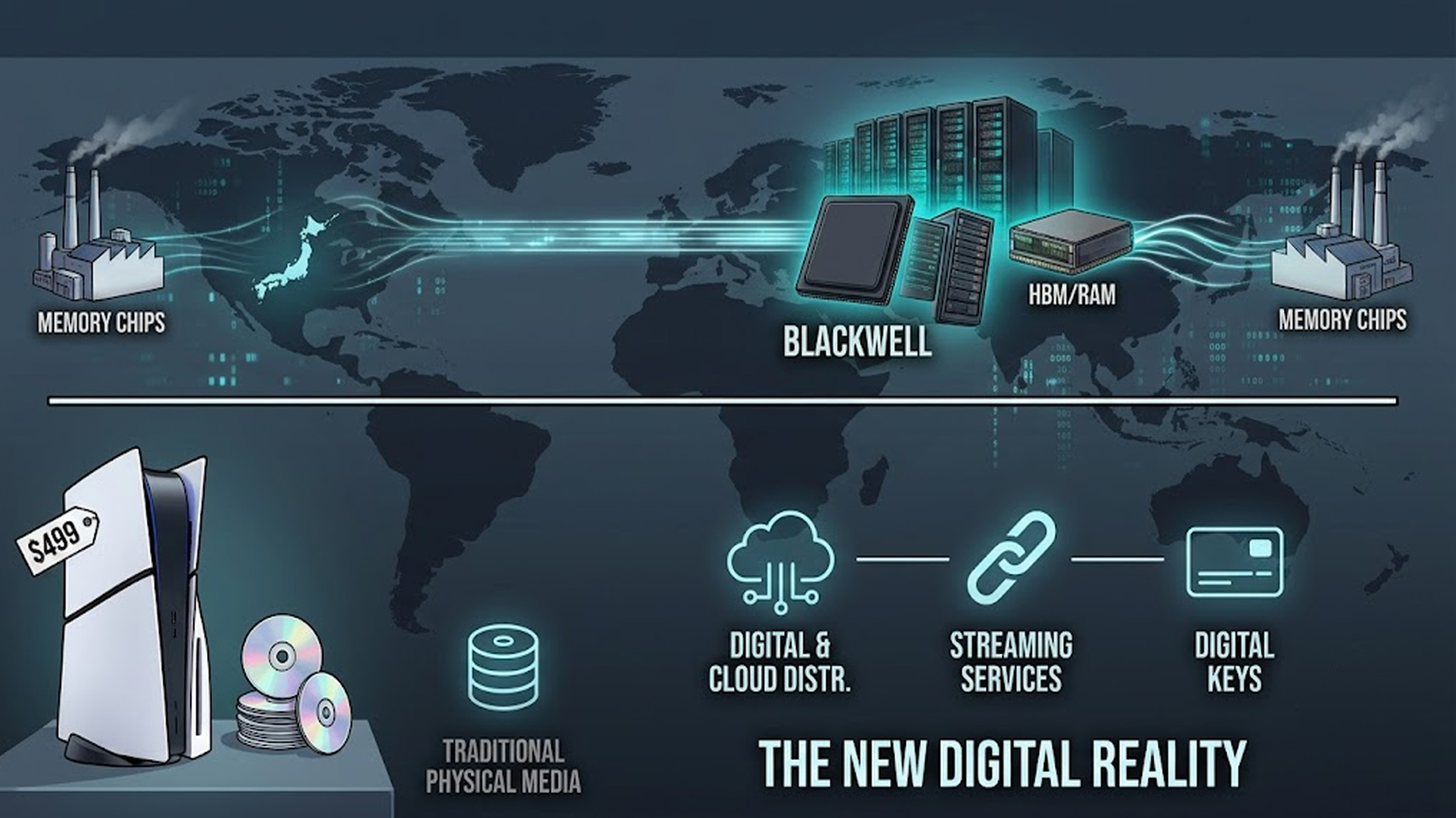
A surge in memory prices and a shift toward digital-only distribution are forcing manufacturers and developers to abandon traditional business models.
47 minutes ago
ERBIL (Kurdistan24) – For decades, video game consoles followed a familiar path. Hardware became cheaper over time, games grew more ambitious, and each new generation reached a wider audience than the last.
That model is beginning to unravel.
Six years after its launch, the <a href="https://comicvibe.com/kitguru-games-playstation-has-shot-itself-in-the-disc/” title=”KitGuru Games: PlayStation Has Shot Itself In The DISC”>PlayStation 5 has done something almost unheard of in consumer electronics. Instead of becoming cheaper, its price has climbed from $399 to $599. Nintendo has increased the price of the Switch 2, Xbox has raised console prices multiple times, physical game discs are disappearing, and thousands of developers have lost their jobs.
While these events may appear unrelated, they are increasingly tied together by a single force: the explosive global race to build artificial intelligence.
The world’s memory is running out
The crisis begins with one of the most overlooked components in modern computing—memory.
A PlayStation 5 contains 16 gigabytes of RAM, enough to power today’s most demanding games. By comparison, Nvidia’s latest Blackwell Ultra AI processor requires 288 gigabytes of memory—equivalent to the RAM inside 18 PlayStation 5 consoles.
The problem is not a single AI chip. AI companies purchase them by the thousands.
Massive server installations built by companies such as Microsoft, Amazon, Google, Meta, xAI, and OpenAI require enormous clusters of AI hardware. OpenAI’s planned Stargate campus alone is expected to consume memory on a scale measured in millions of PlayStation consoles.
Industry estimates now suggest that AI data centers are absorbing around 70% of the world’s total memory production, leaving every other technology sector—from smartphones and personal computers to electric vehicles and gaming consoles—to compete for what remains.
A supply controlled by only a handful of companies
The global memory market is remarkably concentrated.
Most of the world’s RAM is produced by Samsung, SK Hynix, and Micron, giving just three companies extraordinary influence over global supply.
Rather than rapidly expanding production, manufacturers have focused on serving the customers willing to pay the highest prices: the world’s largest technology companies racing to dominate artificial intelligence.
Profit margins on memory have reportedly climbed to between 70% and 80%, roughly double historical levels, reducing incentives to prioritize the consumer electronics market.
The result is a worldwide shortage that is pushing hardware prices sharply higher.
Gaming hardware becomes a luxury
The consequences are already visible across the gaming industry.
Within just three months late last year, the price of a standard 16GB RAM module increased by nearly 300%, dramatically increasing manufacturing costs.
Xbox CEO Asha Sharma described the scale of the inflation:
“The price we paid for console storage components was over two times as high as we paid last fall. These costs have since doubled again, and as we plan for the 2027 holiday season, we expect another significant increase, taking us over five times the prices we paid only two years earlier.”
The impact extends well beyond the major console manufacturers.
Executives in the Windows handheld gaming market have begun describing the sector as effectively “dead,” arguing that memory prices have made launching competitively priced products nearly impossible.
Even Valve, traditionally known for delivering strong value to gamers, recently introduced a Steam Machine priced at $1,049—illustrating how rapidly gaming hardware is shifting from an affordable household purchase toward a premium luxury product.
The slow disappearance of physical games
As manufacturing costs continue to rise, console makers are increasingly looking elsewhere to protect their profits.
One of the biggest shifts is the move away from physical media.
Sony has announced plans to end physical PlayStation game disc distribution by January 2028, accelerating the industry’s transition toward fully digital purchases.
The change would largely eliminate the second-hand game market, preventing players from buying used titles or lending games to friends.
Today’s price differences highlight why that matters.
A digital copy of Immortals of Aveum sells for £69.99 on the PlayStation Store, while physical copies can currently be purchased from third-party retailers for as little as £5.
Nintendo faces a similar challenge. Because Switch 2 cartridges rely on increasingly expensive flash memory, many publishers have begun shipping “game key cards” that contain little more than a download authorization, leaving players to download the entire game using their own storage.
The financial squeeze is also reshaping the games themselves.
Xbox has divested five major game studios and cut approximately 3,200 jobs, including around half of the workforce at id Software.
Industry analysts argue that rising hardware prices are shrinking the future console market, making publishers increasingly reluctant to invest in expensive original projects.
Rumors suggesting a PlayStation 6 launch price approaching $1,000 have only intensified those concerns.
Instead of taking creative risks, developers are increasingly turning toward established franchises and proven commercial successes.
Reports indicate that Obsidian has halted work on an unannounced original RPG in favor of developing the next Fallout title, while publishers continue leaning heavily on remasters and familiar intellectual property.
Meanwhile, companies including EA are exploring real-time advertising systems that could dynamically place commercials inside game worlds, creating yet another
The AI boom is reshaping far more than semiconductor supply chains.
As memory becomes more expensive, hardware grows costlier, development becomes more cautious, and publishers search for new ways to generate revenue, the economics of gaming are changing fundamentally.
Cloud gaming and mobile platforms increasingly appear to offer the industry’s most sustainable business models, while the traditional console experience—built on affordable hardware, physical ownership, and ambitious technological leaps—faces mounting pressure.
For gamers, the implications extend far beyond higher console prices. The industry’s next challenge may not simply be paying more to play, but adapting to a future in which ownership, innovation, and even the way games are experienced continue to evolve under the weight of the global AI race.
