

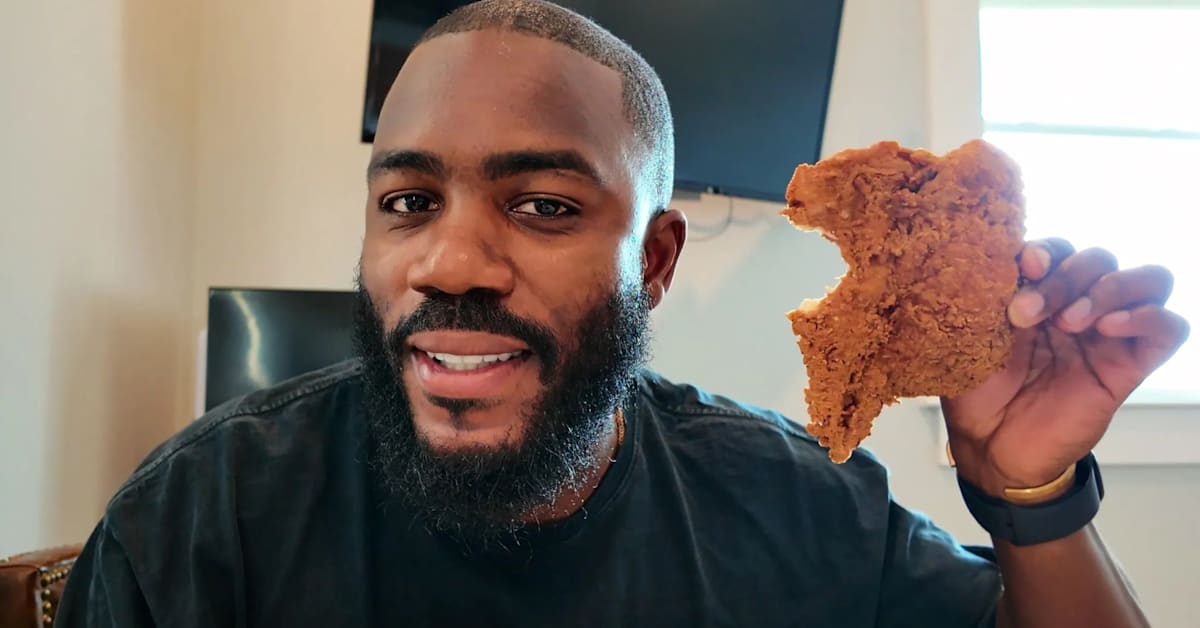
Mo Gilligan’s extreme fried chicken experiment exposes the dark side of fast food, from health risks and large-scale farming to the racial history behind a global obsession.
ByBernadette Giacomazzo
July 31, 2026
Key Takeaways
- Netflix’s upcoming documentary Big Chicken: A Fast Food Conspiracy follows comedian Mo Gilligan as he eats fried chicken three times a day for 28 days while investigating its cultural impact, health consequences, environmental cost, and the massive industry behind it.
- Gilligan, a Black British comedian, uses the film to challenge racist stereotypes linking Black people and fried chicken, tracing how a dish rooted in Black entrepreneurship was weaponized through Jim Crow–era minstrel shows, advertising, and films like “The Birth of a Nation.”
- The project is already being compared to Morgan Spurlock’s Super Size Me, whose scientific claims and legacy have since been discredited amid failed replications, Spurlock’s later admission of alcoholism during filming, and his 2017 confession of sexual misconduct before his death in 2024.
Netflix is betting big on fried chicken—but not everyone is sold on the recipe. The streamer’s upcoming documentary Big Chicken: A Fast Food Conspiracy follows comedian Mo Gilligan as he eats fried chicken three times a day for 28 straight days while investigating the food’s grip on global culture, public health, industrial farming, and race.
The stunt has already invited inevitable comparisons to Super Size Me, the once-celebrated documentary whose credibility has largely collapsed in the years since its release.
Premiering August 5, Big Chicken follows Gilligan from South London to the United States as he digs into the business behind one of the world’s most popular comfort foods. Along the way, he interviews historians, nutrition experts, farmers, medical professionals, and industry insiders while putting his own body through an experiment built around 84 fried chicken meals in four weeks.
The documentary also explores the environmental cost of mass poultry production and the economic machine fueling the industry’s explosive growth.
But Gilligan isn’t just chasing headlines with a food challenge. As a Black British comedian, he uses the documentary to confront the racist stereotypes that have long surrounded fried chicken and Black identity.
While fried chicken is enjoyed worldwide, its association with Black Americans in the U.S. was deliberately weaponized during the Jim Crow era through minstrel shows, racist advertising, and films like The Birth of a Nation, turning a food rooted in Black entrepreneurship and survival into a decades-long stereotype, according to the Jim Crow Museum.
“I thought I knew chicken. Turns out, I knew nowhere near enough,” Gilligan said to Radio Times while announcing the project. “From South London to the US, I wanted to understand where our obsession with fried chicken comes from, who profits from it, what it means for our health and the planet, and why this one food carries so much history.”
He said reclaiming that history became one of the documentary’s central goals: “As a Black British comedian, it was important for me to challenge the stereotypes around Black people and fried chicken, unpack where those ideas came from, and reclaim a dish that’s part of a much bigger story than the one we’ve been told.”
That cultural lens separates Big Chicken from the documentary it’s already being measured against. Morgan Spurlock’s Super Size Me became a pop-culture phenomenon in 2004 after documenting his month-long McDonald’s-only diet.
But the film’s scientific claims have since been widely challenged. Researchers who attempted to replicate the experiment failed to produce the same dramatic health outcomes, while critics argued that consuming roughly 5,000 calories a day and abandoning exercise proved little beyond the dangers of extreme overeating.
The documentary’s reputation deteriorated even further after Spurlock admitted years later that he had been a functioning alcoholic during filming—a revelation that cast fresh doubt on the liver damage attributed solely to McDonald’s.
His 2017 public admission of sexual misconduct also overshadowed his legacy, leading him to step away from his production company.
Spurlock died in May 2024 from complications related to cancer at age 53.
