

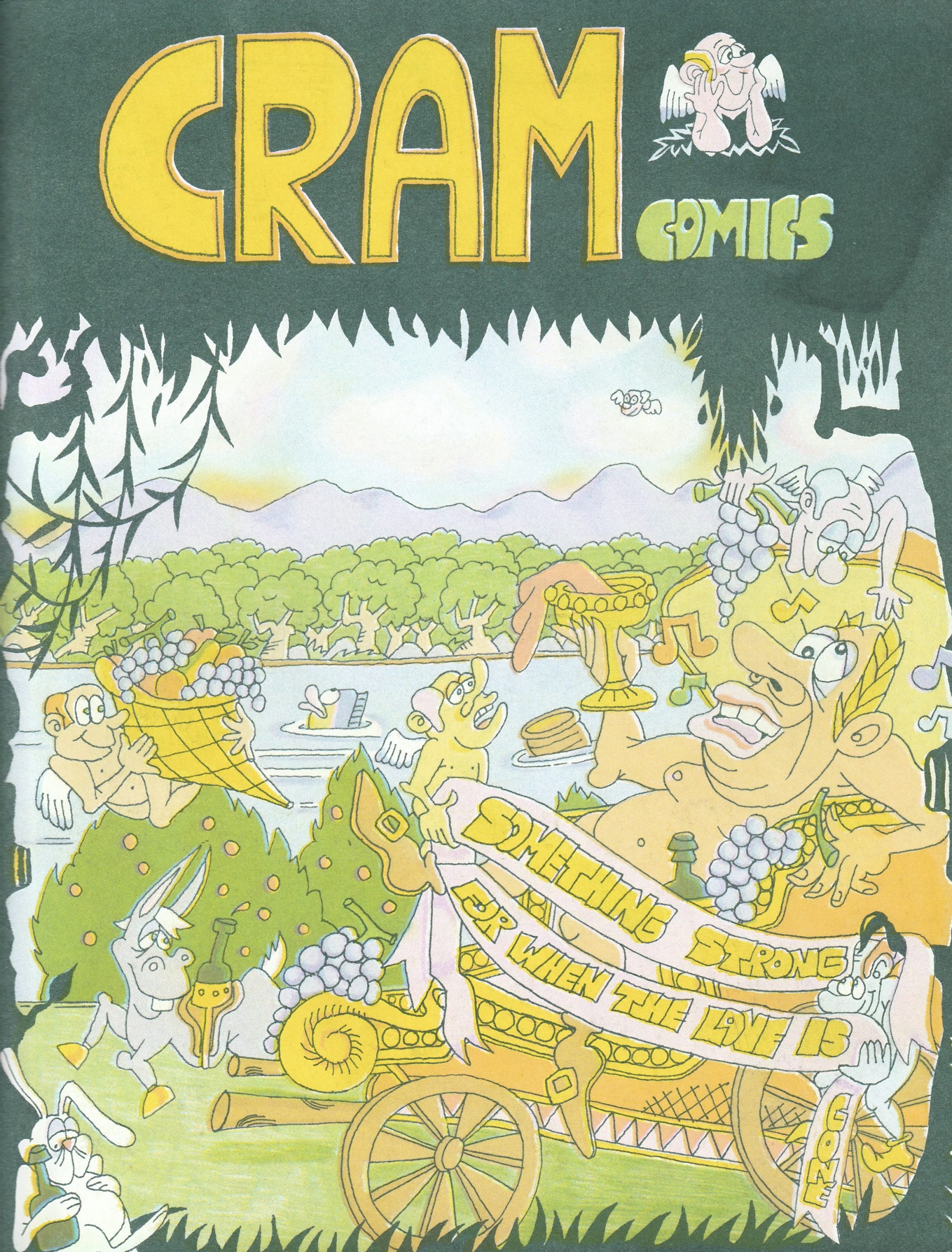
Lillian Ansell’s cover art to the fifth issue of Cram Comics gives us a partial idea of what to expect: a nude Bacchus sings while drunkenly slouching amidst a pastoral scene, all rendered in a loose style of cartooning straight out of a 1960s underground comic. This is going to squarely be a not-what-the-corporations-have-to-offer title, that much is clear; but will the contents necessarily be as colourful and carefree as the scene implies? After all, the theme of the issue (as seen on the banner held up over Bacchus’s nether regions by two balding cupids) is “Something Strong For When The Love Is Gone”, a phrase with rather heavier connotations than joyous inebriation.
Editor Andrew Alexander has pulled together nine short comic stories, each interpreting the given prompt in a different way. At the start we find Swayam Parekh’s single-page “Shabana, I Hate Tears,” a slice-of-life story about the relationship between a mother, a daughter and a family friend, Shabana Aunty. The mother embroiders a set of napkins as a present for Shabana’s 50th birthday: when Shabana fails to thank her even after a week, she is consumed by rage (“Who does she think she is?! It’s been a week! What kind of wretched, ungrateful person is this?!”) And so, it falls upon the daughter to visit Shabana and set things right. The strip’s whimsical drawing style, the mother being depicted with a literal halo above her head, belies the hard-nosed humor of what is, ultimately, a story about bitterness, resentment and problems being solved by yelling at people.
Less humorous is “The River Keeps on Flowing” by Anand. Set in India, the eight-page story outlines the life of an emotionally vulnerable young man who has no luck attracting a girlfriend, and finds solace watching romantic melodramas at the cinema. Then, for financial reasons, his friend’s parents marry their daughter off to him. He is told that the quiet, studious young woman secretly loved him all along, but is that really the case? Alas, real life (and slice-of-life comic strips) cannot be relied upon to provide conclusions as straightforward as those of movie formula.
“Fixing It” by Médar de la Cruz and Médar Serrata is framed as an anecdote told by a father to his grown-up son concerning a leaky bathroom tap. It goes on for twelve pages, managing to stretch out the narrative by finding new ways to make the (entirely plausible) situation more direr. First, the father struggles to find the right tool to unscrew a nut; then, the right implement to stop the ensuing flood; and then, the main valve to the apartment block. Where does the theme of lost love enter the picture? Well, present during the saga of the leaky tap are the man’s wife and children, and their presence allows a subtext about strained marriage: “Then your mom appeared. She saw me battling the raging water but just laughed, like she didn’t care if the building flooded. That’s when I knew she had it out for me.”
Nate Doyle’s four-page “Earthing,” the only entry not composed in panel-based comic-strip format, smashes its borders to exist as free-flowing images and poetic, first-person narrative captions. The narrative begins with the main character visiting a rural location to confront their grief, which is portrayed in visual terms as a series of hellish tortures. Precisely who the person has lost is less important than the emotions brought on by this loss: “Grief, the cost of love. In love there is loss. In loss there is love. It shatters, it comforts it grows… is it not beautiful?”
Romantic love is not the only form in which the issue’s themes manifest. In “Jumbie’s Muse” by Michael D. Kennedy, the protagonist is an artist; the love that has left him is the love of painting. The narrative follows the artist as he traipses through a black-and-white cityscape, where he encounters inspiration in the form of a shapeshifting pink cloud; all this is conveyed across eight pages with no dialogue, allowing plenty of space for the symbolism to spread like slowly-trickling ink. The comic makes a commendable effort to avoid the obvious, the open-to-interpretation climax allowing both of the figures become, in their own way, a touch frightening — who will consume the other, the artist or the now-human-shaped pink cloud?
Cram #5 also has some strips that take the broad theme as an opportunity to celebrate outright oddness. James Collier’s four-page “We’re Here” is a relatively quiet and reserved example, its two characters arriving by horse and cart at a garden owned by strange little people and containing similarly strange plants and animals. The characters’ dialogue is meandering and aimless (“Where?” “We’re in a heath” “What’s a heath?” “We’re in a heath” “Stupid question I guess”) and the narrative, such as it is, has the same loose and unstructured quality, the protagonists drifting around while pausing for meaningless interactions. Despite the absence of any meaningful events, the wobbly-outlined fantasyland is oddly inviting: when the two leads drop out after having a cloud of smoke blown into their faces, the strip succeeds in evoking the more unabashedly hippy-centric strain of old-school underground comix.
Despite a title that riffs on the countercultural literature of c. 1968, Sam Szabo’s “The Enlightened Transsexual in: The Electric Kool-Aid Acid Testosterone Blocker” turns out to be very “now” in is strangeness. The story introduces us to two characters, one named Sam and other named The Enlightened Transsexual: “The Yin and Yang of Yoni Baloney.” The former looks relatively normal; the latter has three eyes, three breasts, and skin that cycles through a rainbow of colors; together, they observe four pages’ worth of a “post-ironic, pre-apocalyptic age” from the comfort of a nuclear bunker. Their dialogue consists of fragmented political concepts, jumbled online cultural references and occasional glimpses of everyday conversation (“Yes, yes… puppygirl heteropessimism… skibidi blajah, and so forth…” “Babe, are you OK? You’ve barely TOUCHED your dada pastiche!”) Somehow, it all makes perfect sense.
Syd Madia’s eight-page “All the Time Aquatics” blends the sort of formalistic experimentation found in Nate Doyle’s piece with the oddness of Collier and Szabo’s contributions. The story follows an aquarium-keeper as he retreats from public and spends time with his fish; the fish are gaining limbs, while the aquarium-keeper seems eager to give his up. As with all the more surreal offerings in the issue, the relevance of the narrative to the overarching theme is ambiguous. We can, perhaps, infer that the man has lost his love for humanity, and feels that our ancestors abandoned something when they gave up for the sea.
The comic does a satisfying job of shaking up its contents for variety, so that, for example, the straightforward slice-of-life narrative of “Fixing It” is followed by the absurdism of “The Enlightened Transsexual.” Similarly, near the start of the issue, the funny-because-it’s-true humor of the one-page opener is followed by the single hardest-hitting entry in the entire anthology: Cameron Arthur’s eight-page “Sacred Heart”. The main character, Eric, is a prison guard; before we are introduced to his job, though, we are introduced to his personal life: he lives in a hotel and has the habit of collecting various odd little trinkets. During his next day at work, he finds another such curio — a religious drawing by one of the convicts — and adds it to his collection. The comic goes on to foreground Eric’s less-than-passionate relationship with his girlfriend; occurring in the background. Meanwhile, is the story of a how a small act can have serious consequences, and how the outwardly bland figure of Eric can hold life and death in his hands.
That detail of the story occurring between the lines is central to how Cram handles its romantic themes. The primary-colored jo
