

We were sitting in the Nejmeh supporters’ section at Beirut’s Camille Chamoun Sports City Stadium, watching the Lebanese football derby between Nejmeh and Ansar, accompanied by an Egyptian friend who supports Al Ahly back home.
As an Ansar fan blending into the Nejmeh crowd alongside my Nejmeh-supporting friends, and as someone who works in sports journalism, I found myself observing the match from a different perspective. Over the years, my enthusiasm for Lebanese football has waned as the quality of the game has declined, making these trips to the stadium an opportunity to understand better how fans react to what unfolds on the pitch.
Almost every whistle the referee blew against their team was met with protests from the crowd, accompanied by a torrent of insults and abuse, and sometimes even bottles thrown toward the field, even when the incident seemed straightforward, and the referee’s decision appeared correct.
I asked my Egyptian friend whether the same thing happened in Egypt. He laughed and recalled a time when he was watching an Al Ahly match from the stands. That day, he said, he completely lost his temper and started throwing objects onto the pitch because, in his view, the referee had failed to award his team six clear and indisputable penalties.
When he got home and watched the highlights, he realized that every one of the referee’s decisions had been correct. Not only had there been no penalties for his team, but he had been completely convinced they had been wronged simply because he was caught up in the emotion of the crowd.
From the Stadium Stands to the Virtual Crowd
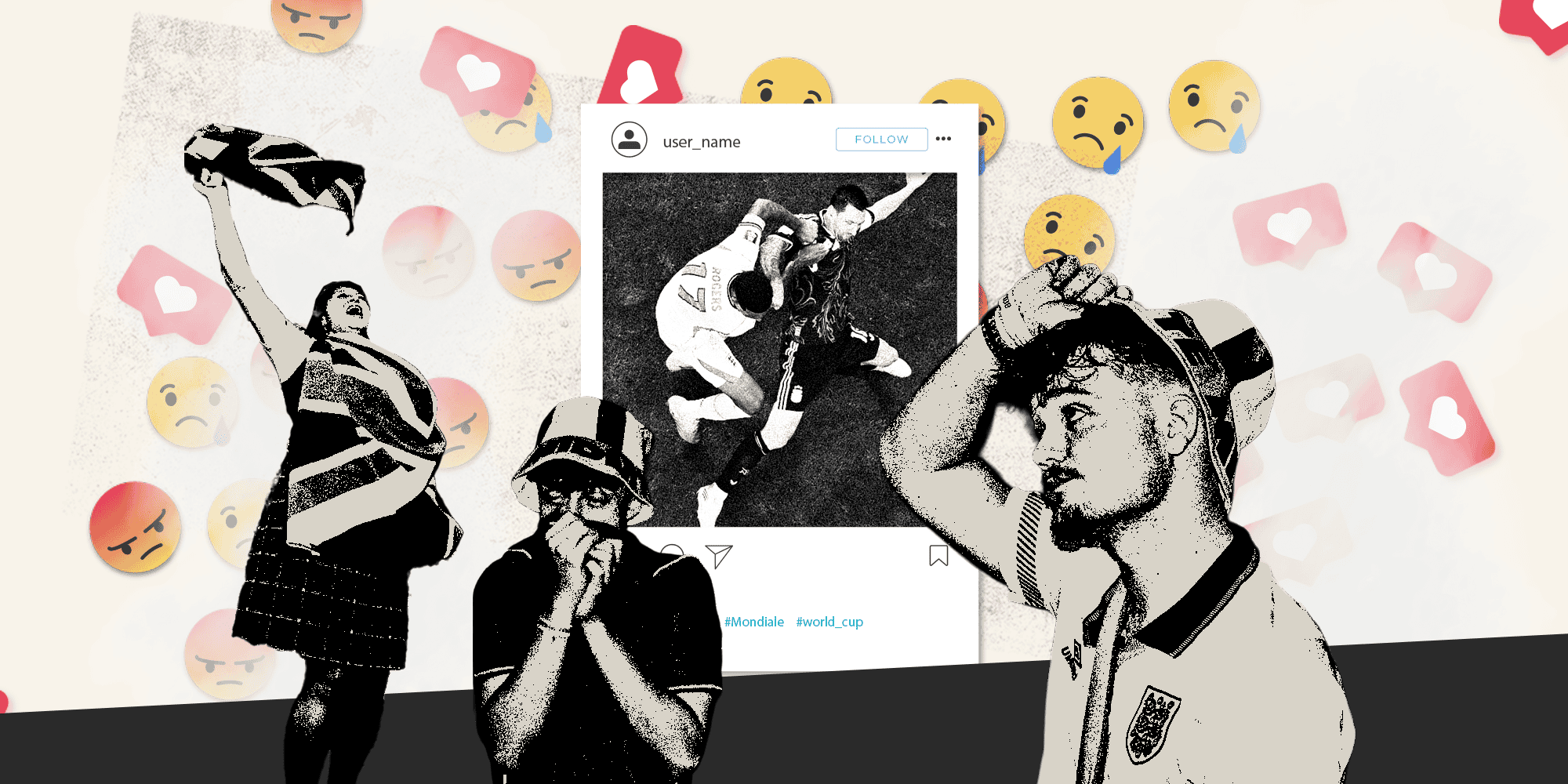
The influence of crowds on judgment extends far beyond football stadiums. In the age of social media, the digital sphere has expanded. Today’s football fan no longer just watches the match. They engage with it through pages, groups, comments, and reaction buttons.
During the <a href="https://comicvibe.com/what-to-watch-sunday-fifa-world-cup-final-the-vampire-lestat-wraps-and-more/” title=”What To Watch Sunday: FIFA World Cup Final, The Vampire Lestat Wraps, And More”>FIFA World Cup, football reaches the height of its popularity. Many people who rarely follow the sport throughout the year become avid spectators during the tournament, openly declaring their support for their favorite national teams in various ways, from changing their profile or cover photos online to hanging flags from balconies and cars.
Families, apartment buildings, and entire neighborhoods become divided by football loyalties, and social media platforms are no different. One of the tournament’s most recognizable rituals is tazreek, the playful taunting of the losing team’s supporters. While they add color to the competition and intensify fan rivalries, these exchanges often go beyond harmless banter. They reinforce bias, undermine objectivity, and help spread inaccurate narratives.
The digital revolution has also transformed spectators from passive viewers into active participants. Every controversial refereeing decision or disputed moment is quickly followed by thousands of posts, short videos, and comments offering competing interpretations. As these explanations circulate widely, viewers can easily become convinced by the version they encounter most frequently, even when it is not the correct one.
The Echo Chamber
Social media deceives us all. Its algorithms learn how we think and continuously present us with content that aligns with our beliefs and convictions. Contrary to what some may assume, this is not a new phenomenon, nor is it solely a product of the recent surge in artificial intelligence. American legal scholar and sociologist Cass R. Sunstein explored this idea as early as 2001 in his book Republic.com.
He later expanded on the impact of closed media environments in Republic.com 2.0, published in 2007, as social media platforms became increasingly widespread. Sunstein argued that these platforms place users inside what resembles an “echo chamber,” where they are continuously exposed to content that reflects and reinforces their existing preferences.
The echo chamber theory intersects with broader research in psychology and sociology, which suggests that social media brings together people with similar views into a shared virtual space. Although the content may vary in form, it conveys largely the same messages. As a result, users are repeatedly exposed to opinions that confirm their beliefs, while opportunities to encounter views that challenge those beliefs become increasingly limited. This reinforces the perception that their opinions are correct and widely shared.
Another study, published in Telematics and Informatics, found that highly committed football fans use social media not only to discuss matches and controversial incidents but also to reinforce their sense of belonging to a group. Every post they write and every interaction they make become an expression of their collective identity, providing them with a sense of satisfaction and belonging.
When Emotion Takes Over
Immediately after the Egypt versus Argentina match, I published a post on my football news page quoting a well-known international refereeing platform, which concluded that Mohamed Salah should not have been awarded a penalty in the incident that had ignited debate across social media.
Within minutes, I was flooded with hundreds of abusive responses, both in the comments and through private messages. They ranged from insults, accusations of betrayal, and threats to mockery, online harassment, and coordinated attempts to report the page. After about an hour, I stopped reading the comments and messages. I had probably shared the post while emotions were still running high, leaving little room for reasoned discussion.
In the days that followed, numerous analysts and content creators across Egypt and the Arab world explained that the penalty should not have been awarded. Rather than placing the blame solely on the referee, they argued that attention should be directed toward addressing the team’s shortcomings and analyzing the match to understand the reasons behind the defeat. By then, most of the comments were supportive. The further people moved away from the match, the easier it became to set emotions aside and assess the incident more objectively.
I remember another incident during that World Cup when I questioned a refereeing decision in the Germany-Paraguay match. The call had little impact on the game’s outcome, and I was discussing it purely from a technical perspective. At the time, I did not even know that the referee was Moroccan. Yet I was once again met with a wave of insults, although nowhere near the scale of the previous incident, from people who assumed I was criticizing a Moroccan, or more broadly, an Arab referee.
Between Emotion and Objectivity
Part of the World Cup’s magic lies in its universality and overwhelming popularity. It is the one tournament that reaches far beyond football’s traditional fan base, captivating millions around the world through the drama of the matches, the atmosphere in the stands, the celebrations of the players, and everything else that surrounds the game.
This immense popularity is precisely what gives the World Cup its unique appeal. At the same time, however, it makes the judgments surrounding it far more emotional. Fans do not experience a match as merely 90 minutes of football, with the team that scores the most goals emerging victorious. They associate it with national identity, personal memories, and a sense of belonging. Strong reactions to controversial refereeing decisions or painful defeats are therefore both natural and understandable in a tournament of this scale and significance.
Spectators, and even analysts or experts, cannot reasonably be expected to remain completely impartial. Before anything else, they are football lovers and supporters. They have favorite teams and players, and their personal loyalties can influence the judgments they make.
Yet emotion should not be allowed to take complete control. At some point, and more often than not, it becomes necessary to step back and assess events objectively, identifying mistakes and underlying weaknesses so they can be addressed, rather than resorting to denial, deflection, or excuses to justify failure.
