

For generations, Anglo-Indians have worn their history in plain sight. It lingered in Elvis Presley-inspired pompadours, sharply pressed bell bottoms, and English spoken with unmistakable cadence. Stylish, cosmopolitan and woven into the making of modern Indian cities, the community became instantly recognisable in public life. Yet, for all its visibility, much of its story remained curiously absent from the pages of history.
‘The History of Anglo-Indians’, a graphic novel, on display at Kolkata’s Dalhousie Institute
| Photo Credit:
Shreya Banerjee
At Kolkata’s 167-year-old Dalhousie Institute club that has itself long served as a social and cultural home for generations of Anglo-Indians, author Keith Butler launched The History of Anglo-Indians,illustrated by Chennai-based filmmaker and illustrator Harry MacLure. Keith was in conversation with Andrew Scolt, quizmaster and senior vice president, Derek O’Brien & Associates.
More than a club
Founded in 1859, the Dalhousie Institute has long been woven into Kolkata’s Anglo-Indian social life. Over the decades, its halls have hosted dances, sporting events, literary evenings, quizzes and community gatherings. Many distinguished Anglo-Indians have been associated with the institution, including tennis star and Padma Shri awardee Leander Paes, quizmaster and parliamentarian Derek O’Brien and quizmasters Barry O’Brien and Neil O’Brien. It was therefore a fitting venue for a book whose central argument is that communities disappear quietly when their stories stop being told.
Keith Butler in conversation with Andrew Scolt
| Photo Credit:
Shreya Banerjee
“Nobody taught us Anglo-Indian history in school,” Harry says. “We learnt it from our parents, grandparents, uncles and aunts. It was passed down orally.” It was Keith who first identified this gap — a point he later raised in an address to the All India Anglo-Indian Association (AIAIA) in Namkum — and who felt young Anglo-Indians deserve to inherit that history in a form they would actually read. A graphic novel, he says, is a wonderful way to introduce it: Five hundred years in panels.
Harry MacLure
| Photo Credit:
Special Arrangement
Having never been taught about his community’s history in school, Keith says, “I want to missionise it: talk about it, support it. To spread the word. ‘Aag jalao’ light the fire: Please talk about our history.”
Noel ‘Bully’ Netto, a raconteur of hockey, jiving with his daughter at Railway Institute Perambur’s Christmas Ball in circa 1980
| Photo Credit:
The Hindu Archives
Speaking about the premise of the book, Keith juxtaposes it with his previous novel, The Secret Vindaloo. He talks about the novel’s protagonist ‘Puttla’ Marks. “I knew our history had been eclipsed. We had been erased from it. When I went to writing school, they told me, ‘Don’t just say your history has been erased. Physicalise it.’ That stayed with me,” he thunders.
Winners of the inter-school table tennis championship for Anglo-Indian schools held at the Y.M.C.A., Chowringhee, Calcutta. The Calcutta Boys‘ Schools senior division team: Ernest Alford, Maurice Moses, Robert Cher (front) and Elias Solomon. The school won in all three divisions-senior, junior and Minims.
| Photo Credit:
The Hindu Archives
“So I created ‘Puttla’ Butler , ‘puttla’ means thin. He’s as thin as a credit card. He can’t live in Calcutta because everyone around him is so heavy. I don’t mean physically heavy. They’re heavy with history. They are Parsis, Hindus. Guess who’s the only one levitating? Me, because I’m so light,” says Keith.
“The moment I thought about levitating, I thought of magical realism. In South American literature, people simply disappear because that’s how writers dealt with political disappearances — the goons would come and take people away. I borrowed that idea and turned it into Thin Butler. He didn’t know his own history, so he invented an alternative world he was obsessed with vindaloo. Food became his anchor. Through vindaloo, he was chasing identity,” says Keith.
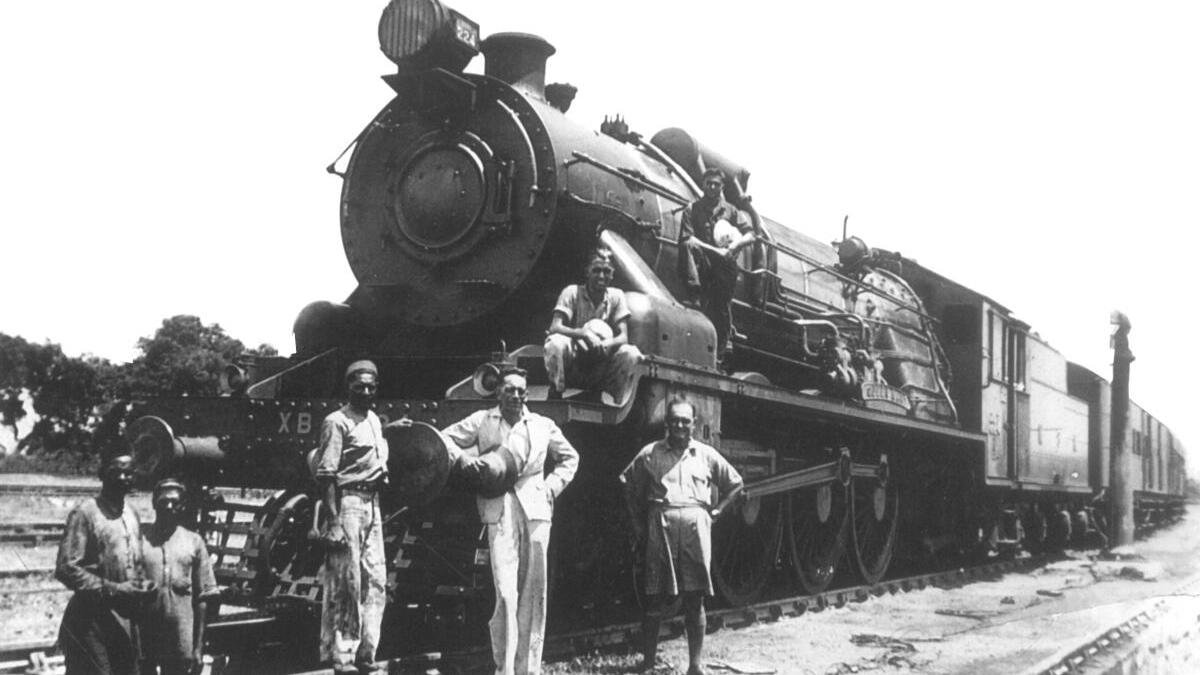
A group of young Anglo-Indian railwaymen
| Photo Credit:
Anglos In The Wind
Drawing a community
Harry is no stranger to documenting Anglo-Indian life. He founded and edits Anglos in the Wind, a community magazine that has chronicled Anglo-Indian life for nearly three decades. Yet this book was not simply about illustrating characters. It required visualising an entire civilisation whose influence often exceeded its numbers.“This is my 13th graphic novel. The earlier ones were science fiction and fantasy. This one was personal,” says Harry.
An Anglo-Indian family in Royapuram. Royapuram has been known for community dances organised by the Anglo-Indians
| Photo Credit:
Special Arrangement
“The community is over 500 years old. You cannot tell that story chronologically inside one book. Keith spent more than three years researching, writing the dialogues and building the script. Somehow he managed to bring five centuries together in a nutshell,” he adds.
The book deliberately avoids becoming a dry historical document. Instead, history is carried through faces, gestures and conversations to make it accessible to children as well as adults. Each illustration was first sketched by hand before being inked using Staedtler pigment liners.
A sketch in progress
| Photo Credit:
Harry MacLure
Only then came colour, speech balloons and page layouts. “I’m old school. For something like this, I wanted pencil, ink and drawing boards,” says the illustrator. “People read a graphic novel in half an hour. They don’t realise how much work goes into every page,” he adds with a smile.
An illustration from the novel
| Photo Credit:
Harry MacLure
One panel depicting the Jallianwala Bagh massacre proved almost impossible to complete. “It was around 2.30 in the morning. Everyone was asleep. It was raining outside. Drawing innocent men, women and children being shot, I almost broke down. After finishing that illustration, I couldn’t continue,” Harry recalls.
Other moments however brought unexpected joy. A sequence showing Anglo-Indians travelling by train between Villupuram and Puducherry reminded him of his own childhood. “I’m a railwayman’s son. My father drove steam locomotives. I grew up riding those great iron horses with him,“ he remembers.
An Anglo Indian homecoming
Keith Butler and Robyn Andrews
| Photo Credit:
Shreya Banerjee
Anthropologist Robyn Andrews, Keith’s wife, discussed how the audience for the book ends well beyond the community as it also traces the history of India. Anglo Indian history is, in many ways, a history of movement from the Swiss Alps, Portugal and Britain to Calcutta, Madras, Bangalore and the railway towns that stitched the subcontinent together. It is a story of exchange rather than isolation, of languages borrowed, recipes adapted, music reinvented and identities negotiated across centuries.
Every civilisation is, in the end, an accumulation of arrivals. The Anglo-Indian community was born of one such encounter and went on to leave its imprint on India’s music, literature and urban life. Yet much of that inheritance survives more vividly in family memory than in official history. The Hisory of Anglo Indians, is an attempt to correct that imbalance, recovering five centuries of a community whose story has too often been told in fragments and returning it, panel by panel, to the larger narrative of the subcontinent.
