

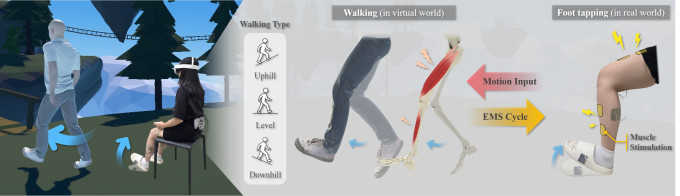
Overview of the EMSWalker system. Provided by GIST
■ Gwangju Institute of Science and Technology (GIST) announced on the 30th that a research team led by Professor Seungjun Kim of the School of Artificial Intelligence, together with researchers at the Massachusetts Institute of Technology (MIT) in the United States, has developed “EMSWalker,” a system that allows users to feel the sensation of walking uphill and downhill in virtual reality (VR) even while seated and moving only their feet. The results will be presented at the IEEE International Symposium on Mixed and Augmented Reality (ISMAR 2026), to be held in Bari, Italy, from October 5 to 9. When the user alternately lifts and lowers the front part of their feet, the avatar in the virtual space walks, and the device electrically stimulates the thigh, shin, and calf muscles in response to the terrain and gait. Even in experiments where no screen was shown, participants distinguished uphill, flat ground, and downhill with accuracies of 78%, 72%, and 58%, respectively. The research team expects the technology to be used in VR games and training content, as it can convey walking sensations without requiring large spaces or sloped floor equipment.
■ Daegu Gyeongbuk Institute of Science and Technology (DGIST) announced on the 30th that SE INNOVATIONS, a DGIST startup, has secured 3 billion won in seed funding from Quantum Ventures Korea, Korea Credit Guarantee Fund, and Daekyo Investment for its autonomous mobile robot (AMR) operation technology. “SynK,” the platform under development by SE INNOVATIONS, uses artificial intelligence (AI) to help robots autonomously create on-site maps and detect and respond to operational errors. It enables robots from different manufacturers to be managed from a single location, with the goal of reducing the manpower and time required for installation and maintenance. The company plans to use the funds to advance its technology, secure additional talent, and expand customer use cases in Korea and Taiwan.
■ Pohang University of Science and Technology (POSTECH) announced on the 30th that 31 researchers from 14 countries, including Professor Junsuk Rho of the Departments of Mechanical Engineering, Chemical Engineering, Electrical Engineering, and the Graduate School of Convergence Science and Technology, have proposed ways to reform research evaluation systems that are overly focused on publication counts and citation metrics. The paper was published online on September 4 in the international journal “npj Science of Learning.” The researchers propose that not only final papers, but also ideas, data, code, experimental methods, and validation results should be made public as interconnected pieces of knowledge and evaluated as such. The intention is to also consider how much other researchers reproduce or practically reuse the results, as well as contributions to the research community. To achieve this, they stress that universities and research institutes, funding agencies, and publishers must jointly reform evaluation criteria and knowledge-sharing frameworks.
<Reference>
– doi.org/10.1038/s41539-026-00449-z
Copyright ⓒ DongA Science. All rights reserved.

1 Comment
Pingback: Studio Jadu Launches, Backing Independent Artists to Craft Animated Shows, Reach Audiences, Build Fandoms and Earn Revenue - Comic Vibe