

Behind the first massively multiplayer virtual world was a home computer that was comically underpowered by today’s standards. Introduced in November 1982, the Commodore 64 was named for its then-generous 64 kilobytes of memory. In its twelve years on the market, it became the best-selling desktop computer in history. A conservative estimate puts its sales at 12.5 million machines worldwide.
The C64 sold for $595 in the US, compared to about $1500 for an Apple II with just 48 kilobytes of memory, and £399 in the UK. The computer, which looked like a thick keyboard, could use a TV as a monitor. Its operating system and the BASIC programming language were built into its hardware, requiring no disk to boot up. Typical for the time, an external drive to store and read software on floppy disks cost extra. Commodore, declared CEO Jack Tramiel, made ‘computers for the masses, not the classes’.
The C64’s low price was made possible by an unusual selection of chips. The CPU was a cheap, efficient, stripped-down industrial controller. The sound chip was designed for music synthesizers, the graphics chip for video games. The result was an inexpensive machine whose sound and 16-color palette were ahead of their time.
In the 1980s, its gaming chops made the C64 low status. ‘The dismissive label of “game machine” implied that because the C64 was good for playing games, it was “too much fun” to take seriously and could not also be used for ‘serious’ things like word processing (which it was used for)’, writesvideo game scholar Jesper Juul inToo Much Fun, a 2024 history of the Commodore 64. ‘The label also meant that if you wanted to be “serious”, you should get a much more expensive computer with nearly identical capabilities except for the ability to play good games’.
But the C64’s cultural implications were quite serious. It helped move video gaming out of arcades, where sessions had to end quickly so players would feed more coins into the machines. It permitted open-ended play at home, enabling a far wider range of games, including one that heralded, for good and ill, today’s hyperconnected world.
Four years after the C64’s introduction, a cosmetically refreshed version dubbed the Commodore 64C came bundled with new software, including a word processor, and offered the option of a Mac-like icon-based operating system. Crucially, it included a telecom program connecting C64 users to a dedicated information network called QuantumLink. Known familiarly as Q-Link, the system offered access at significantly lower prices than competitors like CompuServe.
Q-Link encouraged real-time interactions among C64 owners. Like CompuServe subscribers, they could use online chat, join forums, and play games together, including chess, blackjack, and hangman, with other users. But Q-Link’s most revolutionary game took a few more years to roll out. Developed at Lucasfilm’s games division, it was called Habitat.
Observers at the time, including Q-Link’s marketing team, had trouble explaining what it was. One journalist called Habitat a ‘world simulation game’, another ‘an adventure game…which will involve players from all over the country playing the game at the same time’. Afeature in Compute! magazine described it as ‘an intriguing combination of telegaming and straight online chatting’. Author Kathy Yakal wrote that ‘Habitat, unique to this point in the history of computer entertainment, is an early version of the kind of entertainment often predicted by industry futurists: the interactive motion picture’.
Unlike a movie, however, Habitat had no plot, and unlike an adventure game, it had no goal. It instead offered the tools with which to create a mini-society.
‘It’s the first virtual world’, says Alex Handy, founder of theMuseum of Art and Digital Entertainment (MADE), a video game museum in Oakland featuring playable exhibits and demos. ‘It was theine worlds
LucasArts Entertainment Company.
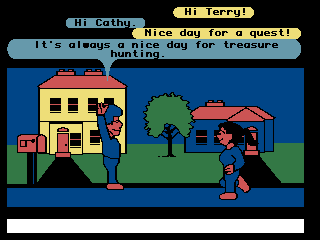
Habitat introduced the term avatar as now used in online contexts. It offered the first in-game currency – players got 2,000 tokens when they started and 100 more each day they logged on – and the first chance for players to buy and sell among themselves. It let them customize their avatars. ‘It was the first time you could pay for cosmetics in a game, which is a multibillion-dollar industry now’, says Handy. Players owned houses they could decorate. They gathered at the central fountain and chatted in speech balloons with other avatars. They threw parties. One published a newspaper called ‘The Rant’. Another started a church, The Order of the Holy Walnut.
The game ‘was deliberately open ended and pluralistic’, creators Chip Morningstar and F Randall Farmer explained in a 1990 paper called ‘The Lessons of Lucasfilm’s Habitat’.
With such open-ended possibilities, even testing with a few hundred participants produced unpredictable outcomes. A puzzle-based treasure hunt took weeks to build. One player solved it in just eight hours, before many others could even get started. ‘The result was that one person had had a wonderful experience, dozens of others were left bewildered, and a huge investment in design and setup time had been consumed in an eyeblink’, wrote Morningstar and Farmer. They had to stop thinking like traditional game designers and more like rule makers.
In another case of unintended consequences, players discovered an arbitrage opportunity. The game included machines called Vendroids, where players could buy items like storage chests or avatar heads, and Pawn Machines, where they could sell them back. Often referred to as vendos, the vending machines were another Habitat first. They produced the items on demand, with no production cost. To make play more lifelike, prices varied from place to place.
But the creators made a mistake. They priced dolls at 75 tokens at one Vendroid and 100T at a Pawn Machine across town. Worse, crystal balls were for sale in one place at 18,000T and could be hocked at 30,000T in another. A few wily players spent hours going back and forth buying and selling dolls, then used their profits to do the same with crystal balls. Each wound up with hundreds of thousands of tokens, quintupling Habitat’s money supply overnight.
‘I gotta say, that was a Monday morning I’ll never forget in my life’, says Farmer. It was the first example of what is now known as a ‘dupe bug’, or money in a game seemingly coming out of nowhere.
When asked about their suddenly expanded bank balances, the arbitrageurs replied, ‘We got it fair and square! And we’re not going to tell you how!’ They eventually explained, and the bug was fixed. Farmer, who served as Habitat’s administrator (‘the Oracle’), communicating with players, let them keep the money. They used it to sponsor treasure hunt games for the community, giving the incident a constructive conclusion.
A happier surprise was the spontaneous emergence of performing arts groups. To coordinate their movements despite the latency of their slow connections, performers practiced using stopwatches and telephone calls. ‘It looked like it was done in synchrony when in fact it was all wildly asynchronous and decoupled’, Morningstarrecalled in a 2022 interview. ‘The fact that people would go to the kinds of lengths that were required, the kinds of obsessive attention to detail, to engage in that kind of creativity – it speaks to something very powerful about people’s drive to interact with each other and be creative.’
Such devotion is all the more impressive when you consider that by 1988, when paid beta testing began, players were paying $4.80 an hour for connection time. Some enthusiasts ran into trouble. A teenage tester ran up a $600 bill in a month, leading his father to demand that he quit. Another player complained that Habitat had made Q-Link too expensive. In his first two years on Q-Link, he’d spent just $35 total. ‘But in the last month, while I was playing Habitat I spent $270!!! I can’t afford that’, he wrote. ‘You need to make it cheaper’.
Habitat was a remarkable technological achievement, built on a platform with just 64 kilobytes of memory and 100 kilobytes of disk space, using 300-baud modems that sent 30 characters a second. Creating the impression of rich visual interaction was almost a magic trick under these conditions. It required an innovative allocation of most code to the server, with the player’s client using a simple list of object definitions and commands like GET. ‘That really helped keep things speedy’, says Stuart Cass, known online as Stublad, who serves as Habitat’s volunteer archivist and historian. ‘This kind of technical model became much more commonplace later on but it was still novel at the time.’
Announced in 1986, the game didn’t reach the general public until 1989 because the problems were both difficult and novel. ‘Debugging distributed systems was a new thing’, explains Morningstar in an email, and ‘introducing a population of humans into the picture added an entire new tier of testing and debugging that nobody anticipated (even though in retrospect it should have been obvious) and nobody had any experience with, so we had to learn as we went. A couple of very big learning curves to overcome.’
Farmer puts it succinctly: ‘We did the impossible.’
When Habitat finally launched for all Q-Link subscribers, the company rebranded the game as Club Caribe, eliminating the pilot test’s weapons and magic wands and some of its fantastic elements. The change saved money, and framing the world’s open-ended play as an island vacation seemed more understandable to a mass audience. Much of the code remained unchanged, however, and soon some of the weirder features, including alien avatar heads, reappeared.
Club Caribe had its own special qualities, including a ‘nude beach’ where the avatars’ clothing was replaced with pink pixels, only to reappear once they left the area. Penguin races were popular sports. ‘Wave teams’ held monthly competitions, performing slow-motion routines that looked ‘very much like cheerleading on Valium’, combining steps, gestures, and text.
Long before social media, Habitat revealed the complexities and dangers of online interactions among many individuals. Some players proved upstanding members of the community, while others went rogue. Different people have different goals, personalities, and moral codes, and Habitat demonstrated that in an online setting ‘people will do everything that can possibly be done – good, bad, evil, neutral, weird, crazy’, says Handy, whose museum has organized the game’s rebirth asNeohabitat.
Farmer and Morningstar, he says, ‘learned from Habitat that people are kind of horrible, and if they’re given anonymity and free rein, they will do horrible things, and they will do against-the-rules things, but they will also do wonderful things and form communities. It’s like some kind of weird coral reef phenomenon where you get wonderfully delicious fish and super-poisonous fish. They’re all there. You don’t get to choose. It all comes together.’
