

When it comes to the best PC games of the ’90s, id Software’s “Doom” and its follow-ups still cast a long shadow. Launched in 1993, the game pits players against the forces of Hell for a sweeping single-player campaign while also laying the groundwork for early first-person multiplayer action. The success of “Doom” and its popularization of first-person shooters was boosted by a sequel being released the following year, as well as numerous ports and spin-off titles. There were countless games from the ’90s that tried to copy “Doom” with varying levels of success and quality.
Today, we’re highlighting the games that evoke those classic “Doom” titles from the ’90s that set the foundation for the franchise. Many of the games that we’re mentioning were also published by id Software, making those similarities all the more visible. The gaming industry wouldn’t be the same without “Doom,” and we’re looking at contemporaries where its DNA can be seen. These are the five best video games like “Doom,” each offering their own first-person shooter thrills.
Wolfenstein 3D
Before there was “Doom,” id Software found first-person shooter success the preceding year with “Wolfenstein 3D.” Inspired by the 1981 adventure game “Castle Wolfenstein,” the game retains the broad premise of an American soldier escaping captivity from the Nazis during World War II. The game’s campaign mode is released in sets of narratively linked episodes, culminating in a climactic boss fight in each level. Like “Doom,” the 1992 game was designed by John Romero and Tom Hall and programmed by Romero and John Carmack.
Given that it was id Software’s main project directly preceding “Doom,” “Wolfenstein 3D” clearly lays the groundwork for its spiritual successor. The rudimentary first-person action remains intact as does the maze-like level layouts as players blast through Axis enemies. And like “Doom,” “Wolfenstein” inspired its own wave of the worst video game rip-offs of its FPS gameplay. Before the 2016 “Doom” revival, “Wolfenstein” received its own set of revival titles, bringing those shooter sensibilities into the modern era.
Heretic
One of id Software’s co-founders, John Romero, teamed up with Raven Software to produce the 1994 game “Heretic.” Published by id for its initial release, the game shifts from the sci-fi horror aesthetics that “Doom” is known for in favor of medieval dark fantasy. After three brothers use their magic to subjugate a kingdom and its armies, an elven hero named Corvus steps up to liberate the realm. This involves Corvus battling armies of the undead, utilizing a whole arsenal of medieval and magical weapons from a first-person perspective.
Along with a relatively more narrative-driven experience, Raven Software leaned more heavily into fantasy game tropes for “Heretic.” This included a more robust inventory system than “Doom” and a greater emphasis on interactive environments in order to progress. The game led to its own dark fantasy series using the latest game engines developed by and licensed by id Software. The “Doom” pastiche that’s perfect for any “Dungeons & Dragons” fan, “Heretic” offers a surprising amount of gameplay depth.
Duke Nukem 3D
One of the most ’90s video game protagonists ever made is Duke Nukem, who started out as a side-scrolling action character. With the release of 1996’s “Duke Nukem 3D,” Duke made the leap to a first-person shooter perspective, while heightening its crude sense of humor and carnage-fueled antics. The game has Duke standing as a one-man line of defense against extraterrestrial invaders before taking the fight back to the otherworldly enemies. Like “Doom,” the game was ported to virtually every major gaming platform of the time after starting on PC.
A video game from the ’90s that would never be made today, “Duke Nukem 3D” combines crass jokes with over-the-top action. But more than just a one-note product of its time, the developers crafted a solid shooter with its own distinct personality. Like “Doom,” many retro games tried to copy “Duke Nukem 3D,” but the 1996 title’s signature sensibilities couldn’t be effectively replicated. The best of its series, “Duke Nukem 3D” adds some charisma to the normally silent FPS genre.
Quake
After creating “Doom” and its plethora of follow-ups and ports, id Software’s subsequent first-person shooter franchise was “Quake.” Predating Valve Corporation’s “Half-Life” by two years, the 1996 game also features an Earth overrun by invaders from extra-dimensional portals. The player controls a Ranger tasked with repelling the invasion, traveling through these portals to stop the conquerors in their native dimensions. The game also places a greater emphasis on multiplayer than id Software’s past projects, especially with the burgeoning online scene.
“Quake” feels like a natural evolution from what id Software was doing with “Doom,” rendering environments and characters in true 3D instead of sprites. Boasting its own arsenal of distinct weapons, the game also takes advantage of its premise with varied environments to explore. The strength of the first game spawned its own series for id, along with a revolutionary game engine redefining what was possible for 3D shooters. Enjoying a surprise revival through remasters of its classic games, “Quake” is the perfect way to follow up from the ’90s “Doom” titles.
Serious Sam: The First Encounter
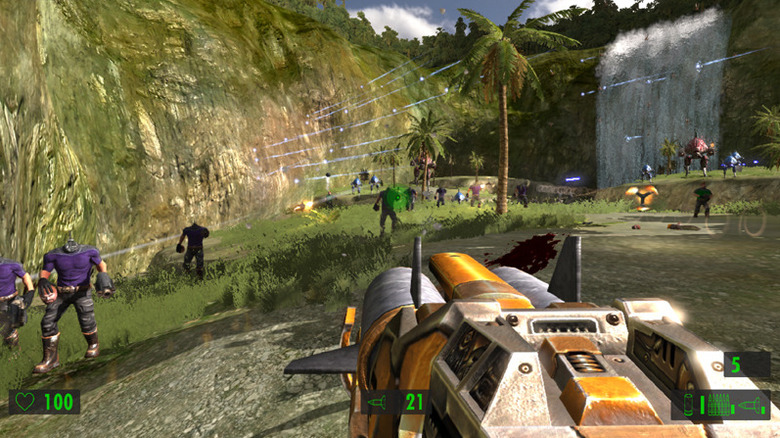
Before “Call of Duty” and “Halo” conquered the first-person shooter genre, “Serious Sam” offered its own twist to FPS games. Predating “Halo: Combat Evolved” by eight months, “The First Encounter” introduces musclebound protagonist Sam Stone (no relation) defending Earth from extraterrestrials. Sam gets a robust variety of weapons to blast through an impressively diverse set of enemy designs as he travels back to Ancient Egypt. Like virtually every FPS, the game has competitive multiplayer modes while the campaign can also be played through cooperatively.
What puts “Serious Sam” on this list over its contemporaries is the fact that it leans into more over-the-top action than titles like “Battlefield” or “Medal of Honor.” That spectacle, combined with intuitive first-person action, is what fuels the appeal to the title and aligns it closer to “Doom.” “The First Encounter” launched a “Serious Sam” series, but it was eventually overshadowed by “Halo” in the sci-fi shooter space. An overlooked gem by modern gamers, “Serious Sam: The First Encounter” offers a lot of deliberately silly fun.
