Buffy the Vampire Slayer was in the middle of the best season it would ever run when The WB decided one of its episodes could not air. “Earshot,” the eighteenth episode of season three, was scheduled for Tuesday, April 27, 1999. Seven days earlier, two students had murdered twelve classmates and a teacher at Columbine High School in Colorado. The episode was pulled that week and replaced with a repeat of “Bad Girls,” and the network offered nothing beyond a promise that it would turn up again at some unnamed point later. That turned out to mean almost five months. When “Earshot” finally aired on Tuesday, September 21, 1999, season three had been finished since July, the characters in it had already graduated from Sunnydale High on screen, and season four was two weeks away from premiering. Viewers watched episode eighteen of a season after they had already watched episode twenty-two. All three of those dates landed on a Tuesday, which was about the only part of the schedule that stayed where it was supposed to be.
Videos by ComicBook.com
The reason it was pulled is the part most people remember, and it is also the part most people have wrong. “Earshot” gets filed as the Buffy school shooting episode, the one too raw to broadcast in the spring of 1999. That is not what the episode is. There is a student in a clock tower with a rifle, and the story is deliberately playing on exactly the assumption a 1999 audience would make, but the reveal upends it completely and the real threat in the episode comes from somewhere nobody is looking. The delay cost the season something quieter than a slot on a schedule. One scene near the end of it reached viewers four months before the conversation that gives that scene its meaning, so the payoff arrived first and the setup arrived in September, and nobody watching in May 1999 had any way of knowing what was missing from it.
The WB Pulled “Earshot” One Week After Columbine And Held It For Five Months
The Columbine shooting happened on Tuesday, April 20, 1999. “Earshot” was due to air the following Tuesday. The WB replaced it with a repeat and issued a statement saying the episode would air at a date yet to be announced. Press coverage that same week described the plot as involving a character who was thinking about killing everyone at the high school he attends, which is a fair account of what the first two acts want a viewer to believe and a poor account of the episode itself. Network chief Jamie Kellner defended the broader decision by arguing that depicting violence at a graduation ceremony was inappropriate even when the violence involved fantasy acts against a sixty-foot serpent. Brad Turell, a senior vice president at the network, made the more practical case, which was that news outlets would lift clips out of context and run them against the show. Neither man was talking only about this one episode by the time he said it.
Buffy was not the only series affected that spring, but it took the longest hit by a wide margin. CBS swapped out an episode of Promised Land built around a gang shooting and a threatened witness, a change that carried extra weight because the series was set in Denver. ABC went ahead with a violent miniseries and absorbed criticism for it. Most networks moved something by a week or two and moved on. The WB held “Earshot” for one hundred and forty-seven days, long enough that the season it belonged to finished airing without it, and long enough that by the time it ran, the students in it had been shown collecting their diplomas. The show never acknowledged the gap on screen. The episode simply appeared on a Tuesday in September, sitting in the dead space between the end of one season and the start of the next. Jane Espenson had written it and Regis Kimble had directed it months before any of this happened.
What “Earshot” Is Actually About Is Not the Episode People Remember
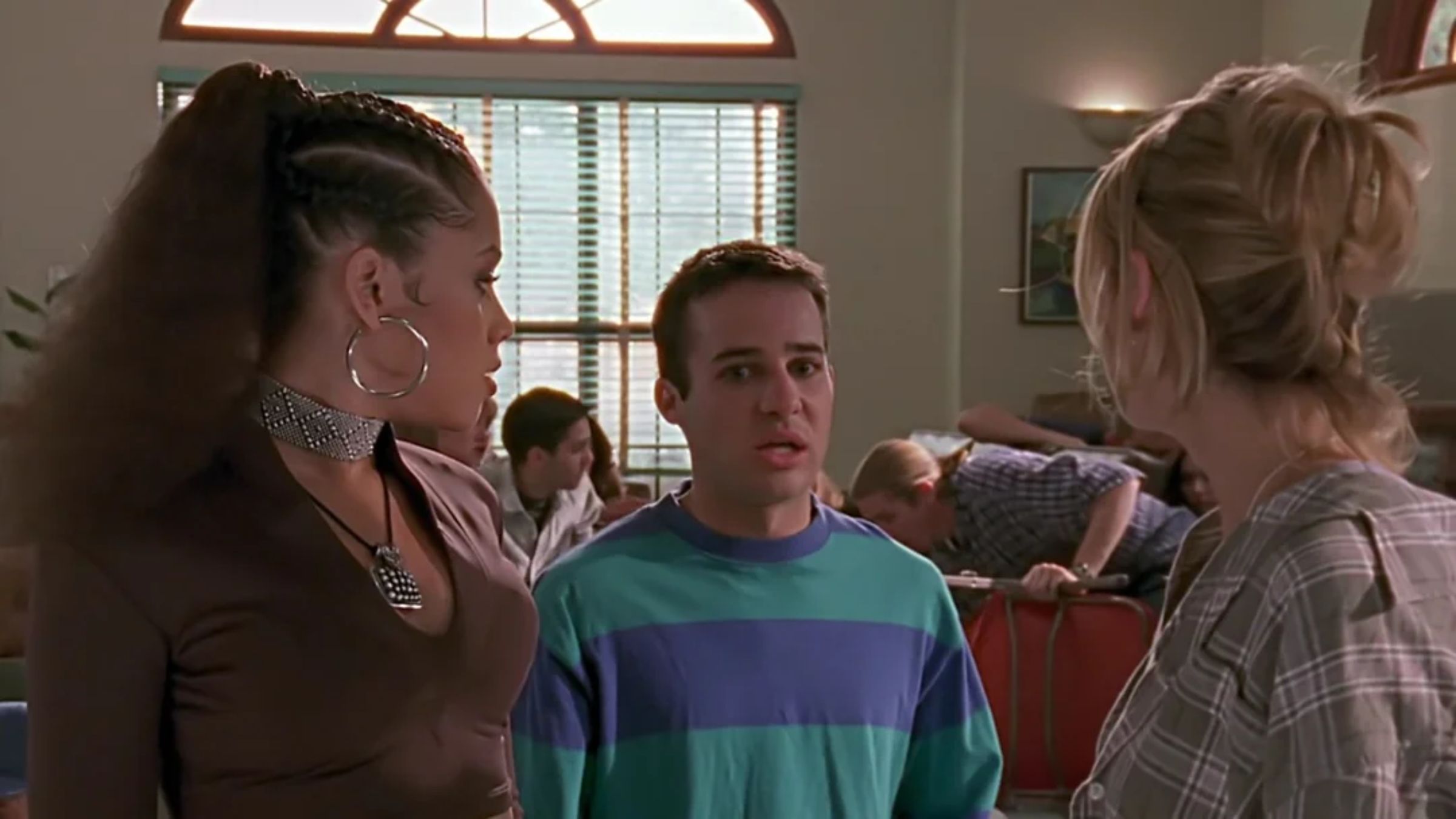
The setup is standard Buffy. Buffy is splashed with the blood of a mouthless demon and develops telepathy, which is funny for roughly ten minutes and then stops being funny at all. Sitting in the cafeteria she catches a single thought with no face attached to it: this time tomorrow, I’ll kill you all. The rest of the episode is a search for whoever thought it. Freddy Iverson, the school paper’s resident cynic, is the obvious suspect and the deliberate red herring, and he is cleared. The answer turns up in the kitchen, where Xander finds the lunch lady emptying rat poison into the students’ food because she has decided the students are vermin, and she comes at him with a cleaver. That is the threat the opening line belongs to. The mass murder plot in this episode is a woman with a grudge and a box of poison. The joke buried in the structure is that the story hands its audience a suspect who fits the profile and then refuses to let the profile be correct.
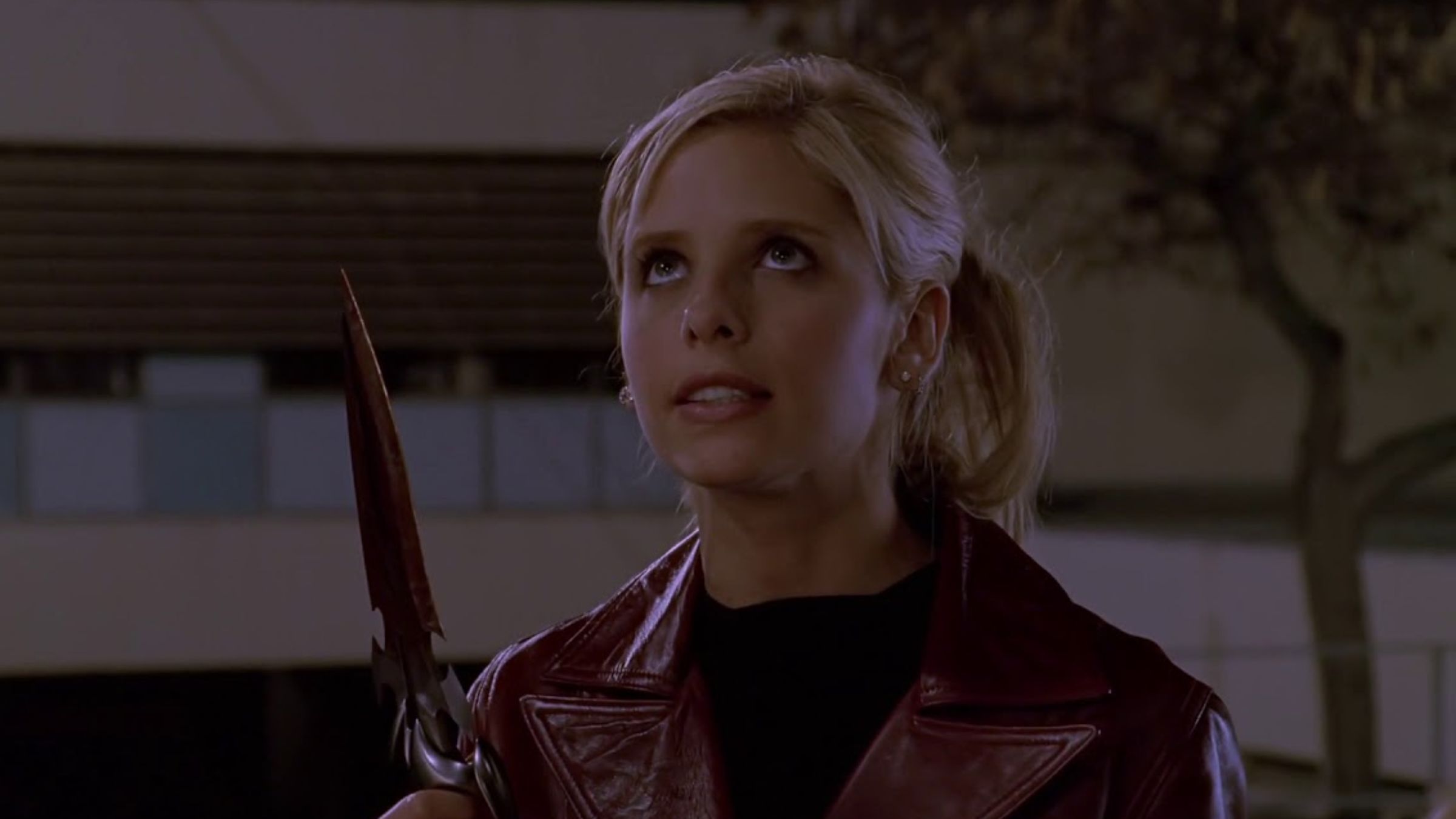
Which leaves Jonathan Levinson up in the bell tower, assembling the rifle, and the scene the episode is actually built around. Buffy climbs up expecting to stop a massacre and works out within seconds that she has read it backwards. Jonathan did not go up there to shoot anyone else. The gun was never pointed outward. What Buffy says to him is the closest the series ever comes to stating its thesis in plain language, which is that every person in that building is drowning privately and none of them can see anybody else doing it, a point the episode has already made structurally by giving her the ability to hear it. Oz gets the line that has aged strangest, observing that school massacres are bordering on trendy, a joke written months in advance by people who could not have known how it would read seven days after it was cut from the schedule.
The Season 3 Finale Got Held Back Too, And That Fight Was Much Louder
Four weeks later The WB did it again, and this time the show pushed back. “Graduation Day, Part Two” was scheduled for May 25, 1999, and the network pulled it roughly two hours before broadcast, running a repeat of “Band Candy” instead. The episode is the one where the entire student body takes up arms against the Mayor at their own commencement ceremony, which is why the network balked, and pulling it left season three hanging on its cliffhanger for seven weeks. It finally aired on July 13, 1999, to roughly six and a half million viewers. The complication was that Canada got it on schedule, so a complete copy was circulating within days and bootleg tapes were reportedly changing hands for around thirty dollars while American viewers waited. Joss Whedon’s public response to that was to tell fans to bootleg the puppy, which is about as close to an endorsement as a showrunner gets. Part One had gone out on schedule a week earlier, on May 18, which is exactly what made the disappearance of Part Two so conspicuous.
Sarah Michelle Gellar and Seth Green both objected on the record, and Jon Stewart got a joke out of it, saying the episode had been postponed until the heat was off and networks could go back to being irresponsible. The finale’s delay is the better known of the two, and it has the cleaner shape, because it ended after seven weeks and everyone moved on. “Earshot” is the one whose consequences outlasted the news cycle. Its delay did not simply make viewers wait. It scrambled the order of the season around it. Episodes nineteen through twenty-two ran from May into July while episode eighteen sat on a shelf, so once it finally surfaced, everything it had been written to set up had already been paid off on screen, in front of an audience that had no way of knowing it was watching the payoff first. Season four premiered on October 5, 1999, so the episode arrived as an orphan between years rather than as part of either one.
Airing Out of Order Cost Season 3 One of Its Warmest Moments
The clearest casualty is Jonathan. Three weeks after “Earshot” was supposed to have aired, “The Prom” ran on May 11, 1999, and in it Jonathan takes the microphone at the dance to hand Buffy a small gold umbrella, the Class Protector award, on behalf of a graduating class that has quietly worked out what she has been doing for them for three years. It is one of the most generous scenes the series ever produced, and it is written to land as a payoff rather than a surprise. Jonathan is the student Buffy talked down from a clock tower a few weeks earlier. He is the one person in that room who understands exactly what it costs to be noticed by her. Viewers in May 1999 had not seen that conversation and would not see it until September. The scene is built on the assumption that the audience already understands why it is Jonathan holding the microphone and not somebody else.
Without it, the award scene plays as a nice gesture from a recurring background character instead of the answer to something. The episode’s reputation recovered on its own terms once people could watch it in sequence, and it lands in the upper third of most rankings of the series, with the write-ups singling out the conversation in the tower rather than the premise wrapped around it. Every episode guide and every box set numbers it where it was always meant to sit, as the eighteenth hour of season three, which means anyone discovering the show for the first time gets the version Jane Espenson actually wrote. The scrambled one belongs only to the people who watched it live, the ones who were there every Tuesday and cared the most. A decision made across a single week in April produced a season that, for that audience, will never quite be in the right order.
I came to this show long after it finished, which means I have only ever seen season three in the order Jane Espenson wrote it, and I did not know there was another version until I went looking for one. That is a strange thing to be lucky about. The people who loved this show hardest, the ones who sat through it live in 1999, are the only ones who ever got the broken copy.
An episode about a girl who can suddenly hear everyone, and a boy nobody had heard at all, became unairable because of something that happened in Colorado seven days before its slot. Nothing inside it had changed. Only the week around it had.
Buffy the Vampire Slayer Revival’s New Title Explained by Sarah Michelle Gellar (& Why It’s Taking So Long)
More TV Shows
<img src="https://comicbook.com/wp-content/uploads/sites/4/2026/04/daredevil-comic-accurate.jpg?w=300" alt="Marvel’s Daredevil: Born Again Officially Over at Disney+ and It’s the End of an Era for the MCU”>
TV Shows
13 hours ago
Marvel’s Daredevil: Born Again Officially Over at Disney+ and It’s the End of an Era for the MCU
TV Shows
14 hours ago
Star Trek: TNG Would’ve Been So Different if Gene Roddenberry Got to Pick the Cast
TV Shows
15 hours ago
Tales From The Crypt’s Crypt Keeper Just Got a Major Redesign From a Walking Dead Legend
Courtesy of 20th Television Animation / Hulu
TV Shows
17 hours ago
Futurama Producers Explain How They Made That Disenchantment Crossover Happen (Exclusive)