

Aitana López has pink hair, more than 340,000 Instagram followers, and a monthly income that can reach €10,000, according to the Barcelona agency that built her. She has fronted campaigns for sports supplements and fashion brands. She has never eaten a protein bar, worn a jacket, or, for that matter, existed.
The Clueless, the agency behind her, built Aitana to solve an entirely mundane problem: human models cancel, negotiate rates, and occasionally say something regrettable on camera. A generated persona does none of that. She is always available. She never ages, misses a deadline, or develops an unexpected interest in a competing brand. Her appearance can be adjusted for every market. Her opinions are approved before she has them. There is only one small problem. She has never used the product.
Virtual influencers are usually presented as a safer alternative to human creators. Brands control the character, the script, and the visual environment. There are no late-night scandals to ensure against and no inconvenient personal beliefs hiding in old social media posts. Control, however, does not remove advertising liability. It concentrates it.
When a human influencer breaks the rules, regulators can examine what the influencer said, what the brand approved, what the agency arranged, and whether the commercial relationship was disclosed. When the influencer is synthetic, the most visible participant is not a legal person at all.
The character cannot be fined. It cannot give evidence, produce an honest opinion or explain that the agency forgot to add “#ad”. Somebody else made every relevant decision. The interesting question is not whether existing advertising law applies. It does. The question is where responsibility lands when a fictional personality delivers a real commercial message.
There is no special exemption for imaginary people.
The UK advertising codes do not contain a separate chapter for virtual influencers. That does not leave them outside the rules. The ASA has said that its existing rules apply regardless of how advertising content is generated. Marketing communications must be obviously identifiable as advertising. Commercial intent must be made clear when it is not obvious. Material claims must not mislead.
The United States has been more explicit still. When the FTC revised its Guides Concerning the Use of Endorsements and Testimonials in Advertising in July 2023, it rewrote the definition of “endorser” to cover an actual or fictitious party — including, by name, virtual influencers powered by computer-generated avatars and artificial intelligence. The revision was not designed to ban synthetic endorsers. It was designed to confirm that the same disclosure and truthfulness obligations follow them, whoever or whatever delivers the message.
There is also no blanket UK requirement to label every use of AI in an advertisement. Replacing a cloudy background with a sunny one is not automatically a regulatory event. Creating a fictional person who appears to have an independent life and recommends products is rather more complicated. The relevant question is whether the audience would be misled without disclosure. An AI label and an advertising label also solve different problems.
“AI-generated” tells the audience something about the identity or production of the content.
“Advertisement” tells them that commercial influence is involved.
A virtual influencer may require both. Neither label cures an underlying false claim.
Disclosure becomes a two-layer problem.
Consider a synthetic lifestyle creator who posts a photograph from a fictional morning routine and writes:
I have used this serum for four weeks and my skin has completely changed.
There are at least four representations inside that very ordinary sentence:
- The account represents an independent individual.
- That individual used the product.
- The stated experience actually occurred.
- The post reflects a personal view rather than brand-controlled advertising.
Adding “#AI” addresses only the first issue, and only partially. Adding “#ad” discloses the commercial purpose but does not make the invented product experience true. This is where virtual influencer marketing begins to collide with endorsement rules designed around human experience.
The US FTC’s Endorsement Guides require endorsements to reflect the honest opinions, beliefs, or experiences of the endorser. An endorser should not claim to have used a product they have never tried. A synthetic character cannot honestly experience a moisturiser, hotel, meal-delivery service or investment platform. It can perform an experience written by somebody else. That does not make every virtual endorsement unlawful.
Animated characters have sold products for decades without society demanding proof that a cartoon tiger personally eats breakfast cereal. Context does the work. A clearly fictional mascot speaking as a brand creation is different from a photorealistic account designed to accumulate the social signals of an independent human creator. The closer the character gets to borrowing human credibility, the harder it becomes to dismiss the performance as harmless fiction.
The regulator will look behind the face.
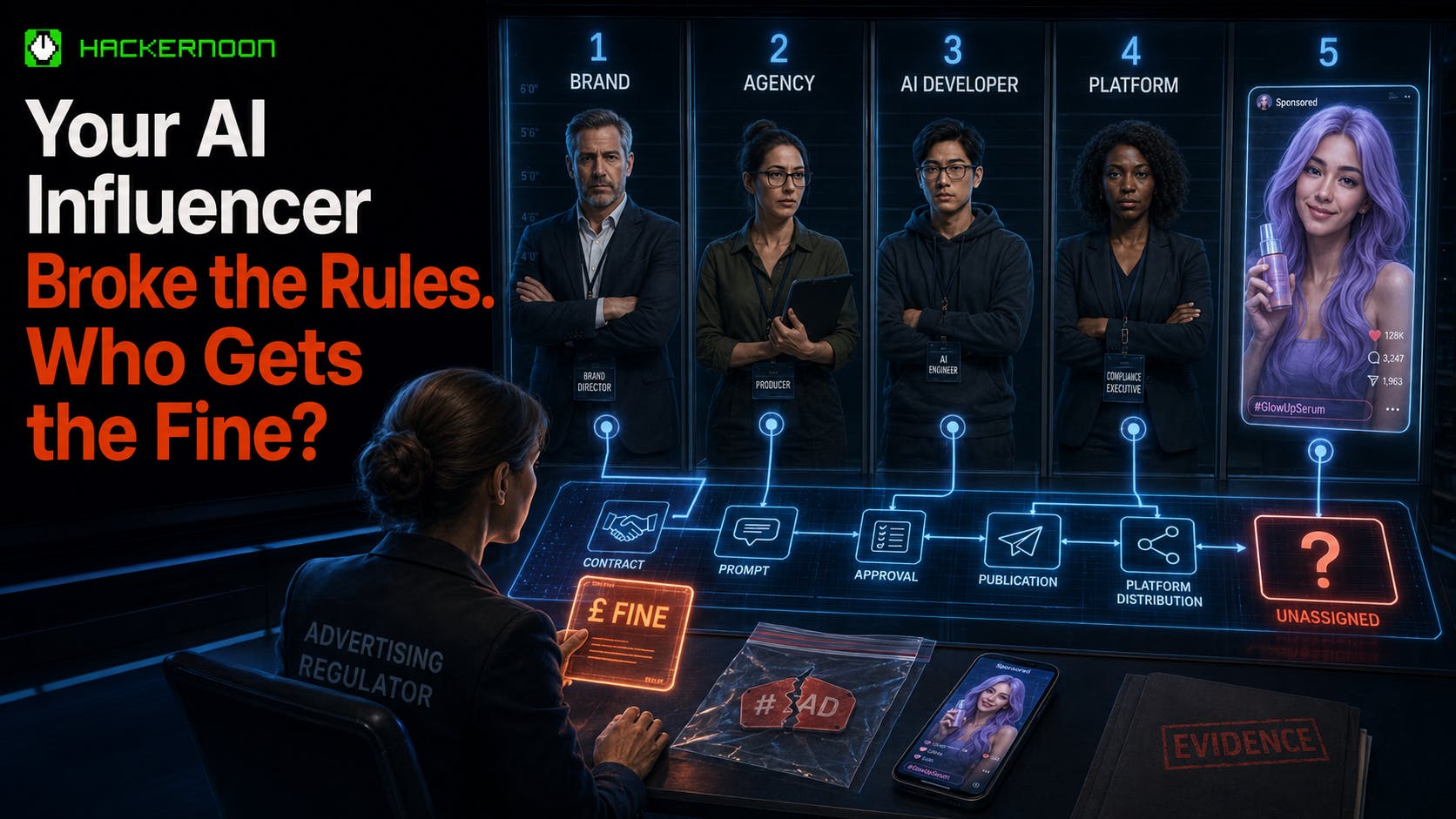
The ASA’s approach to online advertising places primary accountability on advertisers for the creative content, placement and targeting of their campaigns. Agencies, media owners and platforms may assist with compliance and enforcement, but the brand does not stop being responsible because another party built the character. That gives us the first answer to the headline. If a brand commissions a virtual influencer, controls the campaign and benefits from the sales, the brand will be an obvious regulatory target.
The agency may also carry responsibility, particularly where it developed the character, produced the claim or managed publication. Contracts between the brand and agency may allocate approval duties and indemnities, but those arrangements do not rewrite consumer law. A regulator is not required to respect the project’s RACI chart. The character’s owner or operator may be separately exposed if it runs the account, sells access to its audience or presents brand scripts as independent endorsements.
The platform usually sits further away from the underlying product claim, but it controls distribution, labelling tools and removal. It may face its own legal or regulatory obligations depending on the service, jurisdiction and knowledge of the content. Platform action can also become the fastest practical sanction: remove the post, restrict the account and end the campaign before the lawyers have selected a meeting room. The virtual influencer remains entirely calm throughout. Fictional people are excellent in a crisis.
Who actually issues the fine?
This is where the headline needs a lawyer’s footnote. The UK Advertising Standards Authority usually does not impose financial penalties itself. It can investigate, publish an adverse ruling, require an advertisement to be amended or withdrawn and apply further compliance sanctions. Persistent or serious matters may be referred to bodies with statutory enforcement powers.
Under the Digital Markets, Competition and Consumers Act 2024, the Competition and Markets Authority can directly enforce consumer protection law and, where it finds an infringement, impose penalties of up to 10% of worldwide turnover.
The Act also introduced explicit prohibitions concerning fake consumer reviews. That does not mean every virtual influencer post is automatically a fake review. Classification depends on how the content is presented and understood. A clearly labelled advertisement featuring a fictional brand character is unlikely to become a consumer review merely because the character speaks. A photorealistic account pretending to be an ordinary customer, publishing invented experiences and concealing the brand’s control, is much closer to the problem the rules are designed to address.
In the United States, the FTC’s Consumer Reviews and Testimonials Rule creates another layer of exposure. Its guidance notes that influencers who sell celebrity testimonials may be liable if they lie about having used a product or about their experience with it. A virtual character cannot lie in the human sense. The business operating it can publish a false testimonial. The law does not need to punish the pixels. It follows the commercial actor behind them.
No precedent does not mean no rules.
When the ASA responded to a parliamentary inquiry in 2022, it said it had not received complaints specifically concerning virtual influencers and was not aware of evidence showing advertising-related harm from them at that time. That was not a permanent declaration of innocence. It was a description of an emerging market before generative AI made synthetic content dramatically cheaper and more realistic.
The asymmetry is worth noting. At the time, the UK regulator had no recorded complaint to point to. The US regulator had already rewritten its rulebook to name the problem before a single high-profile enforcement case tested it. Neither position means the law is settled. It means the starting point differs by jurisdiction, which matters considerably for any brand running a virtual influencer campaign across both markets at once.
The ASA has since acknowledged the absence of neat precedent around AI disclosure while emphasising that ordinary advertising rules continue to apply. That distinction is important. A regulatory gap does not always mean no law exists. Sometimes the law exists, but the precise distribution of responsibility has not yet been tested against the new facts.
Virtual influencers raise several such questions:
- When does a fictional performance become a testimonial?
- How realistic must a character appear before its synthetic nature becomes material?
- Is disclosure required once, in the biography, or on every commercial post?
- Who verifies claims when the character is licensed to multiple agencies?
- Which party retains the campaign archive and approval record?
- How should responsibility be divided when the character’s responses are generated dynamically rather than scripted?
The first major case will not begin with a philosophical debate about artificial personhood. It will probably begin with a much duller question: who approved the post?
Synthetic scale changes the risk.
A human influencer can publish one problematic endorsement. A generative system can produce thousands of localised variants before lunch. The character can speak multiple languages, respond to followers, mention location-specific offers and personalise claims using audience data. One campaign can become hundreds of slightly different representations. This creates a governance problem that ordinary influencer contracts were not designed to solve.
The brand may approve the campaign concept without reviewing every generated response. The agency may set the prompt but not control the model update. The platform may host interactions that neither party sees in advance. The character operator may reuse approved language in a new context where the claim is no longer accurate.
In Your AI Ships Through a Pipeline — Your Governance Ships Through a PDF, I argued that governance has to operate inside the system producing the output. A virtual influencer makes this painfully literal. A brand guideline stored in a folder will not stop the character from improvising an unsubstantiated health claim during a customer conversation.
The virtual influencer needs an accountable human identity.
Brands should treat a synthetic influencer as an advertising system with a named operator, defined permissions and an auditable approval process. At minimum, that means documenting:
- The legal owner of the character. Who owns the account, visual identity, voice, training assets, and audience data?
- The responsible advertiser for each campaign. Licensing the character to several brands should not make campaign ownership ambiguous.
- The level of automation. Are posts manually scripted, generated from approved templates, or produced dynamically in response to users?
- The claim boundaries. Which statements about performance, health, price or personal experience are prohibited without evidence and human approval?
- The disclosure standard. How will the post communicate both commercial intent and synthetic identity, where each is material?
- The escalation route. Who can stop publication, remove a campaign and respond to a complaint?
- The evidence archive. The organization should retain the approved script, generated output, prompt or instruction set, disclosure, publication date and supporting evidence for objective claims.
- The jurisdictional map. A character with a global following may trigger different endorsement, consumer protection and AI-transparency requirements across markets — as the gap between the UK and US positions above already shows.
Most importantly, the operator must be able to answer for the character in real time. “The model generated it” is not an accountable role.
The disclosure cannot contradict the performance.
Some brands will attempt to solve the problem with a line in the account biography:
Virtual creator. All content is fictional.
That may help explain the character’s identity. It does not provide a licence to make materially misleading product claims. The ASA has been clear that disclosure cannot rescue a fundamentally misleading message. An AI-generated image exaggerating the results of a cosmetic product does not become acceptable because the caption admits that AI was involved. The same logic applies to virtual testimony.
“Fictional character” does not neutralise “this treatment cured my anxiety”. “AI-generated” does not neutralise “I earned £8,000 using this investment platform”. “#ad” does not neutralise “I bought this myself and nobody asked me to post”. A disclosure explains context. It does not reverse the meaning of the claim sitting above it.
The safest influencer may create the clearest liability.
Human influencers are unpredictable because control is divided. The creator owns the personality; the brand owns the campaign; the agency manages the relationship. A virtual influencer appears safer because the business can own everything. That also makes it harder to blame anybody else. Every expression, opinion and experience was designed. Every commercial relationship was known in advance. Every opportunity to disclose was under somebody’s control.
When the character breaks advertising rules, the legal system does not need to recognize the AI as a person. It needs to identify the companies that created the message, authorized the campaign, distributed the content, and profited from the result. The pixels will not get the fine. The paperwork behind them will tell the regulator who should.
This article provides general analysis and does not constitute legal advice.

2 Comments
Pingback: University of Calgary students can study Taylor Swift this semester | Daily Hive - Comic Vibe
Pingback: EU imposes strictest online safety rules on ChatGPT, Reddit and Roblox - Comic Vibe