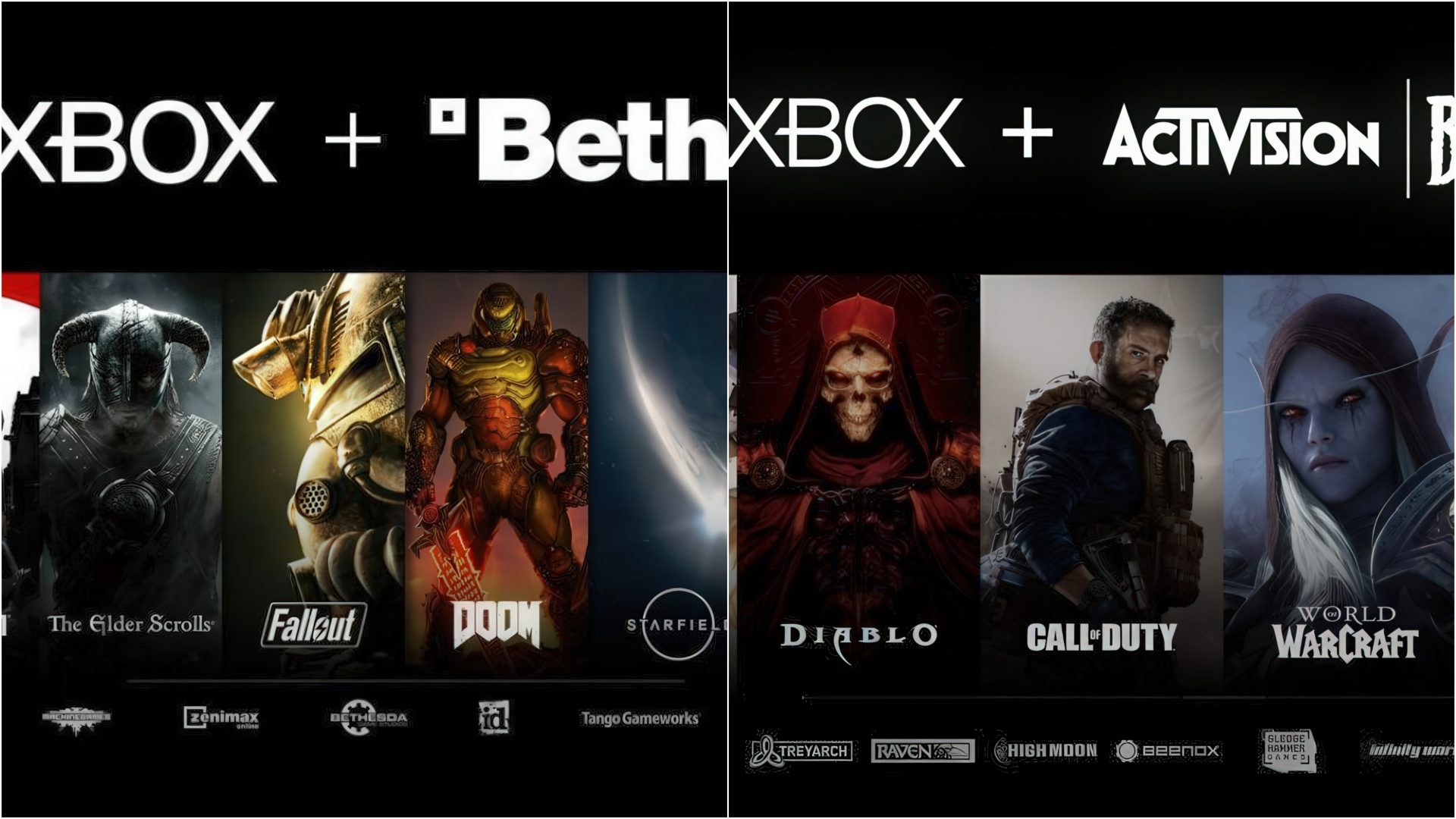
When Microsoft spent $7.5 billion on ZeniMax and $69 billion on Activision Blizzard in the span of two years, the general assumption was that Xbox was absorbing the industry’s biggest franchises. This week’s restructuring, however, suggests the opposite is actually happening.
NYU Stern professor and former SuperData Research founder Joost van Dreunen, writing in his SuperJoost Playlist newsletter, describes it as a reverse acquisition in slow motion, one in which the publishers Microsoft paid $76.5 billion for turn out to be the divisions best equipped to run the studios/IPs Microsoft built itself.
The new structure, announced alongside another 268 layoffs that form part of July’s planned 3,200 reductions in this fiscal year, <a href="https://comicvibe.com/5-tv-shows-to-watch-if-you-like-tyler-perrys-beauty-in-black/” title=”5 TV Shows To Watch If You Like Tyler Perry's Beauty In Black”>shows that clearly enough. Activision takes over World’s Edge, Rare, and development and publishing of the next flagship Halo, leaving Halo Studios to support existing titles. Bethesda absorbs Obsidian, which is working on a new Fallout game, while King takes over Microsoft Casual Games, home of Solitaire and Minesweeper. Playground and Turn 10 merge into a single studio. Only Mojang and Blizzardare unaffected.
The Halo Irony
Van Dreunen calls handing Halo to Activision surprising at best, and at worst, evidence of how poorly Xbox was running its studios. To explain why, he goes back nearly twenty years.
For most of the Xbox 360 console generation, Halo and Call of Duty were direct rivals. Halo 3 opened in 2007 with $170 million in first-day sales, then the largest entertainment launch on record, and had Xbox’s full weight behind it. Activision had to work hard to compete, but when Call of Duty 4: Modern Warfare arrived two months later, it introduced perks and progression systems that went on to define the genre.
Soon, the revenue gap was reversed. Bungie left Xbox in 2007 and signed a ten-year deal with Activision in 2010. By 2012, Halo 4’s $220 million opening day was eclipsed a week later by Black Ops II’s $500 million. As van Dreunen puts it, the Xbox 360 had come to depend more on a third-party shooter than on its own flagship shooter franchise.
The analyst’s broader argument is about vertical integration. In theory, owning the hardware, platform, publishing and development lets a company capture more value. In practice, he argues, integrated firms are slower to react when the market shifts.
Xbox relies on first-party titles for 61% of its content revenue, more than double Sony’s 29%, while pure-play publishers like EA and Take-Two have shipped more reliably without any platform to support. Microsoft built its portfolio during a content cycle, when scale and IP depth won, and the market has since swung toward distribution, turning that same strategy into a financial and creative liability.
Minecraft is the big exception: Microsoft paid just $2.5 billion for Mojang in 2014, and the game has sold roughly 300 million units, but that success was so disproportionately profitable that it justified the ZeniMax and Activision Blizzard purchases, and subsidized projects with far weaker returns.

Gravity Always Wins
Van Dreunen’s own conclusion is that Microsoft’s acquisitions were less about IP and more about managerial talent, drawing a parallel to Disney’s 2006 acquisition of Pixar and the placement of Pixar’s leadership in charge of its own animation studio. I’d add a second, complementary reason this outcome was nearly inevitable: the immense gravitational pull of the IPs Microsoft acquired.
Call of Duty is the industry’s most dependable annual blockbuster. World of Warcraft remains one of the most successful online games ever made, and Diablo is more relevant than ever. The Elder Scrolls and Fallout are two of the biggest RPG franchises in existence, with Fallout’s profile boosted further by Amazon’s highly successful TV adaptation. Halo and Gears of War, by contrast, haven’t had a cultural moment comparable to their respective peaks in well over a decade; Forza Horizon is the only Xbox franchise that’s still growing, but it is shackled by a niche genre.
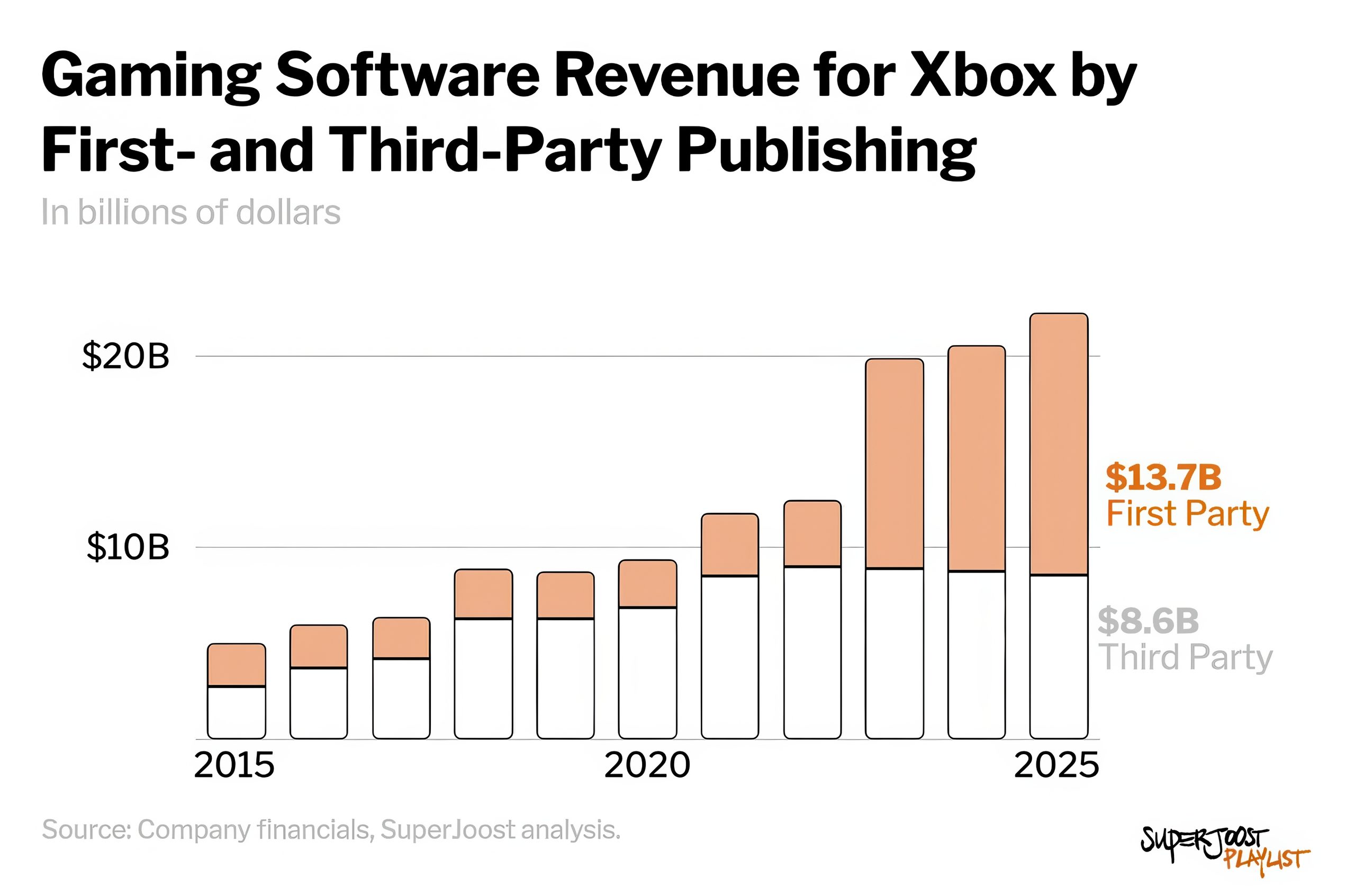
Van Dreunen’s own revenue analysis shows the effect. Xbox’s first-party software revenue stayed below $2 billion a year through 2019, then surged after the Activision Blizzard deal to $13.7 billion in 2025, overtaking third-party revenue within a total of around $22 billion. The acquired franchises aren’t part of Xbox’s first-party business anymore; now they effectively are the business.
When that much of the revenue flows from the acquired IP, investment, talent and organizational authority follow. Obsidian is the neatest illustration: the studio behind Fallout: New Vegas is making a new Fallout game, and now reports to IP owner Bethesda. Xbox’s own studios are increasingly organized around the franchises it bought, not the ones it created.
Of course, that doesn’t mean the restructuring will automatically succeed. Call of Duty has had its own recent struggles: Black Ops 6 was pitched as the biggest launch in the series’ history, but its player base had eroded by the following Spring, and its reception among PC players fell well short of rival shooters like Battlefield 6, VALORANT, and The Finals.
Microsoft, in van Dreunen’s words, bought one of the best publishing organizations in the business, then took another three years to let it do the publishing. Whether Activision really turns out to be Xbox’s Pixar is the question the next few years of releases will have to answer.
About the author: With over two decades of experience in gaming journalism, Alessio Palumbo has led the gaming vertical at Wccftech since August 2015. He started working at a young age for Italian websites like Everyeye.it, Gamestar.it, Nextgame.it, and Multiplayer.it before kickstarting the indie English-language publication Worlds Factory as its founder and Editor in Chief.
In the last decade, he has coordinated the overall output of Wccftech’s gaming section, managed PR relations, assigned reviews, produced daily news coverage, edited gaming content as needed, and delivered game reviews.
Arguably, his trademark content is the long series of exclusive developer interviews that have been cited by Wikipedia and by the biggest news media and gaming publications.
His passion for technology also makes him knowledgeable when it comes to gaming hardware and tech. His favorite genres include RPGs, MMORPGs, and action/adventure games.
Follow Wccftech on Google to get more of our news coverage in your feeds.
Products mentioned