

The <a href="https://comicvibe.com/discover-the-worlds-first-foldable-portable-playstation-2/” title=”Discover The World's First Foldable Portable PlayStation 2″>PlayStation 5 uses a custom AMD Zen 2 architecture with an eight-core, 16-thread CPU and a variable clock speed of 3.5 GHz. The closest AMD CPU in technical specs is the AMD Ryzen 7 3700X, but in real-world clock-speed behavior, it’s closer to a Ryzen 5 3600, a seven-year-old CPU. Even if the gaming system is pitted against an aged CPU, it doesn’t necessarily make the CPU bad — it just shows how rigorously tailored the silicon is to run Sony’s hardware.
Also, newer isn’t always necessarily better, as some of AMD’s high-end CPUs have disadvantages depending on your personal activities. So while Sony’s console has similar desktop counterparts, as it does with its GPU, its execution differs. But if you’re trying to benchmark the system’s prowess, it’s more accurate to look at the Ryzen 5 3600, which uses six cores and 12 threads, with a 3.6 GHz base clock speed and up to 4.2 GHz at boost. While the core counts do differ, it doesn’t matter too much for real-world use, as neither CPU would devote all its cores to gaming (the PlayStation 5 actually can’t).
That’s usually because game engines don’t always use them fully (the primary thread is the bottleneck), while some are kept for system management and the underlying software – with the latter being most relevant to the PlayStation 5. Six cores are usually good enough for modern game engines, and Sony only allows developers to use 6.5 cores for game code. Clock speed is another consideration, since the 3.5 GHz ceiling is closer to the Ryzen 5 3600’s 3.6 GHz base clock, and may vary under certain conditions.
What makes the PlayStation 5’s AMD CPU custom?
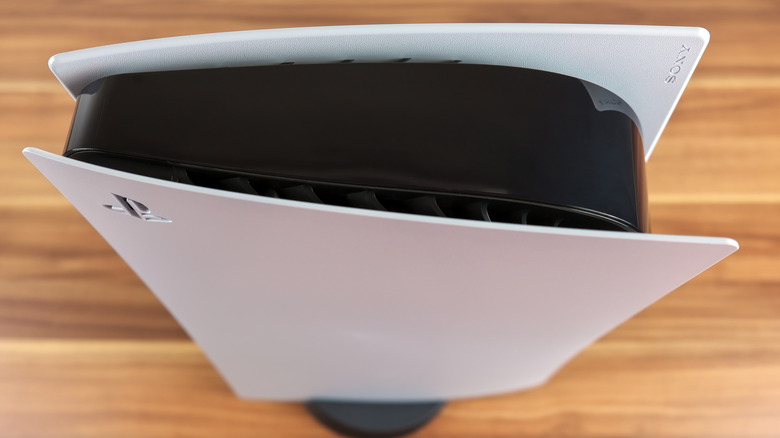
The main difference comes down to the physical die layout and infrastructure. For one, it’s a system-on-a-chip that houses both the CPU and GPU on a single semiconductor die. In computers, you can have a similar structure since there is usually a processor and an integrated GPU. However, a few standard PCs don’t. That means some computers rely more on a dedicated GPU and use a PCIe bus with separate RAM pools to communicate between the CPU and dedicated GPU for daily operation and performance.
Another is with the actual sizing of Sony’s PlayStation 5 custom CPU: AMD also shrunk the floating-point unit, the component the processor uses (256-bit to 128-bit, and physical sizing shrunk by 35%), compared to a standard desktop Zen 2 chip. It was likely a decision made to optimize physical spacing and power budget management without sacrificing performance. Lastly, instead of running at fixed clock speeds or thermal throttling based on temperature, the PlayStation 5 uses a fixed power budget. Essentially, the console was engineered with AMD’s SmartShift in mind.

1 Comment
Pingback: Ways That 'Akira' Is Far More Influential Than You Think - Comic Vibe