

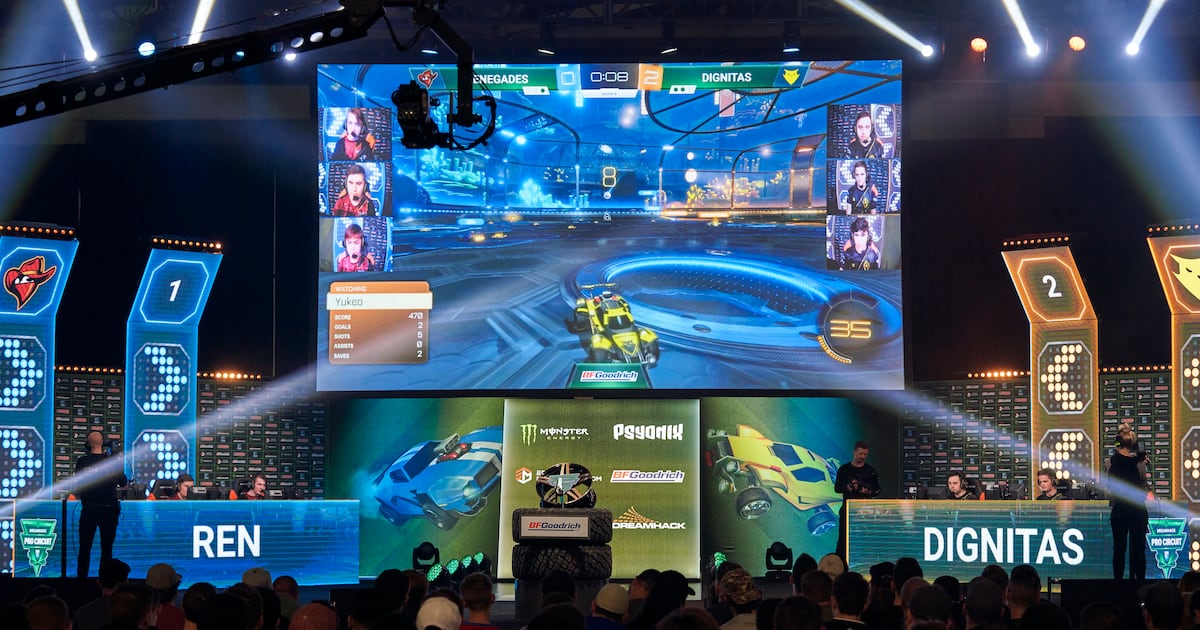
September marked a decade since pro sports in the U.S. began to get serious about esports and video games, when the Philadelphia 76ers acquired Team Dignitas and Team Apex, a combined transaction reported at $7 million to $15 million.
This was seen as the birth of a new revenue stream for pro organizations. Predictions flew about an industry primed for growth. Esports and competitive gaming were seen as “the next NBA.”
At the time, viewership backed that interest. Riot Games’ League of Legends was in its prime, and new competitors were hitting the scene to replace stalwarts such as Id Software’s Quake and Epic Games’ Unreal. This included Blizzard Entertainment’s Overwatch, whose league launched in 2018. Established fighting games, such as Street Fighter and Super Smash Bros., had thriving scenes, just as the Evolution Championship Series, the premier competition for fighting games, was growing. And one of the juggernauts of gaming — Activision’s Call of Duty — was getting into the fray as well. Valve’s Counter-Strike was already one of the most popular games, and its growth continued — even to this day.
As gaming grew, sports got deeper into it. Maple Leaf Sports & Entertainment had an Overwatch team, with a presence in the NBA 2K League and eMLS. Madison Square Garden Sports had Counter Logic Gaming, which was in League of Legends, Counter-Strike, Dota 2, Overwatch, Rocket League, Rainbow Six and Call of Duty, among others. Dallas Cowboys owner Jerry Jones invested in CompLexity Gaming, which had major presences in the biggest esports games, and the Kroenke and Kraft families held teams as well.
“Commissioner [Adam] Silver was talking about the power of esports, and when you work for guys like Josh Harris and David Blitzer and they hear some of the incredible numbers and just sheer eyeballs, they turned and said, ‘We should take a look at this,’” Scott O’Neil said in 2016, while serving as CEO of the 76ers when the team made its esports moves.
Then the COVID-19 pandemic hit, bringing a dual effect with it.
The game industry saw playtime skyrocket. Fortnite and Roblox, already building large communities, watched player engagement soar. So did almost every other big multiplayer online game, and it was the same for mobile games. Investment flowed into the game industry. Publishers such as Embracer and Microsoft scooped up studios, with the Xbox company closing on its deal to acquire Activision Blizzard for $68.7 billion in 2023.
But even as viewership increased, the uncertainty stemming from the pandemic and live events, coupled with smaller sponsorship revenue than first anticipated and rising costs, forced pro sports to pull back on esports. Although some still own their assets (such as the 76ers and Dignitas), teams and leagues collapsed, organizations sold off assets and game publishers like Blizzard pulled support, bringing about the “esports winter.”
Still, esports maintains strengths.
Riot’s League of Legends and Valorant are healthy. Comcast Spectacor, owner of the Philadelphia Flyers, still owns T1 of South Korea, which has the most successful League of Legends team and esports’ biggest star, Lee Sang-hyeok, aka “Faker.” The Call of Duty League lives on and NASCAR continues to support eNASCAR, as does Electronic Arts with Madden NFL and EA Sports FC. Smaller games, such as Rocket League, are doing well, too. Blast has expanded business operations to the U.S. and attracted sellout crowds for its Counter-Strike and Rocket League events. In Asia and South America, even mobile esports players and teams have large, thriving fandoms.
Esports never became “the next NBA,” unable to match what turned out to be unrealistic expectations. But like many parts of the global gaming industry — with an estimated 2025 revenue of $188.8 billion, according to SBJ sister company Newzoo — esports is just one of many niches with its successes and failures.

1 Comment
Pingback: Hyde Street #13 Preview: Miss Goodbody Gets a House Call - Comic Vibe