

There are few words that we reach for as readily as culture. We use it to describe music, food, fashion and art, as well as communities, nations and entire ways of understanding ourselves.
We talk about youth culture, club culture, Black culture and British culture, while brands increasingly speak about participating in culture, institutions attempt to understand it and those of us working somewhere between art, music and community often describe ourselves as cultural workers.
Most of the time we understand what one another means, even if the precise definition remains conveniently loose, but as Notting Hill Carnival approaches and the word begins its annual proliferation across campaigns, conversations and celebrations, I have found myself thinking about another understanding of culture, one that is less concerned with the things a community produces and more interested in the way that community chooses to live.
Within Rastafari, culture can carry this particular weight. While definitions and practices inevitably differ across a movement as varied and decentralised as Rastafari, culture can refer to something much broader than music, clothing, language or food, even though all of these might be expressions of it.
It is connected instead to the idea of a righteous way of life, encompassing how one eats, speaks and treats other people, a relationship with nature and Africa, an awareness of history and oppression, and a rejection of the systems and values collectively understood as Babylon. Culture, understood in this way, is not simply something that a person belongs to or consumes, but something that has to be practised, maintained and expressed through the choices one makes.
There is something about this understanding that feels particularly resonant when thinking about Notting Hill Carnival, although it is important not to confuse that resonance with ownership. Carnival is not a celebration of Rastafari, nor should the history of Carnival be collapsed into a Jamaican story.
Rastafari represents one part of a much larger and extraordinarily varied Caribbean community, while Carnival’s foundations owe enormously to Trinidad and Tobago and the traditions of the eastern Caribbean.
The Caribbean itself cannot be neatly reduced to the Anglophone islands either, but encompasses different languages, religions and histories across places including Haiti, Cuba, the Dominican Republic and Puerto Rico, as well as Caribbean communities and nations along the South and Central American mainland. Notting Hill Carnival emerged from this multiplicity and from the particular experiences of Caribbean people living in Britain, and its richness has always depended upon the coexistence, exchange and occasional collision of those traditions.
Rastafari is therefore only one thread within a much larger fabric, but it offers an interesting thread through which to consider the meaning of culture, particularly because Rastafari has had such a profound influence on the way Caribbean culture has travelled and been understood internationally.
Through reggae, sound-system culture and the global visibility of Jamaican music, Rastafari ideas, language and imagery moved far beyond the relatively small community from which they originated.
The idea of being “cultural” travelled with them, becoming associated within reggae with music that was conscious, roots-oriented or concerned with history, spirituality, Africa and social conditions. In this context culture did not simply describe where something came from, but suggested that it contained substance, knowledge or a particular way of looking at the world.
The word has, of course, travelled much further since. Within contemporary creative industries, culture has increasingly come to describe the network of music, fashion, food, sport, language, nightlife, images and communities through which people recognise themselves and one another, and it is partly for this reason that brands and institutions have become so interested in being “in culture”.
It would be too easy, and probably unfair, to dismiss this entirely as corporate appropriation or empty marketing language, because trainers, records, football shirts, parties and hairstyles really can be cultural objects. They carry histories and memories, communicate class and migration, signify resistance or aspiration and allow people to recognise one another without necessarily having to explain themselves.
The aesthetic expressions of culture are not somehow less meaningful than its philosophical ones, because material things have always been among the ways that communities communicate who they are.
What the Rastafari understanding offers, however, is a gentle challenge to the idea that these expressions constitute culture in its entirety. If culture is also a way of life, then the objects and experiences we identify as cultural might be understood as the visible manifestations of something deeper, made possible by relationships, knowledge, responsibilities and practices that are much less immediately visible.
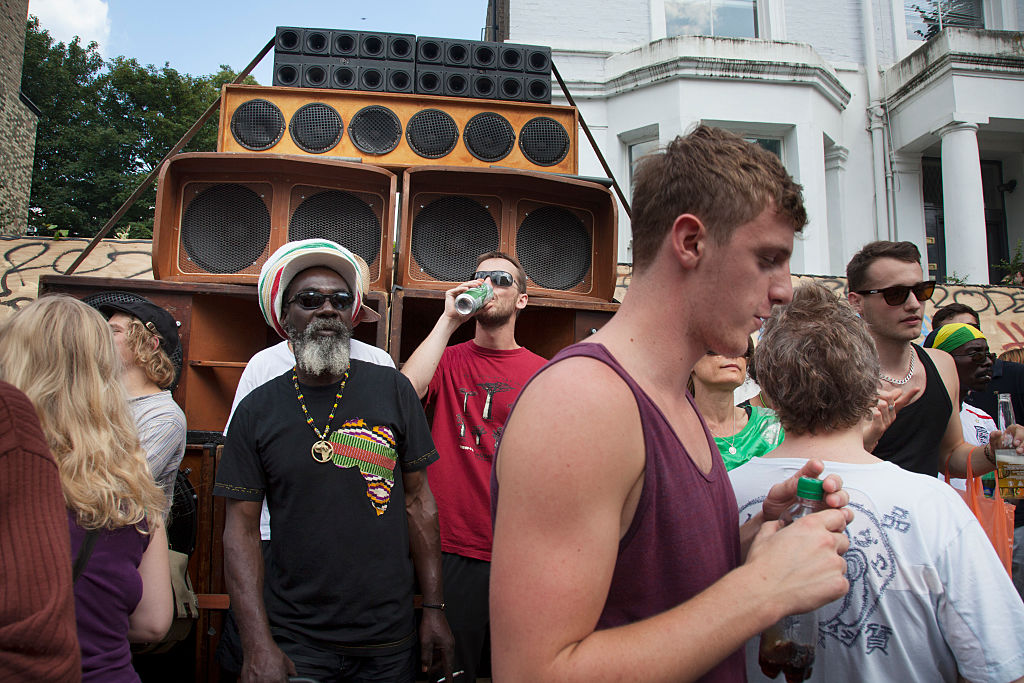
A record is culture, but so is the knowledge and community that allowed that music to exist; food is culture, but so are the recipes, migrations and conversations through which it has been passed from one generation to another; a sound system is culture, but so are the people who have spent decades building boxes, collecting records, finding spaces and maintaining relationships that allow a sound to continue.
Notting Hill Carnival makes the relationship between these two understandings unusually visible because, for two days, culture takes an overwhelmingly physical form. It can be heard through sound systems and steelpan, tasted in food, seen through mas, flags and clothing, and experienced through the simple but politically significant act of hundreds of thousands of people occupying the streets of west London together.
Yet beneath those two days sits a quieter infrastructure that is equally deserving of the word: the months spent making costumes, the maintenance of sound systems and record collections, the passing down of recipes and techniques, the rehearsals, meetings, arguments, friendships and acts of voluntary labour that accumulate over decades.
What appears for one weekend as an enormous spontaneous celebration is actually the visible result of relationships and knowledge that exist throughout the rest of the year.
Perhaps this is where the different meanings of culture can meet, rather than where one has to be declared authentic and the other dismissed as superficial. Culture can be the things we make, wear, listen to, eat and dance to, while simultaneously describing the values and relationships through which those things are produced and sustained.
The Rastafari conception is useful because it asks us to extend our attention from the cultural object towards the manner in which we behave around it, introducing questions of responsibility and reciprocity into a word that can otherwise become so broad that it risks meaning almost anything.
This becomes particularly relevant as Carnival attracts increasing interest from brands, institutions, tourists and people whose relationship with it may be relatively new.
Their presence does not necessarily represent a threat to Carnival, just as commercial participation is hardly a recent intrusion into something that was previously untouched by money. Carnival has always contained commerce alongside celebration, resistance, community and pleasure, and new investment and participation can help traditions survive, develop and find new audiences.
Thinking about culture as a righteous way of life, however, encourages us to ask not simply whether someone is participating in culture, but what the nature of that participation might be. It asks whether relationships are reciprocal, whether knowledge is respected, whether the people maintaining traditions are supported and whether participation leaves something behind as well as taking something away.
None of this requires us to turn Notting Hill Carnival into a Rastafari celebration or to suggest that Rastafari possesses some singular authority over the meaning of Caribbean culture.
Instead, it means borrowing an idea from one tradition within that enormous Caribbean constellation and allowing it to complicate a word that we have become accustomed to using very casually.
There is something generous in the proposition that culture might be understood not only as an inheritance, identity or collection of things, but as a practice, because it means that our relationship with culture is determined not simply by whether we can claim proximity to it, but by what we contribute to the communities and relationships through which it continues to exist.
As Carnival approaches and we inevitably begin speaking again about celebrating, protecting and participating in culture, perhaps it is worth carrying some of that meaning with us. Culture can reside in a record, a costume, a plate of food, a dance, a football shirt or a sound system, but it can also exist in the knowledge behind those things, the relationships surrounding them and the responsibilities we assume towards one another in keeping them alive.
Rastafari’s conception of culture as a righteous way of life does not need to provide the definitive meaning of the word, but it offers a particularly beautiful one: culture not only as something we inherit, make or consume, but as something we continually create through the way we choose to live with one another.
