

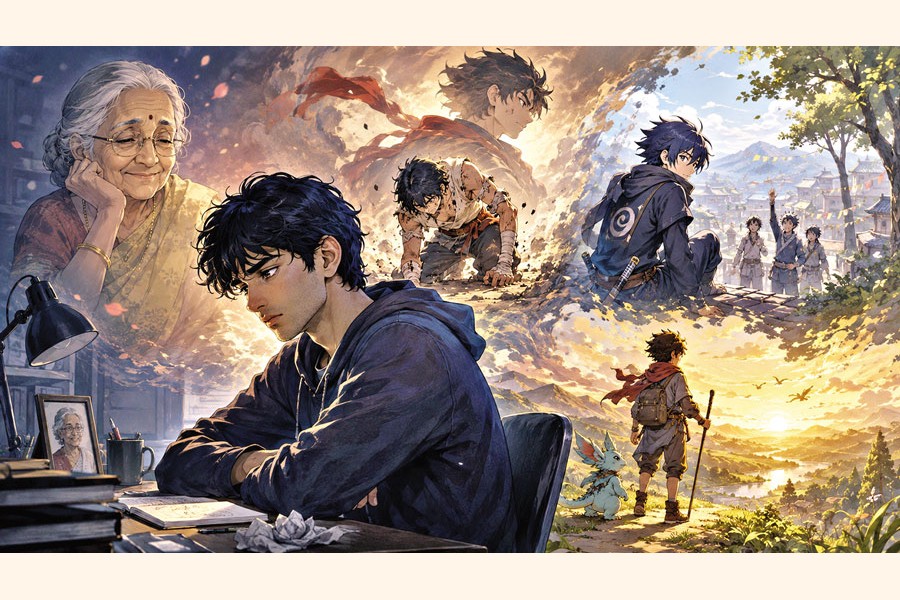
When I was a child I watched anime because it was fun. I wanted to see Goku get stronger in Dragon Ball Z, Naruto become Hokage, Ash win another badge in Pokémon. I waited for the next episode, argued with friends about who would win a fight and sometimes embarrassed myself copying a move. None of it felt like instruction.


In 2021 I lost my grandmother. She was my best friend and the person who made ordinary life feel ordinary. When she went she took most of the everyday noise with her, and I had no idea what to do with the quiet. The country was still in the middle of Covid-19. I went somewhere very dark.
I became depressed. There were stretches when I did not particularly want to be alive. I would dream about her, wake up, remember, and lose her again before breakfast. Nobody warns you that grief repeats. I had assumed it was a single blow you slowly recover from. In practice it arrived most days, sometimes twice.
At some point, and I could not tell you which day, I understood I would have to build again.
I do not think one thing saved me. My family, work, time and a hundred unremarkable mornings all had a hand in it. But something else had been sitting with me since childhood without ever getting any credit: anime. The stories I watched for entertainment had already laid down beliefs I was now leaning on.
We are strangely confident about the line between what is serious and what is only entertainment. But stories are how most of us work out what the world is like, and long before I could have written a sentence about resilience I had met it in cartoon form.
Take Dragon Ball Z. The appeal was never Goku’s strength. Goku loses. He gets beaten and outclassed, and then he goes and trains. As a child I found that thrilling; as an adult I find it instructive, because life does sometimes beat you and the only question afterwards is whether you can find a reason to stand up.
Naruto works differently. He grows up unwanted, shut out by an entire village, and he refuses to let that childhood decide who he becomes. His hunger for recognition turns into something larger: protecting people, and declining to pass on the hatred handed to him. We assume that people who have been hurt turn bitter, and some do. It can also make you gentler, because you know exactly what exclusion feels like and would not wish it on anybody.
Then there is Pokémon, which looks like a programme about travelling and collecting things and is really about trust and slow improvement. Ash loses. He makes bad calls. He keeps leaving people and places behind. He carries on regardless.
That is why these shows mattered when I was putting my life back together. None of them promised anything would be easy. They suggested that difficulty is not where the story stops, which counts for a lot when you are grieving.
Telling someone to move on can be cruel because there are losses you learn to live alongside instead and the person stays in you whether or not they are in the room. I never stopped missing my grandmother. I got better at carrying her absence and those stories had already shown me that carrying something heavy is survivable.
Anime deserves more respect than it gets. Animation does not make a story shallow. A great deal of it goes straight at the questions people have always put to one another: what it means to lose someone, whether anybody really changes, how you carry on when everything has come apart. Those questions belong to everyone which is why the shows travel. A teenager in Dhaka recognises Naruto at once, and so does one in Lagos. The streets outside are different. The feelings are not.
None of this substitute for therapy or a friend who picks up the phone. No series cures depression, and no fictional character replaces the person you have buried. What stories offer is a shape to think with. Mine left a few blunt instructions that got more useful with time: get back up and look after the people you love and do not write off tomorrow.
There is no predicting which line, or which thirty seconds of a fight scene, will lodge in somebody and stay there for a decade. A child watching Goku stand up again has no idea why it matters. Nor does a teenager who sees Naruto shut out of everything and does not yet know he is being handed a vocabulary for his own life. Most of us put on an episode after a bad day because we want an hour off. Sometimes the hour off turns into a lesson, and the lesson eventually turns into a way of living, though you tend to notice that only years later.
I still miss my grandmother. Some days a turn of phrase brings the whole thing back without warning. But I am not where I was in 2021, and I have rebuilt parts of my life I was certain were beyond rebuilding. I will not hand anime the credit for that, and I will not pretend those stories had nothing to do with how I understood resilience years before I needed it.
So be careful about waving away what young people love as just entertainment. When you are at your lowest, the shows you watched as a child can be surprisingly blunt about the one thing you need to hear: it is not over yet.
Arafat Reza is a researcher and journalist based in Dhaka, Bangladesh.
