

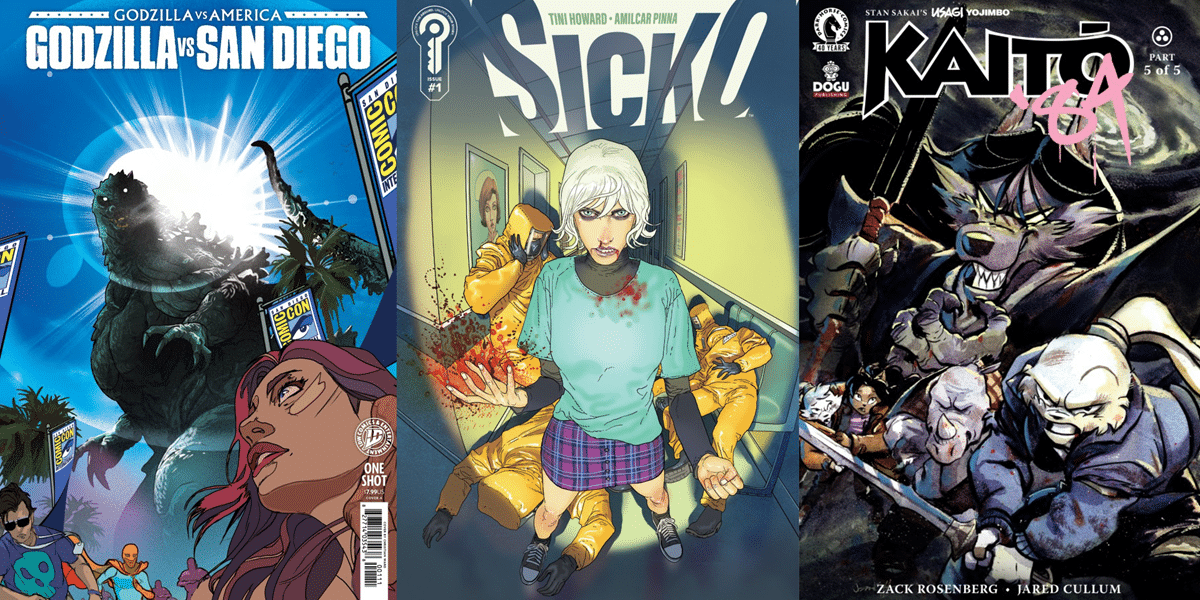

This week’s Wednesday Comics Reviews covers a packed week during SDCC, including the debut of Ignition Press’ new book Sicko, a big swing superhero story from Robert Kirkman with Terminal,and much more! Plus, the Prog Report!
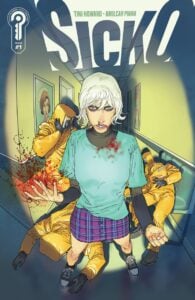
Sicko #1
Writer: Tini Howard
Artist: Amilcar Pinna
Colors: Amanda Grazini
Letters: Ariana Maher
Publisher:Ignition Press
Imagine John Coffey, the death row inmate possessing miraculous healing and empathetic abilities in the novel and filmThe Green Mile, existing in today’s world. Consider how far government and pharmaceutical interests would go in testing, cataloguing, and assessing his capabilities. Or doing all of that, and then the lengths they might go hiding whatever they found for fear of putting themselves out of business…unless they could unlock ways of exploiting him for their own gain.
Now imagine that our protagonist doesn’t have John Coffey’s healing capabilities, but something more the opposite. In the premiere of the 5-issue miniseriesSICKO, protagonist Valentine Virago is a young woman who’s dying. The question no medical professionals can answer is why. Screenings and tests for ailments ranging from terminal to chronic find no recognizable culprit. Her immune system is attacking her, but none of the usual suspect causes are the reason.
Which makes Val’s options for treatment limited given insurance companies won’t readily sign off on any meds or scripts without knowing what they’re supposed to be treating. But somewhere between the hospice offers, the palliative care painkillers, and Val’s stubborn resistance to giving up, a solution surfaces during the flashback and current storyline sequences of the issue. Our patient learns she can inflict the illness she’s suffering on others, and such projecting improves her health. At least for a time.
This dark mirror version of the John Coffey phenomenon is effectively realized in artistAmilcar Pinna’svisionary renders. And that reversal also galvanizes writerTini Howard’sstoryline. Readers who’ve dealt with modern healthcare issues for themselves or their loved ones will recognize the struggles Val faces initially. Limited treatment options, even more limited insurance coverage, and the way healthcare professionals consider such an undefinable ailment less a challenge, more an inconvenience not fitting normal and definable parameters, should strike familiar chords.
All of which makes Val’s discovery of her illness projection ability both cathartic and troublesome. Run the same routine for John Coffey in modern times cited above, but with Val’s power beneath the electron microscope. Consider how far government and pharmaceutical interests would go in testing, cataloguing, and assessing her capabilities. Or doing all of that, and then the depths they might plumb weaponizing whatever they find for their own benefit.
And Val, having started medical training herself before her illness made that impossible, has insights into how far such things might go. With her consent or without. It makes the motivations of even seemingly invested caregivers we meet in Val’s treatment journey suspect. Her escape and determination to handle the immunity curse and its projection ‘blessing’ on her own terms has us in her corner. And hoping she spreads some of the ‘joy’ she’s been inflicted with to other deserving parties as her story unfolds.
It’s been too long since I’ve had aTini Howardscript cross my desk, and this was a welcome return to her work. There’s a section of foreshadowing in the early pages of this issue, one set among patients in a lobby awaiting test results, andHowardmakes the experience real. The approach she takes to Val’s healthcare nightmare fashions a relatable, pragmatic purgatory, its walls fashioned from the same clinical forms and billing claims which restrict needed treatments and supplies in our everyday world.
Pinnagives us a speculative reality organically and beautifully coexisting within the tale’s clinical harshness. Sterile examination rooms and chaotic ERs gain warmth from the presence of Valentine as he imagines her. Stoked by her unwillingness to surrender to her ailments, by her humor. And the symphony of sick she projects when encountering opposition as given form byPinnais science fantasy made both impressive and terrifying.
The first issue ofSICKOis one of those rare accomplishments in a new series. Where the main character is sharply defined, her initial situation fully established, and her possibilities going forward open for many levels of development. How incapacitating or lethal is the affliction Val sics on her enemies? What plans do those in authority have for her? How reliable are people she’s trusting? And more.
The title’s creative team takes a basic concept not far removed from Infectious Lass of DC’s Substitute Legion and makes an allegorical tale critiquing healthcare infrastructure and how our society treats chronic illness. It also deals in the pressures and pratfalls for caring medical personnel stuck between overwork, corporate bottom lines, and relieving patient suffering.
It wouldn’t surprise me if Val’s illness itself might be treated almost like an individual character as the story continues. Maybe as a villain. Perhaps an ally. In either case, part of Val’s prescription is going to be for a dose of medical industry comeuppance. And that should be a remedy for anyone on the receiving end of insurance hassles and pharma indifference. Which makesSICKO’s inaugural issue not just a recommended read but a must-get for your pull list.
Terminal #1
Writers: Robert Kirkman and Joe Casey
Artist: Andy Kubert
Colors: Dave McCaig
Letters: Rus Wooton
Publisher: Image Comics
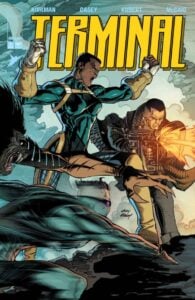
Robert Kirkman, Joe Casey, and Andy Kubert unite for a new, original superhero comic. This should be a grand slam, but unfortunately it’s far from that. The final note in the solicit states “nothing can prepare you for the most violent and unpredictable superhero series of the year!” This was an immediate turn-off for me.
Ultimately, Terminal #1feels incredibly hollow, often attempting ideas done better in other comics, some done by these exact creators. I am a huge fan of Joe Casey and his WildCats and WildCats Ver. 3.0. are, to me, some of the greatest “superhero deconstruction” comics of all time. Kirkman’s Invincible (flaws and all) is one of my favorite comics, period.
But the gory violence here feels purely done for shock value. There are three instances that are all big page turn moments that I feel are just there to get a reaction. It’s very much gore for the sake of gore, and it feels edge-lordy. Now, you could argue that Invincible is incredibly violent, so what’s the problem with this? The violence in Invincible is smart (for the most part), because it’s a visual indicator to let the reader know that there are real stakes, especially early on in the series. Though it resembles typical superhero comics, every action has a lasting impact that will change the story and characters. There are no resets.
The characters and set up in Terminal #1,however, feel generic and forgettable. At the end of this first issue, it feels like nothing we’ve just seen matters that much. There’s a fairly obvious twist that I saw coming a mile away, too.
On a positive note, Andy Kubert’s art is great as always. He’s an industry legend for a reason. The guy knows how to draw dynamic superhero comics. But overall,Terminal #1 was incredibly disappointing for me. Again, I really love all of these creators, so it pains me to have such negative thoughts on this first issue, but alas, this is just not for me.
Godzilla Vs America: Godzilla Vs San Diego #1
Writers:Stan Sakai,Greg & Fake, Dan Jurgens
Artists:Stan Sakai,Greg & Fake,Margeaux Pepoy
Colorists:Emi Fuji,Greg & Fake, Jason Millet
Letterers:Simon Bowland,Greg & Fake, Steve Wands
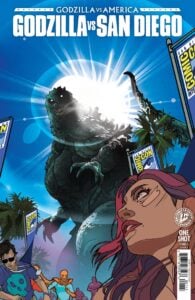
Godzilla’s onslaught on America continues with Godzilla Vs San Diego.This time the King of Monsters has set his sights on the biggest nerd culture event of the yearSan Diego Comic Con. In this anthology issue, we get three short stories each detailing a different Godzilla attack on the con as well as a host of pin-ups and one page comic strips from various comic artists.
The lead off storyChaos at Comic Conis done by comics legendStan Sakai.We get to see some excelling cartooning by Sakai as he has the convention center itself fight back against Godzilla. The humor is sharp and witty throughout. A lot of digs at the infamous Hall H are found throughout this comic but Sakai’s is the funniest. Other gags about the SDCC exclusives (and their often repeat novelty) can also be found through out the issue but it doesn’t feel as forced here in this story as it does in later ones. If anything I think one of the weakest parts of this comic is how often jokes are driven into the ground. That said It’s always a treat to see Sakai’s comic work especially one where he gets to be witty and action packed.
Greg & Fake’sGodzilla goes to the Conmay be one of of my favorite Godzilla shorts in all of the various Godzilla anthologies I’ve read. The creative duo’s style, reminiscent of the Archie’s, blends well with the story of a bunch of friends gloating as various Godzilla foes as they battle the titular monster. This is done in a complete Shōwa style in how the fight scene is executed. There are various sound effects from that era and dynamic expressions but Greg and Fake still manage to capture the rubber suit feel of the classic Godzilla flicks. It’s simply amazing and the star of the book.
Toy Timeintroduces a Jet Jaguar type character via a toy found at a small-time toy vendor’s booth.Dan Jurgenscaptures a much more serious tone compared to the other features as we get a taste of the human impact, but it’s not as critical to the plot as with other Godzilla comics.Margeaux Pepoydoes a solid job on the action sequences with some great expressions from Godzilla, which can be really tricky. However the scenes with the humans are bit stiffer by comparison. They aren’t bad, by any means. It’s just lacks bit of that dynamic punch and emotion that the giant monsters fight provided.
Godzilla vs San Diegois a deeply enjoyable anthology. The stories are all fun jn their own ways and captures different tones found in the Godzilla films, be it silly, serious, or something in between. The pin-ups are extra value as many of them are one-page comics, even if they repeat similar jokes. I had a lot of fun with this one-shot and I recommend checking it out.
Dungeons & Dragons: Total Party Killers #1
Writer: Christopher Hastings
Artist: Denis Medri
Colorist: Dan Jackson
Letterer:Lucas Gattoni
Publisher:Dark Horse Comics
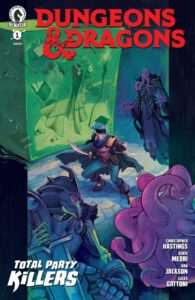
The first issue of Dungeons & Dragons: Total Party Killers is enchanting and full of surprises.
Writer Christopher Hastings compels with an adventuring party beckoned by a letter telling of a magic item (Custos’ Gorget of Dominance) up for grabs. As the party makes their way into the estate, they encounter monsters under the control of the gorget and a deceased Custos’ commands. Its a fantastical and at times explosive first issue that makes use of every opportunity to deceive its characters and I was invested in the ride as things were revealed to me as a reader. Through the journey towards the gorget, the party moves us along pretty quick but that pace is excellent, still providing time for us to breathe and to learn these adventurers before the issue closes.
Things take a turn as a party of monsters engages the adventuring party and sets up the conflict moving into the upcoming issues. The art of Denis Medri with colors by Dan Jackson, is gorgeous and feels as fun as the story is.
Things don’t feel self-serious though the stakes certainly rise by the end, with the gorget in dangerous hands but, the art has an appeal which plays on some of the humor present and also creates some very distinct and visually interesting character designs on the page. Lettered by Lucas Gattoni, the characters’ distinctiveness is only elevated and I really loved the approach to the spell casting; it feels like magic.
The creative team was the perfect fit for executing this story and as our adventuring party travels to stop the new owner of the gorget, I can’t recommend it enough to anyone who enjoys DND and/or fantasy and am excited to read more.
Usagi Yojimbo – Kaito ’84
Writer: Zack Rosenberg
Artist/Letterer:Jared Cullum
Publisher: Dark Horse Comics
The number of people who have had the opportunity to write Usagi Yojimbo comics, other than its creator, Stan Sakai, could probably be counted on one hand. That alone makes Usagi Yojimbo: Kaito 84 notable. But this series is more than just a novelty.
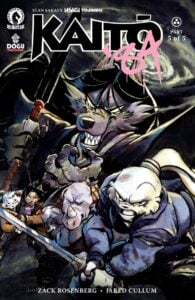
Matthew Rosenbergand Jared Cullum have created a compelling and beautifully composed remix of Sakai’s classic samurai rabbit. The 1984 setting is obviously a distinct visual from the Feudal Japan setting of the classic comic, which Cullum elevates by leaning into the gritty crime dramas of 80s films. His lush watercolors give the book and its backgrounds an appropriately smoggy haze. It’s is far removed from Sakai’s classic black and white minimalism, and yet Cullum is totally in line with Sakai’s loving attention to detail that honors the look and feel of his era of Japan.
This sometimes brutalist urban version 1984 Japan is just as distinctive and evocative as the wide open pastures of Sakai’s wilderness while being wildly different. Setting the action in and around Osaka Castle was a smart decision by Rosenberg and Cullum because it offers a direct connection to the iconic era of the classic Usagi tales.
Rosenberg similarly channels and remixes the Usagi formula, giving us a new version of the character with the same noble spirit but none of the refined skill or cultural respect. Here, Usagi (who goes by Kaito) goes from masterless samurai, a noble but homeless wanderer, and turns him into a modern day Robin Hood, living on the outskirts of society and wanted by the authorities. The story here in the final issue of the first arc makes the ties to the original comics far more explicit than expected but it makes the remix a more literal exploration of the classic character.
It becomes less of a side story and more of an examination of what makes Miyamoto Usagi who he is and what motivates him at his core. Rosenberg and Cullum’s land on a beautiful answer of community and friendship. Sakai’s Usagi is a lone wanderer but over the years has surrounded himself with a cast of friends and rivals who challenge and inspire him.
Here, facing his reborn demon nemesis Jei, this younger Usagi has to choose what he stands for, and how he chooses to fight for it and it makes for a thrilling finale with last minute rescues and beautifully choreographed action. Kaito 84 is a visually stunning and worthy companion to Stan Sakai’s classic that stands on its own as a fantasy/neo-noir mashup and I’m delighted to se that it will continue beyond these initial 5 issues.
The Prog Report
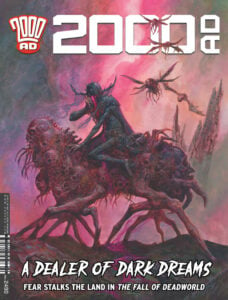
2000AD #2490: Okay, after some initial hesitancy I’m entirely in the bag for Judge Dredd: The Oublietteby writer Ken Niemand,artist Dan Cornwell,colorist Chris Blythe,and letterer Annie Parkhouse.Look, sometimes these grittier Dredd stories run for three chapters and are just spells between something else going on with the character. Not so with this dark gothic nightmare, which continues to spiderweb out this week through the rest of the magazine and its tradition/characters. It’s gotten to the point where I can see anything happening with this story, and that’s an exciting feeling to have. Great work going on here, and especially excellent use of the weekly anthology format. As always, you can pick up a digital copy of The Prog here. And it is also now available weekly in US comic shops! —Zack Quaintance
Column edited by Zack Quaintance
Read past entries in the weekly Wednesday Comics reviews series or check-out our other reviews here!

