Live-fire training is difficult for many fire departments to come by. You need the training facility or acquired structure and the personnel, tools, apparatus and anything else required to conduct particular evoultions. High-tech training through virtual reality (VR) solves many of those problems and opens more training opportunities.
Companies and programs, such as Fire Ground Sim, Tactik 360, XpertVR and Darley’s Flashgroup are creating virtual reality simulations to help firefighters to train on their own or in a comfortable, consequence-free environment.
Ryan Darley, who is vice president of sales at Darley, and XpertVR’s CEO and co-founder, Evan Sitler, explain that simulations can deliver particular scenes, tools, issues and locations into training, giving members room to grow their skills.
“In the virtual world, there are basically no limits,” Sitler tells Firehouse. “What really helped us was the no-fault learning environment to start, and the ability for us to strip away a lot of the distractions, so you didn’t feel like you were on the spot in your training.”
“The opportunities are endless, and we need people to get on board,” Darley adds.
Firefighters and officers
Tactik 360 was created by two firefighters, one of whom is Gabriel Grennon, the company’s director of operations. The concept for the company stemmed from a lack of access to training within his department. It offers two main products through its Officer 360 and Engine 360 platforms.
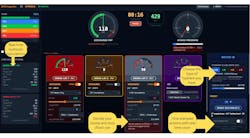
Officer 360 gives company officers the opportunity to practice their communication and management skills during size-ups. The virtual fireground is completely customizable, from props and fire sizes to locations, so officers can be exposed to and recognize every risk that they might encounter. Furthermore, the reconfigurability eliminated the likelihood that officers will memorize a training.
“We want to make sure that it’s always new for them, and there’s always something to work on,” Grennon says.
Officer 360’s voice recognition enables officers to issue orders to virtual firefighters in the system. The consequences of those orders are then output, so if a bad decision is made, the fire will grow.
Tactik 360 allows firefighters to log required annual training hours because Quebec’s safety board approved the platform as a continuous training program. Ghyslain Robert, who is a deputy chief for the Municipality Township of Low in Quebec, Canada, assures that it’s a legitimate way to train.
“Obviously, it’s not like the real deal,” Robert tells Firehouse. “Nothing is ever like the real deal, but it’s very close. It’s a close second, and it works very well.”

Engine 360 focuses on training for pump operations, allowing firefighters to practice at any point. The pump panel is something that XpertVR is working to implement too. This is among the upgrades that Sitler says occur every couple of months within its library of environments, objects, hazardous materials, scenarios and structures.
The opportunities are endless, he continues. An instructor views a scene from a laptop and can make the fire bigger, remove specific tools, insert falling debris and more.
“It takes approximately five minutes to set it up,” Sitler says. “In the fire service, there’s a wide range of ages and technical skills, so we made it super simple to use.”
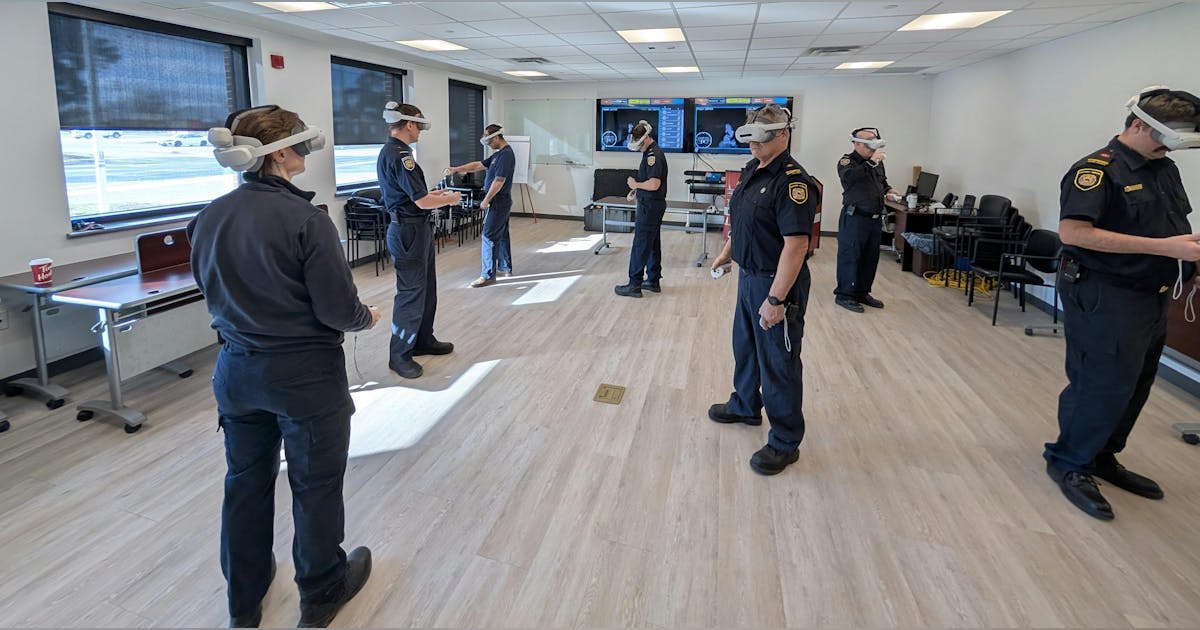
The package from XpertVR comes with four headsets, a laptop, a router and a carrying case. The headset isn’t required, because the system is compatible with any VR headset. Users also don’t need to be connected to the internet to utilize the training mechanism.
XpertVR is rolling out to the entire province of Ontario, Canada, and the 400-plus departments that operate there. That said, the company’s largest customer is San Diego Fire-Rescue Department, which trains with XpertVR weekly. In November 2025, the department put 350 firefighters through the platform in just a couple of weeks.
“We wanted to decentralize a lot of our training,” Capt. J. Jafari Harris tells Firehouse.
It doesn’t stop there for XpertVR, as its partnership with Cognitive enables full data tracking. Every move is tracked and monitored, so higher-ups can see whether objectives were met and the timing of any specific action and get a full playback of the simulation. Harris continues: “Instead of bringing everyone to a central location, we want to take it to them.”
Artificial intelligence
A big component of VR simulators is the use of artificial intelligence (AI). For example, Fire Ground Sim uses AI heavily in its training programs. It was created by Daniel Fernandez, who has been in the fire service for 10 years and is a captain at the Virginia Beach, VA, Fire Department (VBFD).
Fernandez credits his product with helping him to pass the captain exam, particularly by allowing him to practice his tactical operations.
“This is more of a private gym practice that you can do at home,” Fernandez tells Firehouse. “It has the ability to function without any outside help and at your convenience.”
AI helped Fernandez to develop functionality that allows multiple firefighters to interact and program the type of fire and which pumpers and ladders respond based on the members’ city.
Fernandez also created a pump simulator within Fire Ground Sim, because he wanted to get good at doing size-ups. A knowledge tester that he created from his own standard of procedures allows AI to generate a quiz that’s based on those.
Fire Ground Sim has 85 accounts across the United States and pending agreements with several volunteer agencies that are located in Colorado.
“This fire command simulator fills a gap our field has needed closed for years,” Neil Garo, who is battalion chief of the VBFD, says. “As a tutoring rectures cannot.”
Darley’s Flashgroup soon will have AI produce voice recognition for creating scenes. For now, Flashgroup offers customizable options, such as having 50 victims to triage to replicating an airport for aircraft firefighting training. “You can build your own scenario,” Darley says. “You can build whatever you want in there.”
Like XpertVR, Flashgroup has a very quick set-up that Darley says requires just seconds to start training.
Not just for first responders
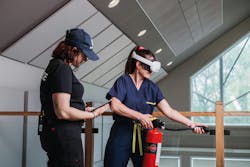
Flashgroup is used in colleges and helps prospective firefighters to get a look at what they will face when they are on scene. An entry-level version is for fire extinguisher training that bolsters public education.
“It’s cool, because the kids can get in VR, and it gets them excited about being a firefighter,” Darley says.
XpertVR works with schools in Ontario, Canada, and colleges in the United States, such as Louisiana State University. In addition to the 100 fire departments in Canada that use Tactik 360, 10 units are being deployed to one of the fire colleges in Quebec.
Future expansion
Impressive as what’s noted above is, the high-tech training road doesn’t end here.
Sitler plans to expand XpertVR by releasing an online multiplayer version that will allow as many as 21 trainees no matter where they are in the world to access it simultaneously.
Fernandez wants to get Fire Ground Sim to the point where it isn’t just a standstill Google AI picture of the scenario. He’s aiming to make his simulator responsive to the incident commander’s actions.
Training is changing
Advanced technology is evolving in the fire service. Greater worldwide adoption of AI and VR means that firefighters and departments train in virtual scenarios when conditions and circumstances don’t permit live fire training.
“We need to be talking about this,” Darley says. “The virtual world is where it’s at. It’s the future. It’s easy. You can train remotely. We must get with the times.”