

Neb. (WOWT) – Medical professionals gathered at the University of Nebraska Medical Center Friday for a conference focused on treating stroke patients, where educators demonstrated technology they believe could eventually help close gaps in rural care
Cheyanne Wood, of Curtis, Nebraska, suffered a stroke last November at age 31.
“I was in inpatient rehab for 19 days. And then I spent seven months in outpatient physical therapy,” Wood said.
First Alert 6 spoke with Wood in Omaha as she was projected from Kearney using a holobox, a freestanding, life-sized cabinet that projects a 3D person.
Every two weeks, Wood travels three and a half hours to Lincoln to see her neuro-ophthalmologist. She said advances in telehealth have helped with communication about her recovery at home.
“I can sit in my bed and talk to her over a computer screen and then have her send me exercises and then I print those off. I’m able to access those immediately. It’s, it’s astronomical and just unbelievable at, at best,” Wood said.
UNMC says distance is one of the biggest challenges for rural residents seeking care.
“So there’s not a whole lot in the middle. And rural communities don’t have access to all the things that we do in the metro area. You know, there’s not a physical therapist on every three blocks. And transportation can be an issue,” said Nichole Cooks, stroke coordinator, UNMC.
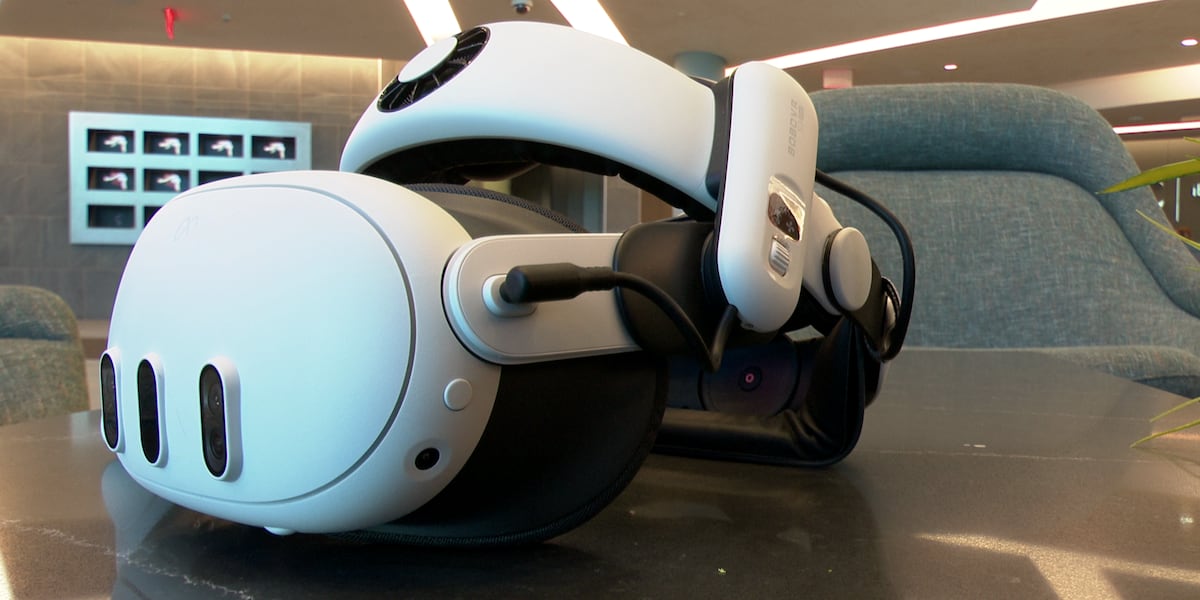
Instructors with iExcel, a program at UNMC,showed off VR training technology currently being used at the university. The technology is designed for students to interact with 3D models of anatomical concepts, like arteries.
“The importance of 3D technology is that it helps people simplify complex anatomical concepts and medical concepts. So, being able to see different anatomical elements in 3D just reinforces those spatial relationships and how things relate to each other, versus it being in 2D on a textbook or on a PowerPoint,” said Dheeraj Varandan, technical director, iExcel.
Varandan said the technology also allows students to simulate scenarios, including communicating with patients, before encountering them in practice.
“The concept of simulation is brought to immersive reality, lets us create these scenarios ahead of time and train people, you know, being able to communicate with the patient, how that might turn out, just really simulate those scenarios in immersive reality,” Varandan said.
The hope is to eventually get more professionals to adopt these advances to better serve metro and rural Nebraskans.
Wood told First Alert 6 she is continuing her home exercises and recently graduated from physical therapy. She said she is grateful for the hope advances in telehealth have given her in her recovery.
Copyright 2026 WOWT. All rights reserved.
